• Get involved.
    We want your input!
    Apply for Membership and join the conversations about everything related to broadcasting.

    After we receive your registration, a moderator will review it. After your registration is approved, you will be permitted to post.
    If you use a disposable or false email address, your registration will be rejected.

    After your membership is approved, please take a minute to tell us a little bit about yourself.
    https://www.radiodiscussions.com/forums/introduce-yourself.1088/

    Thanks in advance and have fun!
    RadioDiscussions Administrators

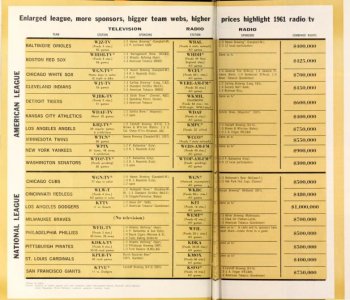
Red Sox broadcast rights in 1961 were very small.

To adjust this for the massive devaluation of the dollar since 1961 (aka inflation), multiply that figure by 11. So that's $4,675,000 for both local TV and radio in 1961 using today's dollars. I believe in another thread it was estimate the current WEEI deal is 20,000,000 over 10 years or 2,000,000 a year. Not sure how TV figures in today or how you split the 1961 figure between TV and radio. My calculation for the inflation rate came from a web search so YMMV.

Not sure how to compare that to other teams in 1961 vs today but thought it would be interesting to do the inflation adjustment.
 
Also, there was one major difference in Red Sox broadcasting in 1961:

That season, only 56 games (slightly more than one-third of the team's total schedule) were televised.

The team that televised the most games in 1961 was the New York Yankees, who televised 129 games (all their home games and 48 of their away games). By contrast, San Francisco and Los Angeles during the early Sixties only televised away games from Los Angeles and San Francisco respectively, due to a combination of high line charges to backhaul televised games originating from the East Coast; the fact that midweek games from the East Coast would have been televised in California at 4:05, 4:35, or 5:05 P.M. PDT; and that neither team allowed home games to be televised.

During the 1967 pennant drive, six of seven late-season games were added to the original 50-game Red Sox TV schedule, and from 1968 through 1971, there were about 56 or 57 televised games a year. In 1972, when the TV games moved to WBZ-4, that number went up to about 70 or so games. By 1983, WSBK-38 was televising 110 regular-season games a year; and since 1984, combining regional cable, national broadcast or cable, and until 2005, local broadcast-TV, every Sox game has been televised locally.

The radio portion of the Red Sox package was far more important prior to 1984 than it is now because about two-thirds of the team's games weren't on TV.

For basketball fans in Boston, things in 1961 was even worse: Although in the midst of their run of eight straight NBA titles, the only Boston Celtics' games televised back then were spotty away games during the playoffs.
 
Off the top of my head (correct me if I'm wrong)....

Hi, neighbor! Have a Gansett.
Give this lager beer a chance.
It's extra light but not too light.
Narragansett Lager Beer's just right
for drinking.
 
For basketball fans in Boston, things in 1961 was even worse: Although in the midst of their run of eight straight NBA titles, the only Boston Celtics' games televised back then were spotty away games during the playoffs.


Celtics started getting better coverage in 1964-5 when WIHS-TV 38 signed on.

Budweiser put together a network of stations in the Northeast and Midwest and hired Harry Caray to do the games.

Harry got in a bit of trouble during Game 4 of the Eastern Finals when the Sixers were able to tie the game at the buzzer ( and won in OT ) because the clock at Philadelphia's Convention Hall never moved and until the ball went in and Harry went nuts wondering if the game was fixed.

The following year Ch 5 took back the contract and televised several Friday night games during the season plus the playoffs.

Channel 56 took over in 1966-7 and for the first season had Marty Glickman doing the games.

WKBG-TV did well with the Celtics and decided to drop the struggling Bruins even though Fred Cusick pleaded with them that the team would soon become good. WSBK-TV took a chance on hockey and we all know how that played out.
 
For basketball fans in Boston, things in 1961 was even worse: Although in the midst of their run of eight straight NBA titles, the only Boston Celtics' games televised back then were spotty away games during the playoffs.

Does any recording exist of Harry Caray doing Celtics PBP on WIHS? I think he took the job after a squabble between beer companies and Ben Kerner (most important man in Celtics history) cost him his winter gig with tthe St. Louis Hawks
 
Interesting chart shows very little participation in local broadcasts by national brewers -- lot of locals, like 'Ganset and regionals, like P. Ballantine & Sons. The three-sponsor arrangement was fairly common as well, with a beer, a tobacco company and a gas station. They sold sponsorships back then, before spot sales began to dominate

"Red Sox Baseball, brought to you by Narragansett Lager Beer, Hi Nabor, have a gansett, now available in GIQ quarts; White Owl cigars and the always-mild White Owl New Yorker, and your host for the opening three innings Atlantic gasoline. Atlantic keeps your car on the go."
 
Does any recording exist of Harry Caray doing Celtics PBP on WIHS? I think he took the job after a squabble between beer companies and Ben Kerner (most important man in Celtics history) cost him his winter gig with the St. Louis Hawks

I doubt any tapes survived.

Hey Kerner thought it was a good trade :)

Red made sure #22 was retired :)
 
Yankees to be broadcast on WFAN, starting next season (2014) at $15 - $20 Million per year,
NYDN.

So the nyy will be getting roughly the the same deal as the RS? If they're paid what they deserve being the #1 market, it says the RS got EEI to grossly overpay but I guess we knew that years ago.
 
Status
This thread has been closed due to inactivity. You can create a new thread to discuss this topic.


Back
Top Bottom
