Not sure about the Armstrong estate. Certainly FM was around and available long before 1965. Companies did not produce so many FM receivers because there was not a big market for them.
FM radios did not sell because, in the early years (1940's) we had a world war and then more than the doubling of AM stations in the later 40's. And radio in the 40's and early 50's was mostly TV without the pictures, with the family around the radio listening to drama. Format music radio was not even created until 1951, and took half a decade to be widely available.
FM radios were available. I used some of one of my earliest paychecks to buy a Zenith portable AM/FM in a neat leather case for under $50.... around 1959.
The problem was that many FMs, put on in thee 40's by big AMs, were now simulcasting and offered nothing new. And a third of all the FMs on the air in 1950 were gone by 1960.
There was no big market for radio sets because there was not much to listen to that was not already on AM.
Most FM broadcasting duplicated what was on the AM stations. Very true that there was an explosion was FM receivers in 1965.
No, there was a gradual increase all during the early 60's because radio got cheaper and FM stereo encouraged a few stations to do something original... full-time classical, all jazz, many ethnic stations in everything from Italian to Polish.
But the big change was in the 1967-68 period when the FCC required most FMs to offer unique programming. We built it, and they came. By the latest of the 60's, FMs were "making the book" in lots of markets.
Which was when I bought my first set. Though my father had got one buying his ship to shore band radio in 1958. And attractive consoles including FM receivers as household furniture were around before. For instance the Magnavox Astro Sonic Stereo of 1962.
Those who assembled or built their own systems in the 1950s often did enjoy the new Classical recordings which were improving sonically year by year. They also listened to Beautiful Music. Read the Hi-Fi and Stereo mags of the 60s and they are full of reviews of the latest beautiful Music recordings as they are of the Classical.
Again, the format was not called "Beautiful Music" except as a positioner for a few instrumental stations until the days of Shulke and Marlin.
As I interpret history, Beautiful Music radio had a lot to do with the rise to prominence of FM from the mid 1960s. because lots of people were buying FM by '65 as an alternative to what they were getting on AM which was either Top 40 or personality-dominated MOR. They bought FM to access more and what they thought was nicer music which was available all over the band by then.
Most of the "Good Music" stations up till SRP and Bonneville arrived were extensions of long-time good music stations like KPOL, WPAT, WDBN and the like. Many of those were insturmental-heavy MOR stations. Here is WVCG in Miami from the early 50's:
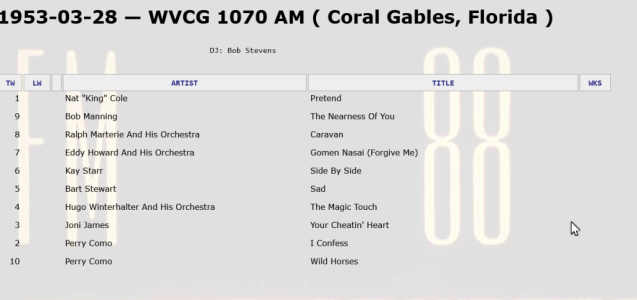
That was a precursor of what, about 15 years later, became Beautiful Music. Lighter Big Band, MOR vocals, crooners and the like. Nothing like Beautiful Music, but one of that format's ancestors.
Oh Classical Music never dominated the FM band. But in the newspaper radio columns they would invariably list the programmed Classical selections on a station. Even though that station might have only played two evening hours of Classical a day and Beautiful and/or vocals all the rest of the day. Yes there were all-Classical stations but these, in those days, were often on AM as well as FM.
Fulltime classical FMs mostly came into the world as either the extension of AM stations like WQXR, WGMS and KFAC in LA or new FMs like WCLV in Cleveland. But those were all classical... with a bit of opera and modern compositions, too..
Remember, that roughly 1000 new FMs licensed by 1950 had declined to around 700 or less by 1960, and most were simulcasting. Some tried unusual things like programming piped into all city busses or a bunch of paid programming outlets and foreign language operations. In 1960, Cleveland had two fulltime stations with over 10 different languages, making lots of money, too.