According to David's website I checked White's Radio Log from 1964 and the 770 in Seattle was KXA, 1KW daytime only.
Don't know when they added night service.
Don't know when they added night service.

 www.thebdr.net
Excellent summary. This makes radio less interesting, given it pretty much sounds the same any station you listen to.the big difference for me is the programming... there were many independent stations back then, and the chains were things like the "Interstate Radio Network" which would play relatively pleasant country music you could listen to while waiting for an ID. Nowadays the vast majority of stations are one of several specific formats, and stations of a given format are pretty much indistinguishable. A station from Illinois is pretty much the same as a station from Florida or a station from Oregon.
Am not so sure that's possible these days, even for FM, given all the noise, the crowding of the band, etc.A 10 element beam put me in a different league than from trying to DX with an FM whip antenna. I could hear a 10 watt station more than 100 miles away. I could catch 3,000 watts at 150 miles, 50,000 at 300 miles, and just about any Cass C 100,000 watt station within 400 miles. Tropospheric ducting is very common in Indiana. So, I was able to DX most evenings, nights, and mornings.
Recently I hooked up my old DX gear to see what I could get. My stepson came into the room and asked if my equipment was broken. What's all that static?
Similar for me, growing up about ten miles east of where I am now (except for my junior year of high school in Hawaii).My experience was different... in NE Ohio, XERF was vastly better than XERF was directional towards the USA, and XEW was much farther to the south with an omnidirectional antenna that sent only about half the power to the US that XERF did. And, of course, 900 was shared by Canada and there was a lot of interference on the channel.
How was Hawaii radio reception?Similar for me, growing up about ten miles east of where I am now (except for my junior year of high school in Hawaii).
XERF was much easier than XEW. CMQ/Progreso was much easier on 640 than KFI. KFI usually also required that you null Cuba, KNX was usually easier than KFI. Somewhat stronger signal, but more interference. 900 then, as now was CHML. The problem with all three of these channels is that they're all more crowded than "back in the day". As, of course, is pretty much the case with all AM channels.
Unfortunately, the where I lived just west of Waikiki, all of the AM sticks were within a couple of miles. The nearest of which was KPOI on 1380, which was basically across the street from my bus stop for school about two and a half blocks away. Also, I was 16 years old, and the only good radio I had was a Hallicrafters S-118 that overloaded on all those signals, and also their harmonics. It was a mess, and I never did hear anything from the mainland while I was in Honolulu. My best catch was DZRH from Manilla one Sunday night on 710 when some of the locals were off.How was Hawaii radio reception?
Am assuming the big West Coast clears may have come in, but not much else from the mainland.
When I was first in Hawaii in the late 70s both WLS and WBBM came in on my panasonic radio. When I went back there in 2010 I heard KFAQ Tulsa, Ok on my rental car radio. One of our posters here gets WBBM during the winter months in Hawaii. If you listen to the Kaneohe, Hi SDR during winter and early spring you can hear WGN. Of course the west coast power houses come in including KSL.How was Hawaii radio reception?
Am assuming the big West Coast clears may have come in, but not much else from the mainland.

Hawaiian DXers in the past, like Dr Wood (RIP) were able to get local channels (even when all were 250 watts at night) from the eastern Rockies and western Midwest, and plenty of regional channel stations all the way to the central US with great regularity and variety.How was Hawaii radio reception?
Am assuming the big West Coast clears may have come in, but not much else from the mainland.
When I was PD of KTNQ, I'd be surprised how our overnight host, who was a Hispanic Art Bell complete with remotes from mystery sites in Nevada, would regularly get calls from Hawaii. One night, after commenting on a Hawaiian girl winning a beauty pageant, he remarked that he "didn't see why". He got call after call all during that show from Hawaii!Fast forward to 1994, I was on Maui, and sitting poolside with a Realistic DX-375 portable one night; All...or almost all....of the big west coast signals were there. The strongest of which were KTNQ and KNX in that order.
That's good to hear.....and wound up hearing WBAP, WWL and WLS, That sas probably 25 miles from Honolulu. A couple of months prior to that, I lugged the Hallicrafters with me on a trip to the big island, and got my first mainland catch, which was KEX from Portland. It wasn't a good DX spot, and I didn't hear anything else from the mainland. Although, KPOI and the other Honolulu stations came in like locals.
Fast forward to 1994, I was on Maui, and sitting poolside with a Realistic DX-375 portable one night; All...or almost all....of the big west coast signals were there. The strongest of which were KTNQ and KNX in that order.
Thanks for the comments.Hawaiian DXers in the past, like Dr Wood (RIP) were able to get local channels (even when all were 250 watts at night) from the eastern Rockies and western Midwest, and plenty of regional channel stations all the way to the central US with great regularity and variety.
Those maps just show an approximation of certain protection issues for shared use of a channel. They don't predict DXer-type reception. Those maps don't represent the potential of a station... the US clear channel stations have been heard world-wide.That's good to hear.
I thought the big clears' signals went farther than the online maps indicate.
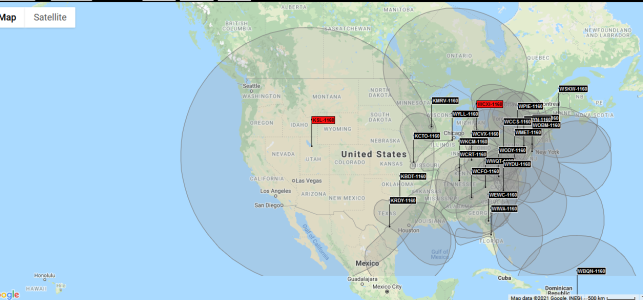
Take this map of the 1160 frequency, which someone said makes it to HI.
KSL 1160 easily makes it to Hawaii most nights. If you're ever up late try one of the Hawaii SDRs and you'll hear it.That's good to hear.
I thought the big clears' signals went farther than the online maps indicate.
Take this map of the 1160 frequency, which someone said makes it to HI.
Radio Data MW Stations Map in Google Maps API v3: NIGHTTIME-UNLIMITED_1160KHz-1
Night Patterns – Amateur Radio Station NF8M
View attachment 1766
If I remember correctly, Dr. Wood had a very good setup -- an R8 (or equivalent for the time) and a good longwire -- something similar. He logged Mideastern MW stations also, I think.Hawaiian DXers in the past, like Dr Wood (RIP) were able to get local channels (even when all were 250 watts at night) from the eastern Rockies and western Midwest, and plenty of regional channel stations all the way to the central US with great regularity and variety.
