^-- What David said. Muzak did make 33 1/3 RPM vertical electrical transcriptions of music (which do show up on E-Bay quite regularly) for both third-party musicians and by their in-house bands for their own service, which were used for their early broadcasts. Muzak initially broadcast via power lines in New York City (a service called "Wired Radio" which later became Muzak) then started leasing broadcast-grade telephone lines from Ma Bell, which lasted (for the most part) until the late 1950s when cheaper/more efficient/cheaper SCA replaced it pretty much everywhere. They still kept some of their wireline syndication infrastructure in place to directly feed FM stations that weren't running Muzak off reel-to-reel tapes, but their wire-to-subscriber service was dead in the water by the start of the 60s. Then once they began satellite broadcasting in the mid-70s, it killed off tape and wireline syndication entirely (yet, strangely, it would take satellite until 2007 to completely annhilate their remaining SCA service nationwide).
also play Muzak Tones or equivalent 4-track cassettes in an AEI player? I keep seeing them pop up on eBay even though I don't have a player...
Short answer: it depends. Muzak had two different, incompatible Philips cassette systems in place for its run of that format and the later/latter of them was identical of AEI's format.
Long answer:
The main differences are in the track layout and playback speed. Their original format was the horrific kludge that was the CP1600, a dual-deck 1 7/8 or 15/16 IPS switchable machine (the latter was hardly ever used for music) and was the one IIRC databits did an analysis of some years ago on Youtube. This big, heavy, 19" rack-mountable monstrosity played cassette tapes in the forwards direction only, tracks 1 and 2 being on side 1 left and right (when compared to a "normal" cassette, anyways) and 3 and 4 were "side 2" right and left, respectively - I put "side 2" in quotes because there really isn't a "side 1" or "side 2" in 1600-land. In fact if you were to play such a tape on a conventional 2-channel stereo deck then the "side 2" tracks appear both swapped and reversed - they actually (literally) are playing backwards. In other words, think of the way they'd be laid out on a multi-track endless loop tape like a 4-track Fidelipac and that's basically like what you have here. (If you download the unprocessed PCM files of, say, "American Graffiti" or "Rock of the 80s" and analyse them in Audacity you can see this for yourself.) WTF? Well, basically, at the end of each track is a 25 Hz cue tone used to signal the deck to rewind the tape back to the start and to switch to the next track. Not kidding. It actually had to rewind the entire 45-minute (or however long) cartridge just to start the next segment of the programme. Slow, inefficient and actually fairly unreliable, though it didn't stop them from operating the service in that format until they said "enough" and finally started playing with......
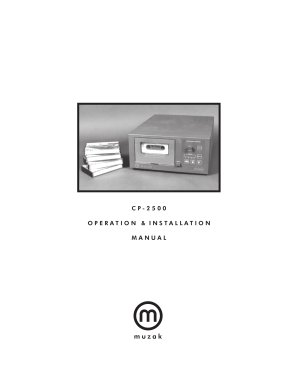
AEI's smaller, simpler, efficient and all around much more elegant Propac 4, which Muzak called the "CP2500". This system is a proper bidirectional 4-track system, albeit running at 1 2/5 IPS (3/4 of the 1 7/8 IPS conventional Philips cassettes and most CP1600 tapes used). The decidedly odd speed was a compromise between runtime and audio quality - high-end response especialy benefits from the higher speed afforded by being between half-speed (15/16) and full-speed (1 7/8). This also made it possible to record up to an hour on a single track of a then-common 90-minute cassette (45 minutes per side). 120 minute blanks were available on the market and they could have just as easily designed it as a 1 7/8 machine and used them, though they weren't as common because the thinner tape gave them an odd stigma of being fragile and unreliable. At the very least it did increase the print-through slightly. (Funny. I suppose on some decks theywould be problematic, but I used them for years with almost no ill effect, except for a Walkman that would get hungry from time to time and crunch one up... but then, it would do that even with 60 and 90-minute carts, which use thicker tape.) Track layout is side 1 1L 3R and side 2 4L 2R....and yes, there really is a "side 2" in PP4/CP2500. At a minimum, when duplicating to the computer, all you would need to do is play both sides into Audacity, speed-correct them by -25.000% then split them into mono tracks. A lot of them could benefit from an additional slight speed reduction (between -1.75 and -2.5%) because I think they both had mastering equipment that ran too slow, therefore the music always sounds pitched-up. Muzak's version of the Propac, at least initially, differed from the AEI unit cosmetically. Muzak's machine had a slider volume control and 4 LEDs to indicate track (like most 8-track players had) whilst the AEI machine had rotary tone and volume controls and an 8-segment numeric LED display.
So, Muzak published cassettes under the Tones label (and later the generic Muzak label) for both the crappy 1600 and the slicker and cooler Propac. If you have a Propac machine then tapes recorded for the CP2500 will play on it ("Motown III" is in this format - again, grab its unprocessed PCMs and compare it to those of one of the AEI tapes) and vice versa with AEI tapes and a Muzak 2500. In fact later in its run, after 2002, Muzak actually discontinued the 2500 and started distributing surplus AEI Propac machines, ostensibly purchased from DMX, and refitted them with Muzak logo decals where the AEI ones were!
Now, "equivalent" tapes: well, maybe, assuming they're at least recorded at the speed the unit expects (1 2/5). You can actually generate tape-out files for it by speeding your audio up to +33.3% (yes, tyhat's right, 33 and one-third) and compiling them using the 1L3R/4L2R mono track layout, then recording them to a cassette. 25Hz is optional; Muzak's literature claims the 2500 can use it but AEI didn't seem to, at least not in any of the tapes I have. I can't guarantee they'll sound very good, but as proof-of-concept or for experimentation it'd be fine. I think AEI and Muzak actually used to boost the treble response when preparing their masters to compensate for the high-end loss that would have happened running at the lower-than-normal speed; if they did then (to my infection- and 500-800cc motocross engine noise-damaged ears, anyways) it seems to have worked.
There you go.