
I feel for you regarding your situation. If you'd look at my past statements about Ed Stolz, I have said he is the Radio equivalent of a cockroach. No matter what you do to him, he will never really go away. I'm sure he probably has figured out some way to file appeals even after he's shuffled off this mortal coil.I'm a priority creditor in a bankruptcy that is radio based. Its still open and 8 yrs later no one has seen a dime. Not even the IRS. It has been strung out due to fraud and theft as well. Its a mess. There cases are emotional and stressful and no one but the lawyers win

-
Get involved.
We want your input!
Apply for Membership and join the conversations about everything related to broadcasting.
After we receive your registration, a moderator will review it. After your registration is approved, you will be permitted to post.
If you use a disposable or false email address, your registration will be rejected.
After your membership is approved, please take a minute to tell us a little bit about yourself.
https://www.radiodiscussions.com/forums/introduce-yourself.1088/
Thanks in advance and have fun!
RadioDiscussions Administrators
You are using an out of date browser. It may not display this or other websites correctly.
You should upgrade or use an alternative browser.
You should upgrade or use an alternative browser.
Royce International saga, update
- Thread starter leethalweapon
- Start date
Indeed, Mr. Patrick's claims would be treated as post petition administrative claims under Section 503(b) of U.S. bankruptcy law, and thus are assured of full payment in connection with any confirmed plan (unless Mr. Patrick consents to less favorable treatment, which I presume is highly unlikely since it would be an unnecessary and self-defeating move).Mr. Patrick is owed the costs of operating the Royce stations during the long receivership. The $2.1 million is a high priority lien because it is a judgement ordered by a federal district court.
Much of the money is due to significant legal costs, as Mr. Stolz repeatedly filed to have the receivership ended with various claims, such as claiming the estate was being defrauded by unreasonbly high fees charged by Mr. Patrick's counsel.

That is, of course, how Ed Stolz typically operates. Harrass people (often his business associates) through the legal system. It's nice to see him hit with a $2.1 million bill for it.no one but the lawyers win
Cash is king right now in the marketplace, and religion is a lucrative cash business.VCY seems to be ramping up to major expansion mode. They could be the new EMF. With station values plummeting, VCY is likely ready to snap up the bargain basement deals.
That's very sad but not surprising. Radio attracts some bullies. Although that's probably everywhere.I feel for you regarding your situation. If you'd look at my past statements about Ed Stolz, I have said he is the Radio equivalent of a cockroach. No matter what you do to him, he will never really go away. I'm sure he probably has figured out some way to file appeals even after he's shuffled off this mortal coil.
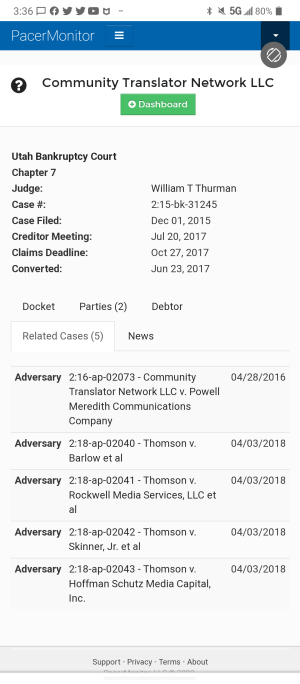
This is my case. Started in 2013 when a 3rd party processor starting processing applications inside my FCC FRN account without my knowledge. They did get 5 permits in their name via the FCC. I was never paid for any of them still to this date. They then sued me in the state courts of Utah and that is still pending, then declared bankruptcy that was re org turned liquidated and that is still active 8 yrs later. Longest bankruptcy case Ive ever seen. There was an appeal of the liquidation by the debtor that was decided in the creditors favor. The debtor then filed 2 new federal lawsuits against me in Texas and lost. The debtor did put three additional permits or mine in their bankruptcy estate that were returned to me eventually. Three others they sold and never turned in the money and the trustee sold the other two through a legal court auction process. It has a large amount of activity but the journals won't touch it most likely because the broker is prominent or its too complicated to understand. The DOJ is involved though anyone who looks up the record can see their involvement. They came in when the debtor tried to get all 8 permits returned to them via multiple state and Federal Texas and Utah courts. I wont ever file for another permit. I won a permit in an auction in Oklahoma and im too scared to build it and have it end up in some bankruptcy estate somewhere.That's very sad but not surprising. Radio attracts some bullies. Although that's probably everywhere.


Its this case. Lots of lawsuits inside the bankruptcy as well. I did prevail in the one against me which wanted more property, cash and to incarcerate me for filing a claim that the judge approved.This is my case. Started in 2013 when a 3rd party processor starting processing applications inside my FCC FRN account without my knowledge. They did get 5 permits in their name via the FCC. I was never paid for any of them still to this date. They then sued me in the state courts of Utah and that is still pending, then declared bankruptcy that was re org turned liquidated and that is still active 8 yrs later. Longest bankruptcy case Ive ever seen. There was an appeal of the liquidation by the debtor that was decided in the creditors favor. The debtor then filed 2 new federal lawsuits against me in Texas and lost. The debtor did put three additional permits or mine in their bankruptcy estate that were returned to me eventually. Three others they sold and never turned in the money and the trustee sold the other two through a legal court auction process. It has a large amount of activity but the journals won't touch it most likely because the broker is prominent or its too complicated to understand. The DOJ is involved though anyone who looks up the record can see their involvement. They came in when the debtor tried to get all 8 permits returned to them via multiple state and Federal Texas and Utah courts. I wont ever file for another permit. I won a permit in an auction in Oklahoma and im too scared to build it and have it end up in some bankruptcy estate somewhere.
Attachments

I'm not a lawyer, but I play one in my backyard.I think Patrick was there one year? Seems high? I looked at the legal fees for Patrick and ASCAP and they are high. Buying this could be a nightmare. If I were VCY I'd run for the hills
Patrick is a First Class guy who had the bad luck of being appointed to run and sell Crazy Ed's stations 'cause his Craziness wouldn't pay creditors. The deal he put together with VCY was higher than their current bid for the stations. VCY's latest $4.5m bid is the minimum at the current auction. If Crazy Ed were to bid, don't be surprised if he tops any offer by a hundred bucks.
hmmmmm.... wonder if bidders are required to take a mental competency test?

I wonder if the whole thing is a stitch-up: in my opinion, it's biased toward an operator who's willing to buy multiple stations in multiple markets at the same time. In the present environment, that means religious broadcasters, of which VCY has become one of the most aggressive. For KREV, there could be minority entities out there that would be willing to buy a station whose coverage seems well-suited to serve East Asian communities in San Francisco and Oakland, for example. But I would tend to think that such entities would not be financially capable of buying the full set of stations and are likely to be outbid in any event. For those communities, for FM coverage there's now only a translator for KVTO. KEST was forced to give up its translator due to interference complaints from Peninsula KXSC listeners. It would be a shame that a signal that could be very useful for an underserved community is likely to be wasted instead on yet another round of highly politicized religious programming.

Patrick is a First Class guy who had the bad luck of being appointed to run and sell Crazy Ed's stations
Do judges just randomly call people and tell them they are appointed to a six-figure job like this that they can't turn down?

I think this one is pretty easy to sum up:
- Crazy Ed will bid for the stations. He will either win the auction, or
- Crazy Ed will sue to stop the transfer of control of the stations to another licensee.
Just to think, he could have solved all these problems by just cutting a check to ASCAP/BMI. Instead, this has turned into a legal debacle that has already eaten up a third of the value of these stations.
- Crazy Ed will bid for the stations. He will either win the auction, or
- Crazy Ed will sue to stop the transfer of control of the stations to another licensee.
Just to think, he could have solved all these problems by just cutting a check to ASCAP/BMI. Instead, this has turned into a legal debacle that has already eaten up a third of the value of these stations.

I have the feeling that he actually enjoys this a plays it like a game.I think this one is pretty easy to sum up:
- Crazy Ed will bid for the stations. He will either win the auction, or
- Crazy Ed will sue to stop the transfer of control of the stations to another licensee.
Just to think, he could have solved all these problems by just cutting a check to ASCAP/BMI. Instead, this has turned into a legal debacle that has already eaten up a third of the value of these stations.
First, it was not a six-figure job. Patrick's own fees are in the low six figures... the rest was paid to various FCC and bankruptcy lawyers. I'll bet he curses the day he took the whole case on.Do judges just randomly call people and tell them they are appointed to a six-figure job like this that they can't turn down?
Second, there are companies that are accredited in different fields to be acceptable as administrators in bankruptcy cases. Patric has prior experience in bankruptcy and debtor in possession cases and is known for this.
This is somewhat like "expert witnesses" in FCC administrative law hearings (the equivalent of a trial). Once qualified the first time by an administrative law judge's review of credentials, you are thus in the future considered as such. After my first case, a license revocation of a very major market FM filing, and following over an hour of "credentials" questioning by the opposing lawyer (who was finally told "move on before this is prejudiced against you), I was automatically given that qualification for further cases.
Patrick is enormously experienced in station operation, transfers and foreclosures. The court approves a fee schedule based on the needed amount of work.
For less than at least something in the low 8 figures, I would not touch anything with Crazy Ed's name on it.
hmmmmm.... wonder if bidders are required to take a mental competency test?
Perhaps they should.

Section 363 auctions do have "Qualified Bidder" standards that need to be followed. In the context of an auction that involves FCC-licensed broadcast properties, some examples of qualification standards may include:
- Ability to show eligibility for ownership pursuant to FCC rules
- Proof of access to capital
- Submission of bid in the manner required by the court and by the deadline established by the court.
Following completion of an auction, there is a brief grace period during which objections against the sale can be filed by Creditors (not disgruntled bidders who weren't selected - unless they also happen to be a Creditor) ahead of the Sale Hearing scheduled by the court. The purpose of the Sale Hearing is to confirm the sale, assuming no objections are sustained. Once all closing conditions in the Sale Order are met, the assets are then transferred to the winning bidder on a free & clear basis. Examples of closing conditions in the context of a broadcast property may include (i) FCC approval of license transfer and (ii) funding of whatever portion of the purchase price is due at closing. Generally speaking, the vast majority if not all of the purchase price is due & payable in cash at closing. The Purchase Agreement approved by way of the Sale Order may, however, include things such as earn-out provisions whereby the purchaser is required to make an incremental payment to the seller (in this context, the bankruptcy estate) depending on outcome of future events.
Do judges just randomly call people and tell them they are appointed to a six-figure job like this that they can't turn down?
In some instances, a committee of creditors may recommend a receiver who the court then approves. In other cases, the judge will appoint a receiver. Depending on the complexity of the case and nature of the business involved, the judge may have someone in mind based on prior familiarity. In highly specialized cases such as this one, receivership candidates may reach out to the court to express their availability and share their qualifications. It sounds like based on David's remarks, there may be a database of some kind that is maintained at the federal level. This seems logical, as the U.S. Bankruptcy Court is subdivided into numerous districts. Some states may have more than one district.
In terms of compensation, Receivers bill an hourly rate much the same way attorneys do, and like attorneys, they also bill to recoup out of pocket expenses. Chapter 11 cases often have Cash Collateral Orders that are approved as part of so-called "First Day" motions that spell out, on a week-by-week basis, projected income, projected operating expense, and projected professional fees for at least the first 90 days to 180 days of the case. When Receivers present a bill to the Trustee for payment, that bill needs to describe the work performed, the hourly rate charged, the out of pocket expenses incurred for which reimbursement is sought, etc.
Last edited:
I have a beer commercial I'd like you to do for a client...I'm not a lawyer, but I play one in my backyard.
Over the years, I have had dealings with competitor, vendors and clients with those qualities.That's very sad but not surprising. Radio attracts some bullies. Although that's probably everywhere.
In radio, my first 5 years were with Richard Eaton, who owned primarily a bunch of "ethnic" stations in fairly large markets in the 50's through the 70's. He lost several licenses due to things like double billing (WFAB Miami) and illegal lottery ads (WOOK in DC) but was as slimy with his staff as well. Where I worked, at WJMO / WCUY in Cleveland, we were on the second floor, no elevator. Eaton was confined to a wheelchair and when he made one of his rare visits we had an office pool that was based on which step on the stairway the wheelchair would tumble to it's occupant's death. If there was no winner, the money went to the NAACP instead.
Are the initials B. L. by chance?I have a beer commercial I'd like you to do for a client...
Nurse Jeff and I are gonna offer the '76 Gremlin for Crazy Ed's stations. It's gotta be worth at least $5m*
(*US pennies)
How else was Eaton to pay for all those full page Broadcasting Mag ads that made him sound like a saint?In radio, my first 5 years were with Richard Eaton, who owned primarily a bunch of "ethnic" stations in fairly large markets in the 50's through the 70's. He lost several licenses due to things like double billing (WFAB Miami) and illegal lottery ads (WOOK in DC) but was as slimy with his staff as well.
Crazy Ed probably has a few more tricks up his sleeve to save his empire. But the courts & FCC are on to him.
First, it was not a six-figure job. Patrick's own fees are in the low six figures... the rest was paid to various FCC and bankruptcy lawyers. I'll bet he curses the day he took the whole case on.
That may be so, but both you and @DrAkbar say this, implying Patrick had no choice. That doesn't seem like that could really be true, is it?
Patrick is enormously experienced in station operation, transfers and foreclosures. The court approves a fee schedule based on the needed amount of work.
It sounds to me like Patrick liked the look of those fees and voluntarily accepted the job, right?
For less than at least something in the low 8 figures, I would not touch anything with Crazy Ed's name on it.
Since as you say, Patrick is enormously experienced in the field, presumably he would have known all about Crazy Ed when he took on the case. Assuming he agreed to take it on, and wasn't somehow forced by the court to do so, then I'm just saying it seems weird to characterize him as the victim if he understood the risks and decided they were worth the reward, which looks quite substantial.
- Status
- This thread has been closed due to inactivity. You can create a new thread to discuss this topic.