
This is exactly the point. There are adjacent HD-FM stations all over the country for twenty-five years that have coexisted just fine. Nobody but a handful of cranky radio nerds with capacitive-tuned radios care. And that's not a very big number.There is no deception. Where is listing to first adjacent signals of any interest except to the few hundred DXers left?

-
Get involved.
We want your input!
Apply for Membership and join the conversations about everything related to broadcasting.
After we receive your registration, a moderator will review it. After your registration is approved, you will be permitted to post.
If you use a disposable or false email address, your registration will be rejected.
After your membership is approved, please take a minute to tell us a little bit about yourself.
https://www.radiodiscussions.com/forums/introduce-yourself.1088/
Thanks in advance and have fun!
RadioDiscussions Administrators
You are using an out of date browser. It may not display this or other websites correctly.
You should upgrade or use an alternative browser.
You should upgrade or use an alternative browser.
Saving AM Radio
- Thread starter BruceB
- Start date
When WTIC(AM) Hartford turned on IBOC at 1080, the nighttime blowtorch WBAL at 1090 became history for me and I'm sure others in Connecticut. But really, since WBAL couldn't monetize those Connecticut listeners and wasn't exactly hard-to-log DX in the first place, it was hard to work up any anger over that. Maybe if I were an Orioles fan ...This is exactly the point. There are adjacent HD-FM stations all over the country for twenty-five years that have coexisted just fine. Nobody but a handful of cranky radio nerds with capacitive-tuned radios care. And that's not a very big number.

K.M. Richards
Program Director, The Eighties Channel™
It’s Xperi now, not Ibiquity
Different name, same issues.
That's the reality. Listeners outside the market don't contribute anything to the station or parent company. Most admittedly don't even patronize sponsors of the distant station.When WTIC(AM) Hartford turned on IBOC at 1080, the nighttime blowtorch WBAL at 1090 became history for me and I'm sure others in Connecticut. But really, since WBAL couldn't monetize those Connecticut listeners and wasn't exactly hard-to-log DX in the first place, it was hard to work up any anger over that. Maybe if I were an Orioles fan ...
It was different back in the dawn of radio when large companies owned radio stations to promote their primary products or services on a national basis.
That model ended entirely back in the early eighties.
K.M. Richards
Program Director, The Eighties Channel™
It was different back in the dawn of radio when large companies owned radio stations to promote their primary products or services on a national basis.
That model ended entirely back in the early eighties.
And by the time that model finished dying, the medium that killed it advertising-wise, television, was heading in the same direction. Here we are a few decades later and the products/services that once had been on radio have almost completed their move away from television as well.
In fact, "wonder drugs" are now becoming the dominant national advertising category on both.

The only people I recall complaining about IBOC, both on AM and FM, were DXers.
I'm not a DXer but IBOC caused a hiss in the background and seemed to make the audio sound muddier, even on my digitally tuned radios that theoretically had narrow bandwidth. It made tuning an AM station on my analog radios frustrating too with excessive noise around the station, and again I could never completely tune out the hiss. I hated it.
IBOC for AM was a lost opportunity to demonstrate that something other than inferior, noisy, mono, voice grade broadcasting can happen on AM. AM broadcasters who installed it never promoted it, ever, nor saw the potential for the possibilities of an MA3 all digital model in the future. Over twenty years have passed, and folks like you are still living in the past having grown up with inferior AM as the only way. So, how has the 'nothing's wrong with AM radio mindset worked out so far?I'm not a DXer but IBOC caused a hiss in the background and seemed to make the audio sound muddier, even on my digitally tuned radios that theoretically had narrow bandwidth. It made tuning an AM station on my analog radios frustrating too with excessive noise around the station, and again I could never completely tune out the hiss. I hated it.

And few stations show up in ratings outside of their local market and, maybe, an adjacent market or two.That's the reality. Listeners outside the market don't contribute anything to the station or parent company. Most admittedly don't even patronize sponsors of the distant station.
There was yet another factor involved and that was the paucity of stations in the first two decades of network radio. So the family that wanted to hear Fibber McGee & Molly in Kalispell, Montana or Petoskey, Michigan, had to tune to Denver or Salt Lake City or Detroit or Chicago to hear that content. And in the daytime, most of those remote places had no radio service at all.It was different back in the dawn of radio when large companies owned radio stations to promote their primary products or services on a national basis.
That model ended entirely back in the early eighties.
Advertisers bought WSB in Atlanta to cover big, unserved parts of SC, GA, AL, TN and more. They bought Denver and Salt Lake to cover much of the Rocky Mountain west except for little areas like Phoenix or Boise that had small, local stations. Stations ran ads in Broadcasting Magazine showing how many states they covered.... at night, of course.
So, with the advent of network radio in the later 1920's, we had advertisers trying to reach the whole country with network buys that, together, covered most of the nation.
But TV killed nighttime skywave network radio and, thus, it killed the wide and salable coverage of the big AM stations. At the same time, the FCC's focus on low power stations serving small coverage areas made radio a very local medium based on daytime ground wave coverage. As radio discovered music formats in the 50's, advertisers started buying local radio instead of network propositions.
Suddenly we got things like SRDS: "Spot Radio Rates & Data" that allowed national advertisers to find rates and rep firm contacts for every last station in the country. Instead of buying time on a couple of national webs, advertisers bought on hundreds of stations across the country, each serving a local market. And the ratings firms like Pulse and Hooper started doing local ratings of local stations so that buyers could evaluate each market's array of stations.
And, finally, the move from AM to FM during the 70's ended even the chance that a "big station" might show up in the ratings of a distant market. While stations like WLS and WABC were famous for showing up in places like Green Bay and Pittsburg in those distant market ratings, the move to FM killed even that.
That's all well and good. But did WTIC wipe out WBAL in any part of Maryland? If my experiences with IBOC on KNX are any indication (loud hiss on 1060 and 1080, 350 miles away, wiping out one of my locals), or horror stories about KDKA and WBZ, I have to guess that WBAL could have been hurt in the outer edges of its own market. THAT'S my point, not WBAL reception being hurt in New England, which doesn't matter to them anyway.When WTIC(AM) Hartford turned on IBOC at 1080, the nighttime blowtorch WBAL at 1090 became history for me and I'm sure others in Connecticut. But really, since WBAL couldn't monetize those Connecticut listeners and wasn't exactly hard-to-log DX in the first place, it was hard to work up any anger over that. Maybe if I were an Orioles fan ...
Over twenty years have passed, and folks like you are still living in the past having grown up with inferior AM as the only way. So, how has the 'nothing's wrong with AM radio mindset worked out so far?
No, I'm not living in the past. I don't listen to AM radio at all anymore, and for at least a decade I listened to the only two AM stations I still cared about on their FM HD2 simulcasts and/or streams, not AM. One of those has now moved to FM and the other is gone.
MA3 would do nothing to get me to listen to AM radio at this point so now who is living in the past?
It depends. They promoted it during the early days when the radios weren't available. That was the biggest mistake. People heard or saw the ads, and couldn't hear the stations. iBiquity spent all its time getting radio stations to add it, and no time convincing electronics manufacturers (most of which are based in China) to add it to existing radios. By the time they did, the potential opportunity had passed. The promotion should have included free radio giveaways. Nobody thought about that. The Consumer Electronics Association wasn't on board with it. Distribution is still the main problem today, and now people don't buy radios and electronics stores have all but disappeared.IBOC for AM was a lost opportunity to demonstrate that something other than inferior, noisy, mono, voice grade broadcasting can happen on AM. AM broadcasters who installed it never promoted it, ever,
The other mistake was not continuing development on the technology to perhaps correct some of the interference issues. Because it was a trademarked technology, they wouldn't allow any tinkering or development of HD Radio. So the issues continued. Now that it's part of xPeri, which is more of a rights management company, we see even less work in getting radios to include it.
I'm talking about twenty years ago, when the mindset of some dyed in the wool radio people who had never even attempted to hear the difference between analog and digital AM were just angry about the sideband data noise and believed there was nothing wrong with AM. They didn't get it, and didn't think anyone else should get it too.No, I'm not living in the past. I don't listen to AM radio at all anymore, and for at least a decade I listened to the only two AM stations I still cared about on their FM HD2 simulcasts and/or streams, not AM. One of those has now moved to FM and the other is gone.
I frankly could care less about your radio listening habits. My point was complaining about HD sideband noise is like complaining that the pickles in your BigMac aren't as wide as they used to be. Big whoop.MA3 would do nothing to get me to listen to AM radio at this point so now who is living in the past?
In the case of the radio station being tuned in that video the population is 174,172 within the FCC's 60dbu contour. A study by Doug Vernier (arguably one of the most respected broadcast engineers around) determined the actual population capable of receiving an interference-free signal is 120,584. That's quite a bit more than a few hundred difference. They were not DX'ers when HD was turned on, yet the station received over 400 complaints of poor reception. I realize this is a unique situation because of terrain. But the interference is very real.There is no deception. Where is listing to first adjacent signals of any interest except to the few hundred DXers left?
Dave B.
Digital Amplitude Modulation? It's the absolute best! 🙃😉I'm talking about twenty years ago, when the mindset of some dyed in the wool radio people who had never even attempted to hear the difference between analog and digital AM ...
This is in heavy rotation on H&I during their nightly Star Trek TOS/TNG/DS9/Voyager/Enterprise marathons. I don't know if it is a national or local placement, but I do know that it's making their commercial breaks feel like a throw-away e-mail address inbox in 2002.Here we are a few decades later and the products/services that once had been on radio have almost completed their move away from television as well. In fact, "wonder drugs" are now becoming the dominant national advertising category on both.

Last edited:
K.M. Richards
Program Director, The Eighties Channel™
This is in heavy rotation on H&I during their nightly Star Trek TOS/TNG/DS9/Voyager/Enterprise marathons. I don't know if it is a national or local placement, but I do know that it's making their commercial breaks feel like a throw-away e-mail address inbox in 2002.
I think you have gotten as far away from the original question as we possibly could.
But as far as "national" vs. "local", I know of very few stations running these diginets that even bother to take the local spot avails. The only one that does (at least that I have seen) is KTLA/5, which covers those with a mix of promos for the main channel and locally-focused PSAs. I suspect most stations feel it would not be worth the trouble to cover one PI with another, especially give the relatively low rate of return.
OTOH, I programmed a standalone AM a couple of decades ago where the PI spots brought in nearly as much as the paid ones (excluding brokered hours). So they may be a small part of what's keeping AM afloat in a lot of markets.
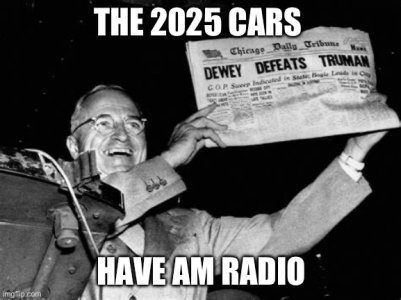
This has got to mean something. I saw a story about AM radio in cars in an actual newspaper. At least that means the story is being covered.
It means that the two dozen people who might read the story probably know what AM radio is. They may even have a Crosley or Atwater Kent table model at home. Not sure if them newfangled horseless carriages fit into their lifestyle, though.This has got to mean something. I saw a story about AM radio in cars in an actual newspaper. At least that means the story is being covered.

K.M. Richards
Program Director, The Eighties Channel™
This has got to mean something. I saw a story about AM radio in cars in an actual newspaper. At least that means the story is being covered.
All that "means" is that one dying medium reported on another dying medium.
You sure do get your hopes raised easily, Chimp. I wish reality could agree with you.