• Get involved.
    We want your input!
    Apply for Membership and join the conversations about everything related to broadcasting.

    After we receive your registration, a moderator will review it. After your registration is approved, you will be permitted to post.
    If you use a disposable or false email address, your registration will be rejected.

    After your membership is approved, please take a minute to tell us a little bit about yourself.
    https://www.radiodiscussions.com/forums/introduce-yourself.1088/

    Thanks in advance and have fun!
    RadioDiscussions Administrators

Saving AM Radio

Because it costs a lot of money. AM as a system is way more expensive than FM.

It's cheaper to either have an FM translator or refer people to your mobile app.

Let capitalism work

I am sure if anyone did do something, it would be the best they can do economically. Letting successfully funded AMs (or any business) take advantage of opertuntires is basic economics. If buying a translator is best then that's the way to go. There is no one size fits all in radio.

In areas of good ground conductivity a decent AM signal will let you get around the 15 mile 60 db rule. If you move a 1 kw station below 800 khz from above 1400 it should push the signal much farther. You might get an extra antenna height for a translator.

Every Station no mater what band needs web exposure.
 
Capitalism can't work if rules hold back any chance of significantly improving your business. What would it hurt to allow property engineered major construction permits on AM? If it doesn't make since it won't be done.

The commission should allow "horizontal" antennas like the Ham HF guys use. Dxengineering.com has a 2500watt HF antenna with 15 db gain. I know you can't use that particular antenna but something similar cut to a commercial AM frequency on a rented roof top could something useful if allowed.

Repeating an action and expecting different results is insane. The FM translators for AM did keep a lot of small market stations in the game. A couple of large market stations also survived too, like 680 in Atlanta. Any chance of AM as we know it having mass usage isn't going to happen with this set of rules.

The former heavily regulated and geographic limited railroads have reinvented themselves. Besides consolation they have change the way they run trains, embraced shipping containers, used distributed power and several other innovations to survive the downturn in the coal business.

Spectrum is like land. There is only so much of it.
 
It doesn't matter to the general public whether an AM station is 500 or 50,000 watts if they never even tune to that band. That's why few operators are interested in upgrading an AM signal. Take a look at the FCC applications for AM's, almost all are actually for downgrades or repeated STA's to operate at variances and/or lower power.
 
Capitalism can't work if rules hold back any chance of significantly improving your business.

Capitalism says if it costs more to fix than it will make, you don't spend the money.

If deleting rules would somehow save AM radio, you'd hear the NAB yelling for them. So far, crickets.

Spectrum is like land. There is only so much of it.

Just like land, some of it is worthless. You think beachfront is worth the same as an isolated desert?
 
Capitalism can't work if rules hold back any chance of significantly improving your business. What would it hurt to allow property engineered major construction permits on AM? If it doesn't make since it won't be done.

The commission should allow "horizontal" antennas like the Ham HF guys use. Dxengineering.com has a 2500watt HF antenna with 15 db gain. I know you can't use that particular antenna but something similar cut to a commercial AM frequency on a rented roof top could something useful if allowed.

Repeating an action and expecting different results is insane. The FM translators for AM did keep a lot of small market stations in the game. A couple of large market stations also survived too, like 680 in Atlanta. Any chance of AM as we know it having mass usage isn't going to happen with this set of rules.

The former heavily regulated and geographic limited railroads have reinvented themselves. Besides consolation they have change the way they run trains, embraced shipping containers, used distributed power and several other innovations to survive the downturn in the coal business.

Spectrum is like land. There is only so much of it.
What do you mean by 2500 watt? Antennas have no power. Do you mean that's the max input power that particular antenna can handle from a given transmitter? It would take roughly 80 watts driven into a 15 dB gain antenna to get an ERP of 2500 watts.
 
Capitalism can't work if rules hold back any chance of significantly improving your business.

The chairman of the FCC welcomes your many ideas and recommendations. He wants to delete rules that are holding back business. Send them all to him:


We encourage commenters to consider certain policy factors, as described below and consistent with standards and objectives set forth in recent Presidential orders as well as statutory and regulatory retrospective review standards.

• Electronic Filers: Comments may be filed electronically using the Internet by accessing the ECFS: https://www.fcc.gov/ecfs/.
 
The commission should allow "horizontal" antennas like the Ham HF guys use. Dxengineering.com has a 2500watt HF antenna with 15 db gain. I know you can't use that particular antenna but something similar cut to a commercial AM frequency on a rented roof top could something useful if allowed.
A horizontal antenna won't work on AM frequencies. First of all, they are too long. The length of a half-wave horizontal dipole is 468/f (MHz). That's almost 900 feet at 530 kHz and 275 feet at 1700 kHz. Then, the antenna would have to be an equal height above ground to keep the radiation from going straight up and down (read: tower height normally used for TV, but two of them), or most of the radiation would just be burned up in the ground, going nowhere. Those frequencies use ground waves, which must be vertically polarized. This was figured out over 100 years ago.
 
Last edited:
Whatever happened to the FCC's plan to finally put the clear channels out of their misery and allow daytimers to run full-power at night? I suppose the current administration has simply forgotten about it, now that they're more obsessed with killing network TV than saving AM radio.
I can't believe that was actually considered. It would wipe out groundwave coverage!
 
I can't believe that was actually considered. It would wipe out groundwave coverage!
It was proposed back in 2018. After much outrage, the FCC backed off a bit and updated the proposal to retain some skywave protection for the clear channel stations. while allowing smaller stations to increase their nighttime power.
 
What do you mean by 2500 watt? Antennas have no power. Do you mean that's the max input power that particular antenna can handle from a given transmitter? It would take roughly 80 watts driven into a 15 dB gain antenna to get an ERP of 2500 watts.
Exactly think of the savings. For directional service assuming your at 5KW: 160 watts (not counting line loss) would really save on the power bill. Your antenna footprint would be a lot less than expensive multiple towers. No phasing cabinets, no antenna field land costs.

I believe the antennas would have to be made to the same standards as a narrow band FM antennas. Fool proof like FM directional antennas that "hold" there patterns assuming they are installed correcty. Also 15 db gain would be extremely narrow but even a 6 db gain would cut your power dramatically.

Also multiple gain directional antennas could allow higher operating powers* daytime if engineered properly helping with the electrical noise in your "targeted" area of service by concentrating the power like a directional aray does without the towers and land costs

*why are we still limiting AMs to 50kw?
 
A horizontal antenna won't work on AM frequencies. First of all, they are too long. The length of a half-wave horizontal dipole is 468/f (MHz). That's almost 900 feet at 530 kHz and 275 feet at 1700 kHz. Then, the antenna would have to be an equal height above ground to keep the radiation from going straight up and down (read: tower height normally used for TV, but two of them), or most of the radiation would just be burned up in the ground, going nowhere. Those frequencies use ground waves, which must be vertically polarized. This was figured out over 100 years ago.
I am assuming you are referring to the Norton ground wave which states vertical ground wave tend to be attenuated.

How do the mobil TIS systems work with antennas nowhere close to even quarter wavelength work and no grounding. Right now WYYZ is using a fiberglass "whip" mounted on the side of a telephone pole with no ground except possibly the ground on the commercial AC and an 3 foot stake at the edge of building cable entrance for lightning protection. The low wattage signal on a very noisy chanel goes about 7 miles daytime which exceed the line of site.

I not arguing but for my own information, Why are ground radials buried horizontal instead of one being buried or drilled a quarter or more wavelength deep?

IMHO funky antennas that engineers 50 years ago would have never dreamed of using might be the future of AM.
 
IMHO funky antennas that engineers 50 years ago would have never dreamed of using might be the future of AM.
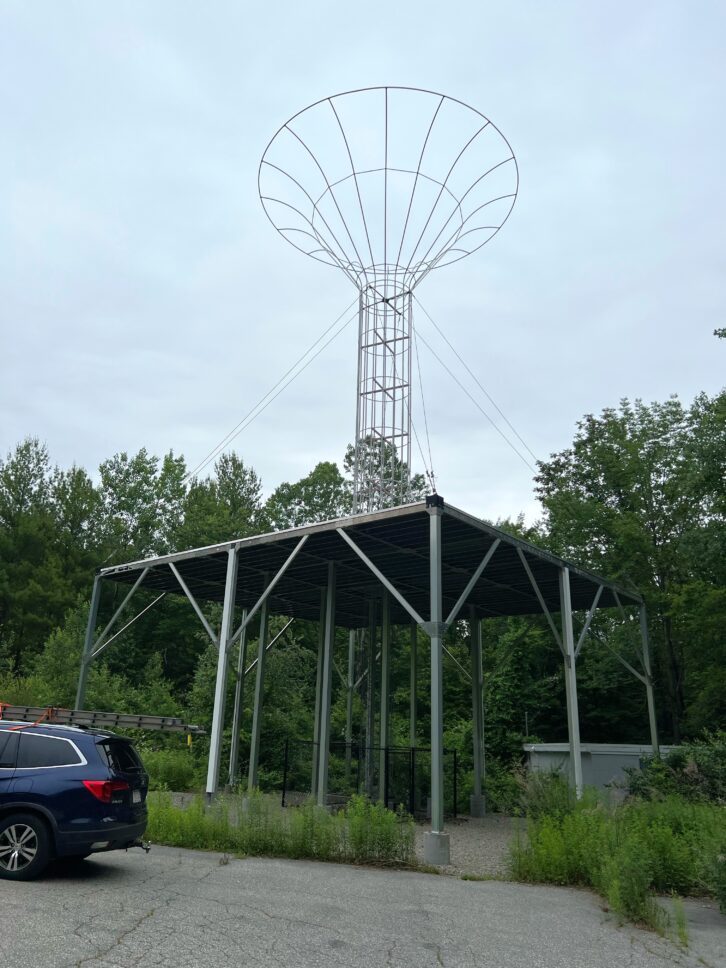
940 WQVR began testing the "High Efficiency Broadband Antenna" (HEBA) in 2016, but recently gave up on it and filed a CP to diplex with co-owned and currently silent 700 WQVD, using a conventional tower.
rw-nab-preview-25-heba-wqvr-726x968.jpeg
 
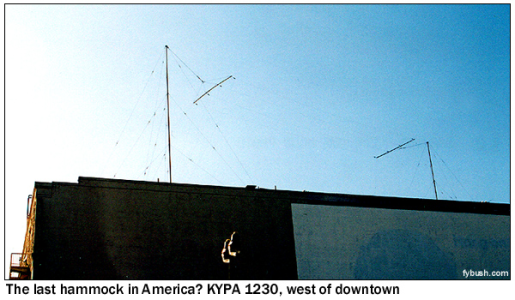
I thought those old hammock antennas were really inverted-L or T systems, with the radiating element being vertical (or close to it), and the multiple "hammock" wires there for top loading (and increasing bandwidth?). They have to be worked against ground, even when using a counterpoise on top of a building, and most of the polarization is vertical. They could still work if designed right.
 
We're all being civil, so it couldn't be on 7200. :ROFLMAO:
Actually, since we're talking about antennas for AM stations, 80 or 160 would be more appropriate. At night, you can usually find several groups of old-timers and/or radio-tech wizards discussing all aspects of AM ham operation on their old National and Johnson boat anchors. Having been an apartment dweller all of my adult life, I can barely imagine the kind of antennas they describe, especially the ones for 160.


Back
Top Bottom