
-
Get involved.
We want your input!
Apply for Membership and join the conversations about everything related to broadcasting.
After we receive your registration, a moderator will review it. After your registration is approved, you will be permitted to post.
If you use a disposable or false email address, your registration will be rejected.
After your membership is approved, please take a minute to tell us a little bit about yourself.
https://www.radiodiscussions.com/forums/introduce-yourself.1088/
Thanks in advance and have fun!
RadioDiscussions Administrators
You are using an out of date browser. It may not display this or other websites correctly.
You should upgrade or use an alternative browser.
You should upgrade or use an alternative browser.
September 2023 Bay Area Radio PPM Ratings
- Thread starter HenryOchs
- Start date

Covering the survey period from Thu. 8/17/2023 thru Wed. 9/13/2023, age 6+ overall alternate view:
San Francisco - RadioInsight (refresh page if not updated)
OR https://www.urbaninsite.com/wp-content/uploads/2023/10/SAN-FRANCISCO.htm
Top 5+ demo rankings analysis from Research Director Inc.:
(scroll down to see San Francisco)
 researchdirectorinc.com
25-54: 1. KOIT 2. KMVQ 3. KMEL 4. KISQ 5. KQED 6. KRZZ
18-34: 1. KOIT 2. KMEL 3. KYLD 4. KITS 5T. KMVQ 5T. KQED 7T. KISQ 7T. KNBR 7T. KIOI
18-49: 1. KOIT 2. KMEL 3. KMVQ 4. KISQ 5T. KQED 5T. KYLD
*************************************************
San Jose Age 6+ overall alternate view: (refresh page if not updated)

 radioinsight.com
San Francisco - RadioInsight (refresh page if not updated)
OR https://www.urbaninsite.com/wp-content/uploads/2023/10/SAN-FRANCISCO.htm
Top 5+ demo rankings analysis from Research Director Inc.:
(scroll down to see San Francisco)
RADIO RATINGS ROUNDUP, September 2023, PART I | Research Director, Inc.
Why does SEPTEMBER serve as the muse for so many songwriters? Why not the AUGUST of my years? Would the 21st night of OCTOBER have worked just as wel
25-54: 1. KOIT 2. KMVQ 3. KMEL 4. KISQ 5. KQED 6. KRZZ
18-34: 1. KOIT 2. KMEL 3. KYLD 4. KITS 5T. KMVQ 5T. KQED 7T. KISQ 7T. KNBR 7T. KIOI
18-49: 1. KOIT 2. KMEL 3. KMVQ 4. KISQ 5T. KQED 5T. KYLD
*************************************************
San Jose Age 6+ overall alternate view: (refresh page if not updated)
San Jose - RadioInsight
Nielsen Audio PPM Monthly Ratings San Jose (Market #39) Population: 1,639,200 Black: 47,500 - Hispanic: 376,400 Average Quarter Hour Share for Persons 6+, Mon-Sun 6AM-Mid 3/30-4/264/27-5/245/25-6/216/22-7/197/20-8/168/17-9/13 APR 23MAY 23JUN 23JUL 23AUG 23SEP 23STATIONNAMEFORMATOWNERCUME...
radioinsight.com
KITS has been solid in the mid-3s, which is I believe higher than it ever was before.Here are the September 2023 San Francisco Radio PPM Ratings:
https://ratings.****************/content/arb009
And the September 2023 San Jose Radio PPM Ratings:
https://ratings.****************/content/arb215
Any thoughts or observations?
KOSF is also consistently in the 3s, even higher in San Jose. They've been playing a lot of new 90s tracks lately, so they may soon re-brand as classic hits.


I don't think I have ever seen this before. The current KGO has higher ratings numbers (0.2 vs. 0.1) for its stream than for its on-air signal:
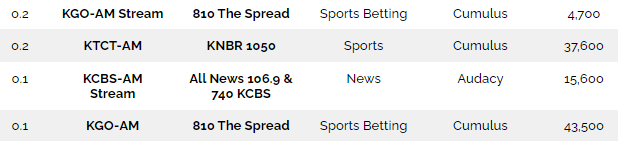
It has a much higher cume for its on-air signal, but the lower rating suggests that people pop onto the signal but do not like it and move on. The truly committed gamblers seek it out online. Hence, the on-air signal would be of better use with a general talk format (oh how I wish it was still the legacy talk version of KGO) and the sports betting format seems to find its adherents online.
It has a much higher cume for its on-air signal, but the lower rating suggests that people pop onto the signal but do not like it and move on. The truly committed gamblers seek it out online. Hence, the on-air signal would be of better use with a general talk format (oh how I wish it was still the legacy talk version of KGO) and the sports betting format seems to find its adherents online.

I don't think I have ever seen this before. The current KGO has higher ratings numbers (0.2 vs. 0.1) for its stream than for its on-air signal:
View attachment 5809
It has a much higher cume for its on-air signal, but the lower rating suggests that people pop onto the signal but do not like it and move on. The truly committed gamblers seek it out online. Hence, the on-air signal would be of better use with a general talk format (oh how I wish it was still the legacy talk version of KGO) and the sports betting format seems to find its adherents online.
That's logical until you realize that much of KGO's current format is structured like infomercial segments or PPI (pay per inquiry) commercials, in which the station gets paid not based on its ratings but on how many people make the phone ring, download the sports betting app or whatever. And it costs Cumulus very little.
Streaming KGO is just one more way to accomplish that. Whatever the metric for success with the program originators is, having both AM and streaming increases Cumulus' chances of meeting the target.
Going back to a traditional format multiplies the cost many times over, and at the end of the day, you're still trying to sell an AM radio station in 2023 in a market that turned its back years ago.

Well, they're already "iHeart Eighties PLUS" which means they can play late '70s/early '90s hits without having to rebrand. (At least until '80s oldies get too "old".)KOSF is also consistently in the 3s, even higher in San Jose. They've been playing a lot of new 90s tracks lately, so they may soon re-brand as classic hits.
The thing is, when you get to shares like 0.1 and 0.2 it's likely possible for only one or two panel members to make a big difference if they listen for long periods of time. We don't know exactly what the metrics used by Nielsen are, but we do know that advertisers pay no attention to stations rated at this level. So the lack of accuracy doesn't matter to anyone except those of us who say "Hmmm... That's weird..."It has a much higher cume for its on-air signal, but the lower rating suggests that people pop onto the signal but do not like it and move on. The truly committed gamblers seek it out online. Hence, the on-air signal would be of better use with a general talk format (oh how I wish it was still the legacy talk version of KGO) and the sports betting format seems to find its adherents online.
Dave B.
KOSF already did rebrand as Classic Hits as 80s+ 103.7.
You want to tweak or flip KGMZ?KRBQ/KGMZ should be Audacy’s next project. Tweak or flip.
to those that know:
1) what calculates ratings, and why are they important?
2) is the drop in ratings of a station like KSOL just bad a big deal?

From Barrett Sports Media, the race is tight between KGMZ + KNBR in the Men 25-54 demo for July-August-September 2023:

 barrettsportsmedia.com
"Weekday Prime" has KGMZ with a 3.2 in 11th place vs. KNBR with a 2.6 in 15th place.
"Full week" (including nights/weekends) goes to KNBR 2.6 in 15th over KGMZ 2.5 in 17th.
95.7 The Game, KNBR Involved in Tight Race in the San Francisco Summer Ratings Book
The summer ratings book showed just how close the two San Francisco sports talk stations are.
barrettsportsmedia.com
"Weekday Prime" has KGMZ with a 3.2 in 11th place vs. KNBR with a 2.6 in 15th place.
"Full week" (including nights/weekends) goes to KNBR 2.6 in 15th over KGMZ 2.5 in 17th.
Yes, I know, that was over two years ago and since I listen to them daily, I had noticed that happened. They are report as 80s, play majority 80s, and have "80s" in their station name. My point is they will likely drop the 80s branding, report as a classic hits station and likely not be majority 80s very soon.KOSF already did rebrand as Classic Hits as 80s+ 103.7.
Two things jump out while looking at these demographic ratings.
1) KQED is at #5 in all three demos: 18-34, 18-49 and 25-54. I don't think any big market NPR station does this well, except WAMU Washington. Most NPR stations do fine overall but much of their listenership is 55+. You don't see these stations in any of the ratings demos.
2) KMVQ is a Top 40 station that does better with older listeners than younger. In 18-34, it's tied for #5. In 18-49 it's #3. In 25-54 it's #2. Contrast that with KYLD, San Francisco's other Top 40 station. KYLD is #3 among 18-34. It's tied for #5 in 18-49. But we don't see it in 25-54.
1) KQED is at #5 in all three demos: 18-34, 18-49 and 25-54. I don't think any big market NPR station does this well, except WAMU Washington. Most NPR stations do fine overall but much of their listenership is 55+. You don't see these stations in any of the ratings demos.
2) KMVQ is a Top 40 station that does better with older listeners than younger. In 18-34, it's tied for #5. In 18-49 it's #3. In 25-54 it's #2. Contrast that with KYLD, San Francisco's other Top 40 station. KYLD is #3 among 18-34. It's tied for #5 in 18-49. But we don't see it in 25-54.
guessed I dreamed it but I kinda thought they already had. I’m so old!Well, they're already "iHeart Eighties PLUS" which means they can play late '70s/early '90s hits without having to rebrand. (At least until '80s oldies get too "old".)

In both cases, we are seeing the loss of most 18-34 listeners to streams and podcasts. So, with the bulk of them gone, stations that didn't appeal to younger demos a decade ago now do very well.Two things jump out while looking at these demographic ratings.
1) KQED is at #5 in all three demos: 18-34, 18-49 and 25-54. I don't think any big market NPR station does this well, except WAMU Washington. Most NPR stations do fine overall but much of their listenership is 55+. You don't see these stations in any of the ratings demos.
2) KMVQ is a Top 40 station that does better with older listeners than younger. In 18-34, it's tied for #5. In 18-49 it's #3. In 25-54 it's #2. Contrast that with KYLD, San Francisco's other Top 40 station. KYLD is #3 among 18-34. It's tied for #5 in 18-49. But we don't see it in 25-54.
If I were going to listen to 810 AM it would be through their internet stream just because of the better sound quality. It’s a shame stereo AM didn’t take off, AM CAN sound good when it wants to but the quality on current equipment is awful.
I gave Live 105 a lengthy listen online last evening (which would've been late afternoon Pacific Time).
I was impressed by the music scheduling, brand imaging and even the audio processing. Didn't hear anything jarring. Commercial breaks were kept to reasonable length. The stationality sounded different - and better - than my local Audacy alternative station, WDZH.
I'd be curious to know how the current iteration of the station differs from the 2010s era of the station, which frequently saw poor ratings.
I was impressed by the music scheduling, brand imaging and even the audio processing. Didn't hear anything jarring. Commercial breaks were kept to reasonable length. The stationality sounded different - and better - than my local Audacy alternative station, WDZH.
I'd be curious to know how the current iteration of the station differs from the 2010s era of the station, which frequently saw poor ratings.
It plays 80s music I believe.
- Status
- This thread has been closed due to inactivity. You can create a new thread to discuss this topic.