• Get involved.
    We want your input!
    Apply for Membership and join the conversations about everything related to broadcasting.

    After we receive your registration, a moderator will review it. After your registration is approved, you will be permitted to post.
    If you use a disposable or false email address, your registration will be rejected.

    After your membership is approved, please take a minute to tell us a little bit about yourself.
    https://www.radiodiscussions.com/forums/introduce-yourself.1088/

    Thanks in advance and have fun!
    RadioDiscussions Administrators

Silver City station seeks move into ABQ market

And you would guess wrong. Just pulled up my copy of the Nielsen market map, which shows both the radio markets and the television DMAs, and three of the states at Four Corners (the exception is Utah) are in the Albuquerque DMA.
There was one county in Utah at one time in the Albuquerque DMA, but it must have been removed.

When KIVA-TV (now KOBF) went on the air, that ultimately opened the door to having that area incorporated in the Albuquerque market. KREZ-TV in Durango, Colorado was originally a repeater for KREX-TV in Grand Junction, Colorado; plus KREY-TV in Montrose, Colorado. For an unusually long time, that was a one-station market, until KJCT-TV came on the air in 1979. Even then, KJCT was an ABC affiliate and KREX (etc.) remained a dual NBC-CBS affiliate.
 
There was one county in Utah at one time in the Albuquerque DMA, but it must have been removed.

Yes, San Juan County, which is now in the Salt Lake City-Ogden-Provo DMA (actually, the entire state is in that DMA, along with a few counties in Nevada, Wyoming and Idaho). Ironically, one of the remaining Four Corners counties in the Albuquerque DMA is San Juan County, NM.
 
Ironically, one of the remaining Four Corners counties in the Albuquerque DMA is San Juan County, NM.

Well, of course, because that's where Farmington and KOBF are!

I think my comment on irony missed the mark. Both the removed Utah county and the retained New Mexico one have the same name.
 
I think my comment on irony missed the mark. Both the removed Utah county and the retained New Mexico one have the same name.
That's because the San Juan River goes through both counties.

Which emojis did I forget this time?
 
There might be one more thing to learn about San Juan County (the one in Utah), something I didn't know until just now.

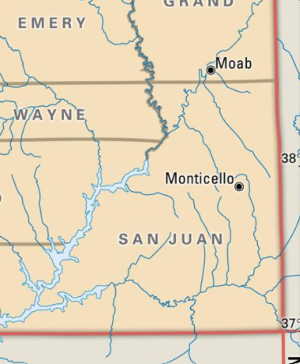
It is bordered by more counties than any other county in the United States, at 14:

San Juan County Archives - Community Data from Demographics Utah

I do have to question whether it can be said to "border" SJ County in New Mexico, in that it only touches that county at an infinitesimally small point, but the conventional wisdom would say it does, so I'll go with that.

I may be having a false memory that, somewhere, a place with San Juan in its name is pronounced "san-JOO-WAN", the way it would look to an English-speaker who has absolutely no clue how to pronounce Spanish, and I want to say it's the county in Utah, but I can't swear to that, and the Wikipedia entry doesn't back that up. Rio Grande, Ohio is in a similar situation, locals call it "rye-oh-grand" and always have.

Bringing this thread back across that infinitesimally small point to New Mexico now...
 
There might be one more thing to learn about San Juan County (the one in Utah), something I didn't know until just now.

It is bordered by more counties than any other county in the United States, at 14:

San Juan County Archives - Community Data from Demographics Utah

I do have to question whether it can be said to "border" SJ County in New Mexico, in that it only touches that county at an infinitesimally small point, but the conventional wisdom would say it does, so I'll go with that.

Looking at the Nielsen map, one additional county falling into that "small point" has to be counted in order for that total to be valid.

These are the counties that border San Juan County, UT. I have added an asterisk to the two where the "border" is a single point of demarcation:

In Utah: Kane, Garfield, Wayne, Emery, and Grand
In Arizona: Apache, Navajo and Coconino
In New Mexico: San Juan*
In Colorado: Montezuma, Dolores, San Miguel, Montrose, Mesa*

Personally, I would exclude those two as not having any highway directly connecting to them from Utah. But that's just me.
 
Looking at the Nielsen map, one additional county falling into that "small point" has to be counted in order for that total to be valid.

These are the counties that border San Juan County, UT. I have added an asterisk to the two where the "border" is a single point of demarcation:

In Utah: Kane, Garfield, Wayne, Emery, and Grand
In Arizona: Apache, Navajo and Coconino
In New Mexico: San Juan*
In Colorado: Montezuma, Dolores, San Miguel, Montrose, Mesa*

Personally, I would exclude those two as not having any highway directly connecting to them from Utah. But that's just me.

And for that matter, Emery County in Utah as well:

1729464309714.png

However, in the case of both Mesa and Emery counties, without drilling down to a very detailed map which I wouldn't know where to find without some digging (think something like the Delorme Gazetteer series), there might or might not be small "jags" that are inherent to surveying, and that would show a border longer than just an infinitesimally small geometric point. It's the same idea that renders Wyoming and Colorado not perfect rectangles as they appear on a map, but rather consisting of any number such "jags".
 
And for that matter, Emery County in Utah as well:


However, in the case of both Mesa and Emery counties, without drilling down to a very detailed map which I wouldn't know where to find without some digging (think something like the Delorme Gazetteer series), there might or might not be small "jags" that are inherent to surveying, and that would show a border longer than just an infinitesimally small geometric point. It's the same idea that renders Wyoming and Colorado not perfect rectangles as they appear on a map, but rather consisting of any number such "jags".
Benchmark atlases cover all the states in question and are excellent. Benchmark also used to publish a street atlas of Albuquerque that was very nice, but they don't appear to do that any more.

The "touching" of Mesa County, Colorado was a shocker, though; the county seat of that county is Grand Junction! That may be a bit misleading, though: it appears, from the Benchmark atlas of Colorado, that the Grand-San Juan county line in Utah continues at the same latitude in Colorado to become the Mesa-Montrose county line for another 55 km (or about 34.2 miles) until that line turns 90° to the north.

Colorado county boundaries tend to be weird anyway; I'm still trying to make sense of them, particularly in the mountain areas. Then there's the added feature of two cities that have decided to each become their own county: Denver and Broomfield.

State boundary surveying errors are quite prevalent in the West. That work was done in the 19th century, often by amateurs.
 
Well they have just filed a new amendment to change the city of license to Truth of Consequence with just the 1.2kW signal. So it looks like they won't be able to move this into Albuquerque or Socorro. It does seem very rare that a television station is permitted to be moved far from the area it was originally assigned to. We'll see if the FCC permits this change. https://enterpriseefiling.fcc.gov/d...&id=25076ff3944810780194618b66df651e&goBack=N

Recently the Movies! channel was removed from KUPT-LD 16.1 which has had a blank screen since about the end of November and KUPT-LD is no longer listed as an affiliate on the Movies! website. So that and MeTV Toons are the Weigel networks that are currently unavailable here. KOB currently has 6 subchannels along with the 1080i main channel so they may be at their capacity. KOAT carries Story Television which is carried on most Hearst stations since I think they own much of the content on that channel. However with KCHF now licensed on Sandia Crest they might be willing to pick up those channels since MeTV Toons is about as G-rated as it gets with commercial networks and Movies! doesn't seem too edgy either. Those channels are certainly of higher quality than what is currently on that signal. A low-powered station on Sandia can still provide pretty good coverage in most of the city if Weigel can buy an available signal if anyone is willing to sell or if they can get a low-powered CP if the FCC would permit that.
 
Well they have just filed a new amendment to change the city of license to Truth of Consequence with just the 1.2kW signal. So it looks like they won't be able to move this into Albuquerque or Socorro. It does seem very rare that a television station is permitted to be moved far from the area it was originally assigned to. We'll see if the FCC permits this change. https://enterpriseefiling.fcc.gov/d...&id=25076ff3944810780194618b66df651e&goBack=N
The new proposed rulemaking for KKAB drops the 3-node Distributed Transmission System (DTS), covering Socorro, Albuquerque and Truth or Consequences, in favor of a standard transmission system serving only Truth or Consequences. By specifying only the Truth or Consequences coverage, I would think that it improves their chance of being allowed to move, as KKAB would be providing a first television service to a currently white area (i.e. no full-service television stations). The previously proposed Albuquerque node added one more signal to an area that was already signal-rich, while the Socorro node had some overlap with Albuquerque stations, IIRC.

If the FCC approves the modified rulemaking request, and I think that they will, I wouldn't count out seeing the DTS proposal for KKAB revived somewhere down the road.
 
The new proposed rulemaking for KKAB drops the 3-node Distributed Transmission System (DTS), covering Socorro, Albuquerque and Truth or Consequences, in favor of a standard transmission system serving only Truth or Consequences. By specifying only the Truth or Consequences coverage, I would think that it improves their chance of being allowed to move, as KKAB would be providing a first television service to a currently white area (i.e. no full-service television stations). The previously proposed Albuquerque node added one more signal to an area that was already signal-rich, while the Socorro node had some overlap with Albuquerque stations, IIRC.

If the FCC approves the modified rulemaking request, and I think that they will, I wouldn't count out seeing the DTS proposal for KKAB revived somewhere down the road.

Dumb question, maybe, but how do DTS signals on the same channel keep from cancelling each other out?

Though they're not DTS, I have a continuing problem with WZRB (seven miles away) getting just enough interference from WJZY on OTA 25 to make reception difficult. Oddly enough, just tonight I was out on Killian Road (a couple of miles closer to Charlotte, and about the same distance from WZRB), testing out the portable TV set I keep in the car (rabbit ears placed on the roof), and WZRB was actually easier to receive than it is for me at home.
 
Dumb question, maybe, but how do DTS signals on the same channel keep from cancelling each other out?

Though they're not DTS, I have a continuing problem with WZRB (seven miles away) getting just enough interference from WJZY on OTA 25 to make reception difficult. Oddly enough, just tonight I was out on Killian Road (a couple of miles closer to Charlotte, and about the same distance from WZRB), testing out the portable TV set I keep in the car (rabbit ears placed on the roof), and WZRB was actually easier to receive than it is for me at home.
Certainly not a dumb question. DTS signals must be precisely tuned to avoid destructive interference. Even so, early on, there were problems with DTS implementations, but improvements to receivers in detecting and compensating for static multipath interference has mitigated the issue, making DTS feasible. The 8VSB modulation used in the ATSC 1.0 standard is not well-suited for DTS. Multipath interference is problematic with 8VSB, so if a DTS is not properly tuned, it will cancel itself out. OTOH, the ATSC 3.0 standard using COFDM modulation, which is much better suited for DTS operations.

In your case, you have two different stations on the same frequency, so you get destructive interference. I have the same issues with stations in the Phoenix market, where the broadcast towers are less than 10 miles from my home, and co-channel stations from Tucson, which are about 100 miles away. However, I can go to areas closer to Tucson and get the Phoenix stations without issue, and I can go to an area about 3 miles from the Phoenix stations and pick up Tucson. Terrain shielding and interference to one or the other signal from buildings or other obstructions are the reason. Generally, in a situation with co-channel stations, you want a highly directional antenna which will pick up the desired signal, but not the undesired signal.

The previously proposed DTS for KKAB had almost no overlap in signal, and there is virtually no one living in the areas that did overlap, so destructive interference would not have been a problem. Even in those overlapping areas, use of a directional antenna would favor the desired station and not pick up the undesired station.
 
Last edited:
Status
This thread has been closed due to inactivity. You can create a new thread to discuss this topic.


Back
Top Bottom