
The argument against Quad of "we have two ears, not four" only works for people with no understanding of spatial hearing, which was the general status of the market at the time.
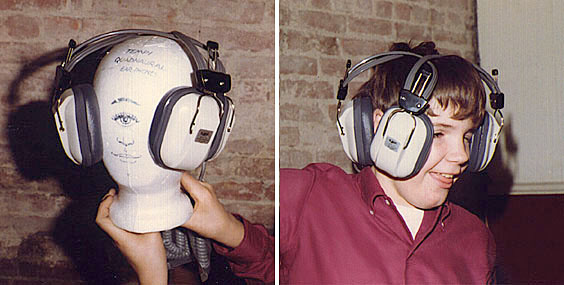
There was always _that_ little problem.
Last edited:

The argument against Quad of "we have two ears, not four" only works for people with no understanding of spatial hearing, which was the general status of the market at the time.
There were quite a few quad recordings that presented a front row-center seat location, but Quad as a concept was always hobbled by the lack of a hard center. Nearly all orchestral quad recordings presented that exact mix. The "inside the band" mix was not fully achievable with either dominant matrix system anyway, though it was certainly attempted.You are forgetting the key issue that goes beyond technology:
Audio listeners associate dimensional sound as being what they hear in a front row-center seat location at a live show.
Audio listeners did not want sound that appeared to be from center stage, on the stage. They wanted it to come from the left, right and center.
Spatial hearing isn't a marketing concept (and never was) it's a description of the ability of humans to hear spatially, with focus on, but not limited to, Head Related Transfer Function. There are entire books....While spatial hearing is a nice concept, most listeners to recorded or broadcast music did not understand it or want it or perceive a need for it.
Yeah, it was actually clearly discernable, just not successful. This quote from Julian Hirsh, of Hirsch-Houck Labs, pretty much positions the Quad concept ca. 1972:"We had been highly sekptical of the early clams that four-channel sound was much of an improvement over two-channel listening as the latter was over mono. At this point we are ready to eat crow. Going back to two channels after listening to four channel is like going back to mono...It generates a sense of involvement with the sound which is so easy to accept that after awhile one is unaware of its existence. On many an occasion we switched off the rear speakers and the contrast was most striking. It can only be compared to turning off most of the lights in a well-lit room after one has become adjusted to a high ambient light level." (Audio magazine, July, 1972). The unique selling position was, simply, "better than stereo", so much so that going back to stereo was painful. It turns out, every time you double reproduction channels, the difference is unmistakable to any listener, with the point of diminishing returns being somewhere around 20 channels. That simple "better than stereo" position was clearly and definitely communicated to consumers by equipment ads and reviews (in print of course) of the time. The detractors looked almost silly in the thick of it.So there was no desirable Unique Selling Proposition for Quad.
I generally agree, but in specific, that statement doesn't work. The creative usage of multichannel sound varies so widely with the needs and desires of the director and producer, the ability of off-screen effects to support the plot, and the related budget. I've mixed a 5.1 show or two, they are far more that twice the work of stereo or 3.0. Some shows just don't benefit from the expense and time, using surround for simple ambience efx or not at all, others ping surround efx from everywhere in the room (Dolby Atmos).For video, we are talking movies, not music. Movies can and should have sound coming from all directions, and positioning of sound can be key to a show.
Again, having been there, there was plenty of appeal and demand, just not enough to cut through the obsticles to success.But quad audio never developed consumer appeal and demand.
Minor point, but important in history: The first Dolby Stereo film release with surround was "A Star Is Born", 1976.In another thread in the QQ forum, the success of Dolby Labs in reintroducing Surround Sound in ~1982, just about 5 years after Quad faded from the marketplace, is discussed.
Dolby Surround, as released on home video by virtue of home video with stereo tracks, was simply the Dolby Stereo LtRt (the completed, matrixed track mastered for Dolby Stereo optical film release) with only the Dolby A-type noise reduction being applied. The matrixed surround material was still there for decoding. It wasn't really deliberate, it's just that the track was already mixed that way. I build a decoder for it in 1981. The first few home decoders didn't even have the modified Dolby B NR applied to the surround channel. Later licensed units appled the correct NR to surround and included a surround time delay, important because they didn't get the steering logic until ProLogic in 1987, and without it, the delay provided a little Haas effect separation enhancement. Dolby Stereo LtRt tracks included a surround channel limited to 7kHz because of optical slit alignment issues in film playback.Dolby Labs was clever to link Surround Sound to the emerging stereo home video market (LaserDisc in 1978, some cable TV via FM stereo in the early 1980s, Beta HiFi in 1983, VHS HiFi in 1984).
Well, the mono incompatibility is real, but in film at least, surround effects aren't completely gone in mono because of the 90 degree network between channels that permits full panning without cancellation mid-pan. There was always some surround in Left and Right, some intentional, some not, because without ProLogic to hype the separation, there is only 3dB separation between adjacent channels. Surround doesn't completely vanish in mono, because Dolby Stereo was meant to be mono compatible in theaters without a Dolby installation.Too bad Dolby Surround encoding wasn't/isn't mono compatible (the surround channel is completely lost) and thus not suitable for AM or FM radio, although a few CDs have been released that are Dolby Surround encoded:

Pyotr Ilyich Tchaikovsky - Dolby Surround Classics
View credits, reviews, tracks and shop for the 2003 CD release of "Dolby Surround Classics" on Discogs.www.discogs.com
But how many consumers over 70 are buying new electric cars?AM definitely didn't need that extra stab wound, but I figured it was coming, in the name of Green. This would almost certainly usher in a wave of new translators on FM if it wasn't for that prohibitive cost. We would benefit from a 21st century standard for AM transmissions that would keep them going, like what Mr. Kirk said

Quite a few, particularly in areas where there are concentrations of retired persons.But how many consumers over 70 are buying new electric cars?
Palm Springs? Those are mainly golf carts. Same goes with 'The Villages' in Florida.Quite a few, particularly in areas where there are concentrations of retired persons.
In chatting with some older friends here in the Palm Springs metro, I find that the idea of not having to go to gas stations is appealing and the belief that this is a way to help the environment are both motivators.
But how many consumers over 70 are buying new electric cars?
I'd imagine that most folks when they are 70 or 80 would be driven around by, per se, their kids. The ones that do drive are certainly used to gas cars, so they probably don't bother with electric. (I applaud those that do, but you know how stubborn grandparents in my state can be?) And yeah, living in a retirement villa like that Morgan Freeman movie, golf carts are the way to go around, and let's not forget the buses!Quite a few, particularly in areas where there are concentrations of retired persons.
In chatting with some older friends here in the Palm Springs metro, I find that the idea of not having to go to gas stations is appealing and the belief that this is a way to help the environment are both motivators.
Obviously, this sentiment may be higher in CA than other more conservative states. I'm even waiting a year or two more to see if options on electric vehicles increase and costs continue to decline.
I think I would save money, too. When I get gas, I always spend (waste?) money on a lottery ticket or two.
So in my first example, radio probably will be taken out of electric cars, but most seniors will be using some other method that permits radio.

Hooray I got my first meme response on here. Also, that is funny, but I generally don't believe the stereotype.
Then you must be incredibly offended by TV shows like Family Guy and The Simpsons.Hooray I got my first meme response on here. Also, that is funny, but I generally don't believe the stereotype.
Is that where that image came from? I actually like the Simpsons, but meh on Family Guy.Then you must be incredibly offended by TV shows like Family Guy and The Simpsons
That's a cartoon character from a stock photo image. My point was: The Simpsons are famous for stereotyping via cartoon characters: Mr. Apu, Grandpa Simpson, Bart, Ned Flanders, etc.Is that where that image came from?


 www.quadraphonicquad.com

