• Get involved.
    We want your input!
    Apply for Membership and join the conversations about everything related to broadcasting.

    After we receive your registration, a moderator will review it. After your registration is approved, you will be permitted to post.
    If you use a disposable or false email address, your registration will be rejected.

    After your membership is approved, please take a minute to tell us a little bit about yourself.
    https://www.radiodiscussions.com/forums/introduce-yourself.1088/

    Thanks in advance and have fun!
    RadioDiscussions Administrators

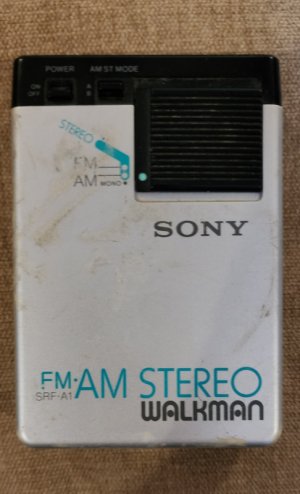
Sony SRF-A1

I have the later version that was CQUAM only. FM was mediocre at best, but AM stereo sounded good. I used it a lot in the mid 90's when KWLO 1330 Waterloo, Iowa was one of my locals and had oldies in AM stereo.
 
I have the later version that was CQUAM only.
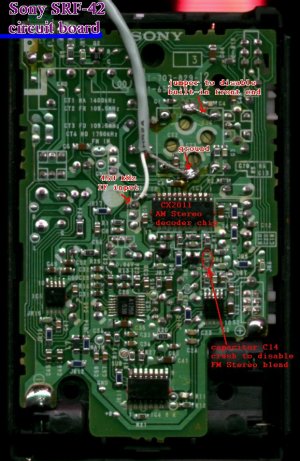
If you're referring to the SRF-42, that still uses Sony's multi-system decoder chip; they just removed the 90° phase shift circuit to properly reproduce the Kahn system. Also there's a trick to improve its FM sound quality by crushing the tiny surface-mount capacitor marked C14 on the circuit board to disable the FM high-blend feature which makes weaker signals sound muffled.

srf-42.jpg
 
I have the later version that was CQUAM only. FM was mediocre at best, but AM stereo sounded good. I used it a lot in the mid 90's when KWLO 1330 Waterloo, Iowa was one of my locals and had oldies in AM stereo.
Most of the Sony FM Walkmans were of fair-to-poor quality, and got worse as time went on. They were especially prone to front-end overload, causing spurious reception products all over dial. I had an SRF-A1 in Kansas City, where I lived just a few miles from the transmitting sites of KYYS, KCMO-FM, and KQRC, all full class-C stations. On the Sony units, nothing from outside the market could come in at all, particularly not KLZR from Lawrence or 107.3, which was then a rimshot from Odessa. The SRF-A1 was a little better on FM than most other Sony Walkmans, but still had the problem with overloading.

The only two Sony Walkman models that are worthwhile on FM are the first one, the SRF-40W, and its successor, the SRF-30W. The 30W is slightly less sensitive than the 40W but otherwise similar. The 40W was fairly decent for its time and had much less of an overloading problem than the later units. They show up on eBay often.

By the way, the SRF-A100, which was legendary for its AM performance and flexibility in AM stereo decoding, was absolutely horrific on FM. The de-emphasis was wrong, the sensitivity was lacking, and the front end overloading was even worse than a typical Sony FM Walkman.
 
In my brothers house on my Sangean DT200X, I can't pick up 1440 KVON

On my SRF-A1, I could just hear the Stereo Pilot, or what ever you call it
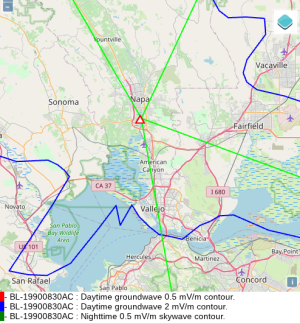
I know the KVON pattern is aimed away from the greater Bay Area, but didn't know what reception was like in Vallejo, which is roughly 15 miles away from Napa, and the KVON array is on the south side of Napa.

KVON didn't have such a great signal in the town of Sonoma either, though it was definitely receivable there.
 
Most of the Sony FM Walkmans were of fair-to-poor quality, and got worse as time went on. They were especially prone to front-end overload, causing spurious reception products all over dial. I had an SRF-A1 in Kansas City, where I lived just a few miles from the transmitting sites of KYYS, KCMO-FM, and KQRC, all full class-C stations. On the Sony units, nothing from outside the market could come in at all, particularly not KLZR from Lawrence or 107.3, which was then a rimshot from Odessa. The SRF-A1 was a little better on FM than most other Sony Walkmans, but still had the problem with overloading.

The only two Sony Walkman models that are worthwhile on FM are the first one, the SRF-40W, and its successor, the SRF-30W. The 30W is slightly less sensitive than the 40W but otherwise similar. The 40W was fairly decent for its time and had much less of an overloading problem than the later units. They show up on eBay often.

By the way, the SRF-A100, which was legendary for its AM performance and flexibility in AM stereo decoding, was absolutely horrific on FM. The de-emphasis was wrong, the sensitivity was lacking, and the front end overloading was even worse than a typical Sony FM Walkman.
I have an SRF-A100 and find the FM quite good. And the AM is outstanding.
 
I know the KVON pattern is aimed away from the greater Bay Area, but didn't know what reception was like in Vallejo, which is roughly 15 miles away from Napa, and the KVON array is on the south side of Napa.

KVON didn't have such a great signal in the town of Sonoma either, though it was definitely receivable there.
I was like walking to Safeway, Still can't get KVON

Even outside by the Glen Cove Area, I thought because of all the interferes in my brothers house

Screenshot 2025-07-02 3.17.19 PM.png
 
I got this for $13.17 at a Antique Store for

FM didn't work at first, But it's working now

Dirty, But not home, In Vallejo

The only Stereo I got on AM was KDYA 1190 Vallejo

View attachment 9509

Wow! I had one of those in the 80's when AM Stereo was at it's peak.

A lot of AM stations that were still playing top 40 music broadcasted in stereo and I was always amazed to listen, especially to the distant stations in stereo at night.

I got mine in 1984 not long before I moved to Florida and my favorite station to listen to was the old '66 WNBC', especially Howard Stern in the afternoons when he played songs as part of the show.

What I thought was interesting was hearing the stereo broadcast when there was ground wave/skywave interaction at night that was common at 80 miles away.

Then when I was in Florida, I could hear WNBC pretty good in stereo after sunset when there wasn't as much interference from the Cuban station on the same frequency in those days.

WLS from Chicago came booming in at night back then in Florida and they used a different mode of stereo than WNBC, as I remember most stations used the 'B' mode whereas WLS sounded better in the 'A' mode.

And when I would visit my brother in the Bay Area, 610 KFRC sounded great in stereo and also KFI at night.

When AM Stereo started to fade in popularity and most all AM stations that played music went to talk, I lost interest in the my AM Stereo Walkman and ended up throwing it out when I moved one time.

I actually thought AM stereo sounded better than FM stereo because it had a more solid sound but I guess it was no competition at all against FM.
 
Which ones? I grew up in the 80’s and never saw or heard of a car radio with a manual LO/DX switch.
The “local/distant” switch tended to be on aftermarket car stereo systems, not original radios that came with the vehicle. Big business back in the day, before automakers upgraded their entertainment systems and made them more tightly integrated into the overall electronic system.

I personally installed a few of those in our cars back in the 1970s and 80s. Never needed to use the “local” setting as I never encountered any receiver overload.

I still have a Sony SRF-A1 that I purchased around 1984. Haven’t fired it up in many years; guess this thread will prompt me to do so. Hopefully it still works.
 
Which, in my experience, is ineffective, and indicative of a bad design to start with.
Not sure they were bad designs. If you look at the circuits, most Walkmen had circuitry similar to the boomboxes and clock radios of the day -- front end chip for FM, IF chip, maybe a multiplexer chip if the IF chip didn't have the FM multiplexing/stereo output integrated. Maybe one or two ceramic filters at best. And remember, on FM the Walkmen had to work off the headphone cord as the antenna, so the RF front end chip had to be fairly robust because of the vagaries of the cord's positioning while the user was jogging, working out, biking, out walking or studying, etc.

And most Walkmen users weren't FM DXers, or even cared to get FM fringe stations. They wanted the main FM's in their city or market. For those purposes, the circuitry in the Walkmen was quite adequate. Same with competitors. I still have a Sanyo walkman that was really good on AM. I got it at a thrift store in 1984 or 85. It's a 1982 model. Still works well, amazingly enough. Haven't tried the cassette but I only used it for the radio. FM didn't have a ton of overload, probably had an extra filter.
 
I personally installed a few of those in our cars back in the 1970s and 80s. Never needed to use the "local" setting as I never encountered any receiver overload.
The alternative used by Mercedes-Benz was to have a switch on the center console to raise or lower the power antenna. The manual said to lower the antenna in strong signal areas.
 
I still have a Sony SRF-A1 that I purchased around 1984. Haven’t fired it up in many years; guess this thread will prompt me to do so. Hopefully it still works.
I bought mine on closeout from W. Bell (remember them?) either late in 1985 or early in 1986. I know I had it by April 1986 because I took it to the Jean-Michel Jarre outdoor concert on Buffalo Bayou. That's when the lens for the LED signal-strength indicator popped out; I've been running without it since.

More on its present-day performance after this message.

Not sure they were bad designs. If you look at the circuits, most Walkmen had circuitry similar to the boomboxes and clock radios of the day -- front end chip for FM, IF chip, maybe a multiplexer chip if the IF chip didn't have the FM multiplexing/stereo output integrated. Maybe one or two ceramic filters at best. And remember, on FM the Walkmen had to work off the headphone cord as the antenna, so the RF front end chip had to be fairly robust because of the vagaries of the cord's positioning while the user was jogging, working out, biking, out walking or studying, etc.

And most Walkmen users weren't FM DXers, or even cared to get FM fringe stations. They wanted the main FM's in their city or market. For those purposes, the circuitry in the Walkmen was quite adequate.

I don't think you can say it was a good design. Adequate? Depends on the circumstances. I liked the SRF-A1 but, in Kansas City, the conditions were just impossible for it, with powerful FM transmitters close-in. To be fair, the A1 handled the situation a bit better than the typical Sony Walkman of the time, and way better than the A100. This wasn't an effort to DX, this was an effort to pick up stations trying to serve the market and I couldn't get some of them due to the overload.

I fired up the A1 and the A100 this afternoon to see how the FM sections perform under present-day conditions. My Denver location is far enough away from Lookout Mountain west of the city that I don't get intense blanketing from there. The A100 still suffered from false products and had trouble with stations spaced 400 kHz apart...which, due to LPFMs and translators, is now a common situation. The A1 did better; the full-power stations from Lookout and Morrison were mostly OK. There was a little overload but I don't think it masked any actual stations. On the other hand, Lookout translators, and there are a lot of them, just couldn't be picked up at all. KBCO, which transmits from near Boulder, was noisier than I think it should have been. Most receivers can pick it up noise-free. With stations on Lookout with less than C/C1 facilities, such as KVOD and KVOQ, there was substantial noise when the station could be picked up at all. KXWA, whose site is west of Castle Rock, was buried by noise. The "Aurora Triangle" of translators and an LPFM at 93.7-93.9-94.1, a challenge for any receiver, was not great, though KETO-LP managed to break through. The KDFD and KOA translators were swamped. HD "whine" was a scourge.

Sure, present-day conditions are tough for older units. In a time before LPFMs and translators were stuffed onto the dial, the A1 would have been a passable performer on FM, though with limitations. I recall that it was OK for me to use in Houston. In Kansas City, it was impossible even before LPFMs and translators came along. I imagine it would simply not be usable there now.



Back
Top Bottom