• Get involved.
    We want your input!
    Apply for Membership and join the conversations about everything related to broadcasting.

    After we receive your registration, a moderator will review it. After your registration is approved, you will be permitted to post.
    If you use a disposable or false email address, your registration will be rejected.

    After your membership is approved, please take a minute to tell us a little bit about yourself.
    https://www.radiodiscussions.com/forums/introduce-yourself.1088/

    Thanks in advance and have fun!
    RadioDiscussions Administrators

Station Tower Efficiency

I'm back home safely from a long road trip, and I had to notice, particularly on the AM band, but FM too, that some stations seem terribly inefficient for their given location (on the dial), wattage, ground conductivity, etc. I learned in engineering that matching the tower to the wavelength (or a factor of that wavelength, like 1/4) is crucial for a clear signal. So what I'm wondering, is what stations do you feel are out of whack in your area? And also may I get some opinions on why it ends up like this?

My FM example:
KAZY and KRRR share the exact same tower and has very similar wattage, but KAZY made it farther than KRRR, and was more consistent.

Now for AM:
810 KBHB (25kw) does not make it as far as 920 (5kw) or 1380 KOTA (5kw). 650 KGAB (8.5kw) blew the socks off by being practically in the clear in Chadron, Nebraska, meanwhile KZMX (AM, 2.3kw) wasn't even audible in Hot Springs (come to think of it, they were probably off air, despite the FM side repeating the liner that they were on 580). Finally, 870 KJMP (1.2kw) is barely perceptible even within Fort Collins and Cheyenne.

I suspect 570 WNAX is even more efficient than 550 KFYR as they are both 5kw, and they both reach Rapid City. (KFYR was readable into Northern Nebraska near Crawford).

Oops, I got a bit on the long side, sorry.
Thank you for your responses!
 
AM and FM are fundamentally regulated differently, so they should not be grouped together for this analysis.

On FM, there are no efficiency requirements, the regulation is on the radiated power. Theoretically an FM station could use a simple whip antenna to transmit, but no one does it that way because it is not economical.

FCC regulations for spacing do not generally protect stations to a range where listening to them becomes impossible. Stations have protected contours. Effectively what this means is within a bubble of about 70km from any class B or C FM transmitter in flat terrain, there should be no interference from other broadcasters. Beyond that, bets are off. So, I would guess that in your Cheyenne market example, the next station on 104.9 is closer to your direction of travel than the next station on 93.7.
 
AM and FM are fundamentally regulated differently, so they should not be grouped together for this analysis.

On FM, there are no efficiency requirements, the regulation is on the radiated power. Theoretically an FM station could use a simple whip antenna to transmit, but no one does it that way because it is not economical.

FCC regulations for spacing do not generally protect stations to a range where listening to them becomes impossible. Stations have protected contours. Effectively what this means is within a bubble of about 70km from any class B or C FM transmitter in flat terrain, there should be no interference from other broadcasters. Beyond that, bets are off. So, I would guess that in your Cheyenne market example, the next station on 104.9 is closer to your direction of travel than the next station on 93.7.
Thank you for the clarification, and feel free to separate these out as needed. The only thing that is remotely close enough to warrant protection is adjacent channel KNNG on 104.7 (Sterling, about 90 miles). Maybe that's it.
 
But there is a STANDARD ERP EFFICIENCY OF 222 mV/m @ 1 kW @ 1 km, or 138 mV/m @ 1 kW @ 1 mile.

In the old days of FM before 1962, ALL FM STATIONS CLASS A and CLASS B, were protected to the 1 mV/m contour, now generally called the 60 dBu F(50,50) contour. Stations were limited to 1 kW/250 feet for Class A, 20 kW/500 feet for Class B. Stations outside FM congested areas, called Zone II, were allowed unlimited ERP, but 500 kW was about the practical limit of equipment available. The 1 mV/m F(50,50) were protected as follows.

0 kHz 10:1 F(50,10) 20 dB D/U
200 kHz 2:1 F(50,10) 6 dB D/U
400 kHz 1:10 F(50,10) -20 dB D/U
600 kHz 1:100 F(50,10) -40 dB D/U

Stations were allowed to use ERP reduction, HAAT in each direction, and DAs to protect each other by the contour overlap restrictions above. Many stations were on AM towers, averaging 150-250 feet HAAT, and used ERP below maximum. There were few FM DAs in the early days.

Later rules allowed higher power for Class C but limited to 100 kW/2000 feet HAAT.

All of this was changed by ever changing FCC rules, which resulted in all the so called "short spacings", and later allowed for more flexibility under Section 73.213 and Section 73.215.

The grandfathered High ERP/ High HAAT combination Class B stations were in areas that used to be in Zone II, but are now in Zone I.
 
Last edited:
But there is a STANDARD ERP EFFICIENCY OF 222 mV/m @ 1 kW @ 1 km, or 138 mV/m @ 1 kW @ 1 mile.

In the old days of FM before 1962, ALL FM STATIONS CLASS A and CLASS B, were protected to the 1 mV/m contour, now generally called the 60 dBu F(50,50) contour. Stations were limited to 1 kW/250 feet for Class A, 20 kW/500 feet for Class B. Stations outside FM congested areas, called Zone II, were allowed unlimited ERP, but 500 kW was about the practical limit of equipment available. The 1 mV/m F(50,50) were protected as follows.

0 kHz 10:1 F(50,10) 20 dB D/U
200 kHz 2:1 F(50,10) 6 dB D/U
400 kHz 1:10 F(50,10) -20 dB D/U
600 kHz 1:100 F(50,10) -40 dB D/U

Stations were allowed to use ERP reduction, HAAT in each direction, and DAs to protect each other by the contour overlap restrictions above. Many stations were on AM towers, averaging 150-250 feet HAAT, and used ERP below maximum. There were few FM DAs in the early days.

Later rules allowed higher power for Class C but limited to 100 kW.

All of this was changed by ever changing FCC rules, which resulted in all the so called "short spacings", and later allowed for more flexibility under Section 73.213 and Section 73.215.
This makes for an interesting read, thank you. To go off track for a second, you mentioned there was a time when FMs could gave unlimited ERP, but the practical limit was 500kw. I know WBCT is the current highest at 320kw, but what is the official maximum anyone has tried in the US for FM?
 
WBCT, as WJFM, had applied for 550 kW ERP, but eventually was licensed for 500 kW. This required the use of 2 converted 25 kW Low VHF TV transmitters, combined to get 50 kW TPO. Originally, it was Horizontal Polrization, later they decreased to 470 kW ERP, with a much lower Vertical Polarization, like 64 kW as I recall.
 
... some stations seem terribly inefficient for their given location (on the dial), wattage, ground conductivity, etc. I learned in engineering that matching the tower to the wavelength (or a factor of that wavelength, like 1/4) is crucial for a clear signal. ... may I get some opinions on why it ends up like this?
Many AM broadcast stations use directional antenna systems that increase their radiated power (with respect to the power output of their transmitter) in some compass directions, and reduce it in other directions.

So it isn't too useful or informative to consider only their FCC-authorized/advertised transmitter power when comparing the signal strength of one AM station to that of others, at any given receive location.
 
I'm back home safely from a long road trip, and I had to notice, particularly on the AM band, but FM too, that some stations seem terribly inefficient for their given location (on the dial), wattage, ground conductivity, etc. I learned in engineering that matching the tower to the wavelength (or a factor of that wavelength, like 1/4) is crucial for a clear signal.
Antenna height can be optimized for the strongest signal possible and minimization of night skywave cancellation zones. But the height does not change whether the signal is clear.

While things like the ground system, the area ground conductivity, tower height and such will affect coverage, they don't affect having "a clear signal". They just affect the range of the station.

A "clear signal" is a product of what is fed into the transmitter to modulate it and the transmitter itself. The tuning of the transmitter to the tower can affect bandwidth if, to make the ATU easy, it has a High Q and sharp rolloffs on both sides, making the audio tend to be, in lay terms, less crisp.

But the height of the tower affects coverage, not the quality of the audio.

I had a station on 570 with just over a 1/8 wavelength tower that was enormously top loaded. It measured 13 ohms and the tuning unity (ATU) had to match the transmitter to that low impedance and compensate for the high reactance. We could not use the site with a taller tower, and alternate sites were rocky or on mountainsides. But the important thing is that the station, due to the studio gear, the STL and the processing as well as using premium components in the home made transmitter, sounded better than of the other 36 stations in the market.
 
But the height of the tower affects coverage, not the quality of the audio.
Along with the audio quality of the original source material, the quality of the audio a person is listening to from an AM receiver includes the signal-to-noise ratio of that audio channel, which in AM broadcasting is heavily dependent on:
  • the field intensity of the arriving AM signal,
  • the adjustment/settings of the audio and the modulation processor used by the station,
  • the r-f input sensitivity, "flat" r-f bandwidth, and antenna characteristics of the AM receiver, plus
  • the ambient r-f noise level including the amount of co- and adjacent-channel interference arriving at the receive site from other AM stations.
 
Last edited:
Along with the audio quality of the original source material, the quality of the audio a person is listening to from an AM receiver includes the signal-to-noise ratio of that audio channel, which in AM broadcasting is heavily dependent on:
  • the field intensity of the arriving AM signal,
  • the adjustment/settings of the audio and the modulation processor used by the station,
  • the r-f input sensitivity, "flat" r-f bandwidth, and antenna characteristics of the AM receiver, plus
  • the ambient r-f noise level including the amount of co- and adjacent-channel interference arriving at the receive site from other AM stations.
But a station makes a conscious decision, based on regulatory restrictions, available transmitter sites and zoning, and even budgetary considerations, that determine the usable reception range of a station. In addition, ever-increasing man made noise will affect area with an all-things-considered usable signal.

If a station is on a busy channel such as the old Class IV stations, the owner knows that coverage, despite the best technical facility, will mostly be limited by cochannel stations. If a station is in an area of low conductivity, they accept that 1 kw will cover about 15% or less of what it might cover were it in eastern South Dakota. And, of course, the station has no control over the ever declining quality of AM radios.

Two stations with equal field strength at a given location, both properly installed, can and should have the same quality. If one wishes to tailor its audio to fit perceptions of its format's needs, that is a conscientious decision to "enhance" the audio for a specific group of listeners and evaluation is subjective. Similarly, "loudness wars" are subjective when evaluated in a competitive situation. Both tailoring the audio and seeking loudness are choices a station makes to be more competitive. They are not inherent limitations of AM or defects of the equipment.
 
WBCT, as WJFM, had applied for 550 kW ERP, but eventually was licensed for 500 kW. This required the use of 2 converted 25 kW Low VHF TV transmitters, combined to get 50 kW TPO. Originally, it was Horizontal Polrization, later they decreased to 470 kW ERP, with a much lower Vertical Polarization, like 64 kW as I recall.
Sweet! That's a complex amount of power.
 
Thank you David for sharing about 570 in your town (city?), I did forget that modulation played a part in this as well. So what you're saying is that, barring things like local noise and ground conductivity, the difference boils down to their equipment type?
 
Thank you David for sharing about 570 in your town (city?), I did forget that modulation played a part in this as well. So what you're saying is that, barring things like local noise and ground conductivity, the difference boils down to their equipment type?
The station I referred to was HCRM1 in Quito, Ecuador, the nation's capital and then a metro of about a million persons. I had AMs there on 570, 590, 660 and 805 plus five FMs.
 
Antenna height can be optimized for the strongest signal possible and minimization of night skywave cancellation zones. But the height does not change whether the signal is clear.

While things like the ground system, the area ground conductivity, tower height and such will affect coverage, they don't affect having "a clear signal". They just affect the range of the station.

A "clear signal" is a product of what is fed into the transmitter to modulate it and the transmitter itself. The tuning of the transmitter to the tower can affect bandwidth if, to make the ATU easy, it has a High Q and sharp rolloffs on both sides, making the audio tend to be, in lay terms, less crisp.

But the height of the tower affects coverage, not the quality of the audio.

I had a station on 570 with just over a 1/8 wavelength tower that was enormously top loaded. It measured 13 ohms and the tuning unity (ATU) had to match the transmitter to that low impedance and compensate for the high reactance. We could not use the site with a taller tower, and alternate sites were rocky or on mountainsides. But the important thing is that the station, due to the studio gear, the STL and the processing as well as using premium components in the home made transmitter, sounded better than of the other 36 stations in the market.
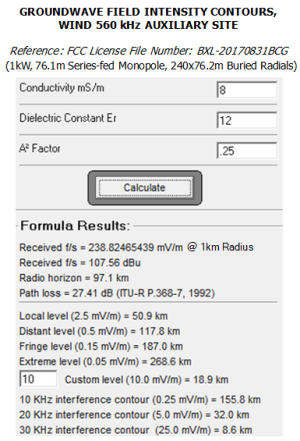
That 570 1/8 wavelength tower is almost exactly like the Licensed AUX for WIND 560 at the WYLL Day site in Des Plaines, IL. I wonder how that gets out.

 
Last edited:
Sorry, but a correction is needed to the labels at the top of my Reply15. The height of the monopole is 67.1m, not 76.1m. The other values in the graphic there are based on that (corrected) height.
 
Last edited:
I forget what the new standards for coverage are, but it looks like the WIND AUX would extend 20 miles to the 5 mV/m contour, which would be more than 50% of Chicago. No Night NIF contour is required over Chicago under new standards, including electrical height for minimum Class B efficiency. So if they had to move at a moments notice, all they would have to do is apply for a CP and then LIC at the "new" site. Wonder if that's the plan? It would be a shame though, since it has such a good 5 kW signal from Griffith, IN.
 
Last edited:
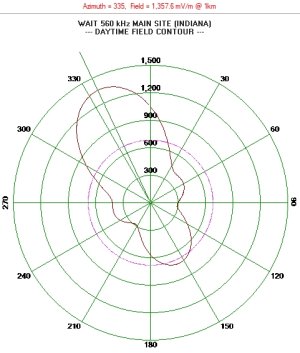
Yes, and WIND has a great signal into Central Indiana in the Daytime. I remember being surprised at how well it came in near Fort Wayne and Muncie. They must have been grandfathered when Westinghouse owned both WIND and WOWO, as there is a large area of overlap of the 0.5 mV/m contours, which as I recall was the standard at one time.
 
And then there are the Blaw-Knox towers, like what WSM and WLW use, that specifically adds to groundwave potential. What is everyone's experience with those?
 
Status
This thread has been closed due to inactivity. You can create a new thread to discuss this topic.


Back
Top Bottom