Do you still have those DX recordings?Not much. Recorded a bit of DX, though.

-
Get involved.
We want your input!
Apply for Membership and join the conversations about everything related to broadcasting.
After we receive your registration, a moderator will review it. After your registration is approved, you will be permitted to post.
If you use a disposable or false email address, your registration will be rejected.
After your membership is approved, please take a minute to tell us a little bit about yourself.
https://www.radiodiscussions.com/forums/introduce-yourself.1088/
Thanks in advance and have fun!
RadioDiscussions Administrators
You are using an out of date browser. It may not display this or other websites correctly.
You should upgrade or use an alternative browser.
You should upgrade or use an alternative browser.
Stories About BUDs (Big Ugly Dishes)
- Thread starter Markxxx
- Start date
I remember watching HNIC games in the 90s, TSN by that point was scrambled for sure, although there was one occasion where it wasn't- because the Sharks-Maple Leafs game would not be over before Canucks-Flames was- BC & Alberta got it in its entirety, so they got a 2nd feed up for those 2 cities and it was unscrambled.The CanCom channels were in the clear into the mid-1980s, I think. Watched a lot of midweek NHL games on CHCH, CITV and CHAN. TSN was also in the clear originally. All that was scrambled well before CBC, which went to hash early in 2001 and it was time to go to a small dish. But the big one is still there, all 12 solid feet of it, should I get the urge to install a digital receiver and go hunting for signals. (And install motors to move the monster after all these years.)
Fox had their NHL games in the clear, because i remember watching a Capitals-Penguins playoff game in 1995, with Kenny Albert doing the play by play, and i remember seeing a Sabres-Flyers game the same postseason with Dave Strader doing the game. I remember sometimes CBC and Fox would be doing the same game (usually on Sundays during the postseason)), i remember a Rangers-Canadiens playoff game in 96 where you'd have Mike Emrick calling it for Fox, but Dick Irvin Jr was calling it on HNIC, Ken Daniels did a Blackhawks-Flames game the same day with Jiggs McDonald doing it on Fox, and Don Wittman doing Red Wings-Jets on CBC and Kenny Albert doing the same game for Fox.
NBC on NFL Sundays would usually have as many as 12 feeds going to different cities, CBS the same. For the "feature" games, NBC had 2 feeds- one which was a "flex" feed, the other one would go to the 2 team cities. NBC West Coast feed was a "spot beam" but i remember watching Sisters on that feed at least once due to some news thing. There were the pre-feeds of network shows (I assumed from the production companies to the networks) because i watched a lot of syndicated shows this way. PBS had a national feed, i would watch Sesame Street, Square One Television, Ghostwriter, Barney, Shining Time Station, etc. I watched NCAA Tourney games on CBS this way too, i remember watching a UNLV game one year even though CBS was showing 60 Minutes, in 1988.I had friends who had home dishes in the late 80s but didn't get to play with them. When I worked in a TV station in Indiana, we had the CBS dishes that were automatically switched by the network (they could even switch a specific region for one commercial break), different receivers for recording syndicated show feeds, and one we used for sports backhauls, newsfeeds, some shows and miscellaneous, and late at night when not in use, I got to play with that. CBS and ABC was scrambled by then (mostly but there were exceptions), NBC was in the clear (including their Mountain Time feed, though West Coast was a spot beam). There were the pre-feeds of network shows (I assumed from the production companies to the networks). Most of the syndicated show feeds were in the clear ("how do you know ALL the Jeopardy answers!"). There seemed to be 9,762 home shopping channels, "Shepherd's Chapel" which had the same preacher 24/7 and some oddities like a preview of the Las Vegas Television Network, which in addition to shows about old Las Vegas, ran soft porn overnight. When one of the satellites went down, and networks had to scramble for space, we found a Montreal French language station that mostly carried U.S. movies and shows dubbed into French. This was everything from The Blues Brothers, to the Adam West Batman (le pow?), to Dougie Howser M.D. (Docteur Doogie). There was always something interesting.
One of the best kinds of feeds on C-band were the sports backhauls. These were the uplinks from the satellite trucks parked at the stadiums. When watching backhauls, you saw less (or no) on-screen graphics, and there were absolutely no commercials. It was the next best thing to being in attendance at the game, in person. When a commercial break began on the network, the video and sound on the backhaul would continue, keeping you "in the game" with uninterrupted stadium ambiance (all of the crowd sounds, the stadium organs and PA announcers, the cracks of bats during warmups at the mound, etc.) coupled with ever-changing camera scenery as the technical director communicated with his cameramen about which shots and angles he wanted pre-positioned. Sometimes the sound mixer would forget to fade down the announcer booth, and you'd also be treated to several minutes of someone like Bob Uecker's locker room talk.
An even better category of feeds were the clean feeds. These were special pre-feeds, typically 24 to 96 hours in advance, of every new episode of every show on the six US networks (NBC/ABC/CBS/Fox/UPN/WB). Clean feeds had no commercials, no on-screen bugs, and no end credits voiceovers or split screen promos. They were raw, straight play-throughs of the master tapes, complete with the technical VTR title slates from their production houses. The reason clean feeds existed was to get advance copies of U.S. shows to all the Canadian networks (Global, CTV, CBC) so they could be previewed by their censors and inserted into their automation for later live simulcast against the American network affiliates' telecasts. (Most Canadians live along Canada's southern border and can see our northernmost OTA signals. So Canada's networks were always given special simulcasting permission by our networks to discourage as many Canadian viewers as possible from going around their local stations and watching new shows on the American signals.) Suffice it to say, watching all your favorite television shows via their clean feeds made for an experience indistinguishable from viewing DVD boxed sets today. You also got to see occasional cut or alternate scenes when American censors or producers decided to change things around in an episode at the last minute, well after that episode's clean feed had already left the building. Sometimes, an episode of a show would be fed to Canada and then get preempted at the last second by its American network because of a major breaking news event or long-running game. I once had an episode of "The Simpsons" on tape from its clean feed that Fox pulled at the last minute (and told Canada's Global to also preempt). It was fun sharing it with trusted friends for the 10 months before it was finally re-scheduled and shown to the rest of the world. Knowing the answers to every evening's Jeopardy questions before your co-workers got home and saw them could also make BUD owners seem something like perpetual Bill Murrays from Groundhog Day.
As great as the sports backhauls and the Canada-bound clean feeds were, though, I'd have to say that the absolute best feeds to see were the special event backhauls and news remotes. Perhaps the best way to convey the joy of watching those would be by simply referring anyone reading this to the fabulous 1995 documentary by Brian Springer called "Spin" (read the video's description at Youtube):
P.S. A nice collection of NOC/TOC slates from the C-band days is available at http://vidiot.com/SatSlates.html. And here are a few trips down memory lane as far as all the clean (and syndication) feeds BUD owners alone could access back in the day:
https://web.archive.org/web/20000817192201/http://www.nmia.com/~roberts/wildfeed
https://web.archive.org/web/19980214040458fw_/http://vidiot.com/Wildfeed.html
https://web.archive.org/web/19970302070950/http://www.tripled.com/ONSAT/feeds.htm
https://web.archive.org/web/19991116051515/http://www.orbitmagazine.com/wfeedsac.cfm
An even better category of feeds were the clean feeds. These were special pre-feeds, typically 24 to 96 hours in advance, of every new episode of every show on the six US networks (NBC/ABC/CBS/Fox/UPN/WB). Clean feeds had no commercials, no on-screen bugs, and no end credits voiceovers or split screen promos. They were raw, straight play-throughs of the master tapes, complete with the technical VTR title slates from their production houses. The reason clean feeds existed was to get advance copies of U.S. shows to all the Canadian networks (Global, CTV, CBC) so they could be previewed by their censors and inserted into their automation for later live simulcast against the American network affiliates' telecasts. (Most Canadians live along Canada's southern border and can see our northernmost OTA signals. So Canada's networks were always given special simulcasting permission by our networks to discourage as many Canadian viewers as possible from going around their local stations and watching new shows on the American signals.) Suffice it to say, watching all your favorite television shows via their clean feeds made for an experience indistinguishable from viewing DVD boxed sets today. You also got to see occasional cut or alternate scenes when American censors or producers decided to change things around in an episode at the last minute, well after that episode's clean feed had already left the building. Sometimes, an episode of a show would be fed to Canada and then get preempted at the last second by its American network because of a major breaking news event or long-running game. I once had an episode of "The Simpsons" on tape from its clean feed that Fox pulled at the last minute (and told Canada's Global to also preempt). It was fun sharing it with trusted friends for the 10 months before it was finally re-scheduled and shown to the rest of the world. Knowing the answers to every evening's Jeopardy questions before your co-workers got home and saw them could also make BUD owners seem something like perpetual Bill Murrays from Groundhog Day.
As great as the sports backhauls and the Canada-bound clean feeds were, though, I'd have to say that the absolute best feeds to see were the special event backhauls and news remotes. Perhaps the best way to convey the joy of watching those would be by simply referring anyone reading this to the fabulous 1995 documentary by Brian Springer called "Spin" (read the video's description at Youtube):
P.S. A nice collection of NOC/TOC slates from the C-band days is available at http://vidiot.com/SatSlates.html. And here are a few trips down memory lane as far as all the clean (and syndication) feeds BUD owners alone could access back in the day:
https://web.archive.org/web/20000817192201/http://www.nmia.com/~roberts/wildfeed
https://web.archive.org/web/19980214040458fw_/http://vidiot.com/Wildfeed.html
https://web.archive.org/web/19970302070950/http://www.tripled.com/ONSAT/feeds.htm
https://web.archive.org/web/19991116051515/http://www.orbitmagazine.com/wfeedsac.cfm
Last edited:
Most Canadians live along Canada's southern border and can see our northernmost OTA signals. So Canada's networks were always given special simulcasting permission by our networks to discourage as many Canadian viewers as possible from going around their local stations and watching new shows on the American signals.
I don't quite understand. If the programs were simulcast in Canada and the US, what kind of "special simulcasting permission" would they have been given, and how would it have discouraged Canadian viewers from watching the same shows at the same times on US stations? And why would they even want to seek out the US station, if it's the same program? Or by "going around their local stations", do you mean that the local stations were not showing those programs, and viewers would want to watch them on US television instead, rather than watching whatever was on the Canadian stations at the same time?
I know that back in the days (1970s), some US network shows would air on Canadian networks before they were shown in the US, but that's not "simulcasting". I have to think that was a special treat for US viewers near the border who could get Canadian TV.
Last edited:
I know that back in the days (1970s), some US network shows would air on Canadian networks before they were shown in the US, but that's not "simulcasting". I have to think that was a special treat for US viewers near the border who could get Canadian TV.
I remember that from my years at Syracuse U., where CKWS Kingston put in a decent signal on the top floors of my dorm.

Who remembers this one Conus Satellite Trucks that TV stations used in the 1980's. at that time those trucks used a satellite dish to relay video from one part of the country to another whenever a local TV station needed to get the segment nationwide. That was the big deal at that time when local TV stations can send their news clips nationwide and have those segments appear on the networks.
I don't think I have found any 2nd-hand VHS recordings of the "clean primetime feeds" for Canada yet. But there were some people with the dishes who would tape the clean master tape feed for The X-Files or Buffy. They seemed to feed 1-3 days before US air.
And speaking of Jeopardy!, you could do the same thing with Wheel of Fortune. Solve all the puzzles early in the morning and find out that the episode you watched on C-Band was actually for the NEXT NIGHT...so you already "cheated". Syndicated Feud may have been in advance, too.
And speaking of Jeopardy!, you could do the same thing with Wheel of Fortune. Solve all the puzzles early in the morning and find out that the episode you watched on C-Band was actually for the NEXT NIGHT...so you already "cheated". Syndicated Feud may have been in advance, too.
I imagine things may have changed, but working at a TV station in the 90s meant we recorded Wheel and Jeopardy shows that aired a week later.I don't think I have found any 2nd-hand VHS recordings of the "clean primetime feeds" for Canada yet. But there were some people with the dishes who would tape the clean master tape feed for The X-Files or Buffy. They seemed to feed 1-3 days before US air.
And speaking of Jeopardy!, you could do the same thing with Wheel of Fortune. Solve all the puzzles early in the morning and find out that the episode you watched on C-Band was actually for the NEXT NIGHT...so you already "cheated". Syndicated Feud may have been in advance, too.
The entire industry needed to consent to these simulcasts because the simulcasts made it equally possible for Americans to view new episodes from cross-border Canadian signals in reverse. So there were basically two choices:I don't quite understand. If the programs were simulcast in Canada and the US, what kind of "special simulcasting permission" would they have been given, and how would it have discouraged Canadian viewers from watching the same shows at the same times on US stations?
1) Let the Canadians broadcast new episodes of American shows behind the US networks' schedules, like the rest of the world does. In this case, most of Canada's population, being on the southern border, would watch the American broadcasts in order to see everything ASAP. That would destroy the ratings potentials for the Canadian stations once they later ran those new episodes locally. Or:
2) Pre-feed new episodes to the Canadians so they could simulcast all new episodes with our own networks' affiliates, costing some of those American affiliates a limited amount of viewers. But in return, the bulk of the ratings potentials for the Canadian stations would be preserved.
In the latter case, and to answer your question about discouraging cross-border viewing, both sides of the border would simply count on viewers gravitating to which ever signal was the closest/best, similar to how nearby 50,000 watt stations airing "Coast to Coast" on AM generally attract their own, local listeners. (Canadian and U.S. cable companies along the border were also made to black out the other side's stations during any simulcasting timeslots, since historically, those systems carried all antenna-receivable stations from both sides of the border.)
In deed. Which is why the simulcasting arrangement began, to remove most reasons to do that. As long as Canadian simulcasts were available, most Canadians simply watched their local Canadian station's version of the broadcast. Exceptions only happened with niche viewers for niche reasons. For example, CRTC standards sometimes forced the Canadian networks to remove violent scenes that the US networks would air. Canadian viewers who were aware of this would watch the "uncensored versions" coming over the border. In other cases, dedicated fans of certain shows would sometimes prefer Canada vs. the US for how that show was treated by the broadcaster. You might get lots of talking over the end credits of your show on Fox, but not on Global in Canada, for example.And why would they even want to seek out the US station, if it's the same program?
In cases of shows that could only be seen on American stations (i.e. shows not in international syndication to Canada), there were never any CRTC rules prohibiting the Canadian public from watching those shows via cross-border signals, or industry attempts to confine all Canadian eyeballs to Canadian shows for ratings purposes. (They may as well have forbade VHS rental shops under that logic.)Or by "going around their local stations", do you mean that the local stations were not showing those programs, and viewers would want to watch them on US television instead, rather than watching whatever was on the Canadian stations at the same time?
That may have been because of Canadian stations airing everything they got from the clean pre-feeds the same day the feeds happened. I can imagine those treats drawing the ire of many of those American stations, and eventually resulting in agreements to not show things up there ahead of their official timeslots down here.I know that back in the days (1970s), some US network shows would air on Canadian networks before they were shown in the US, but that's not "simulcasting". I have to think that was a special treat for US viewers near the border who could get Canadian TV.
I assume you are talking about cable or satellite. There would be no way to prevent Canadian viewers from watching OTA US stations, if they were close enough to receive them.In cases of shows that could only be seen on American stations (i.e. shows not in international syndication to Canada), there were never any CRTC rules prohibiting the Canadian public from watching those shows via cross-border signals, or industry attempts to confine all Canadian eyeballs to Canadian shows for ratings purposes.
I recognize one of the promotional segments in that video. In 1986, channel 40 Sacramento somehow convinced the great Leslie Nelsen to travel to the station and film tons of on-set promos not only for its 10 o'clock news, but for the debut of its own Ku-band satellite truck. You can find broadcast-quality copies of his all spots, taken from the original 1" C master tapes, here. The fourth is a long outtakes reel of his work. Prepare for fart noises.Who remembers this one Conus Satellite Trucks that TV stations used in the 1980's. at that time those trucks used a satellite dish to relay video from one part of the country to another whenever a local TV station needed to get the segment nationwide. That was the big deal at that time when local TV stations can send their news clips nationwide and have those segments appear on the networks.
It's surprising these videos have only a few hundred views. There's probably a Leslie Nielsen fan club somewhere that would love to know they exist. Actually, the uploader's entire Youtube channel deserves a plug. He's apparently a broadcast engineer who used his access to Ampex 1" Type-C and 2" Quadruplex machines at work to archive many neat things from both his local airwaves and from national C-band feeds at incredible quality. My favorite item: the best quality copy I've ever seen of ABC's network-to-affiliate C-band feed of 1989's MLB World Series Game 3, uncut and starting from the very beginning. This of course was the infamous game interrupted live on-air by the Loma Prieta/San Francisco earthquake:
ABC News coverage of the 1989 Bay Area (Loma Prieta) earthquake - from ABC satellite feed (10/17/89)
This recording starts at the beginning of the ABC's coverage of Game 3 of the 1989 World Series -- at 5:04pm Pacific Time, a magnitude 6.9 earthquake hit, kn...
 www.youtube.com
For any archivists or aircheckers who might be interested: I found the following link while looking through the above video's comments. Seems the uploader also uploaded the full raw 10 mbit/s MPEG-2 capture of the satellite feed at native 480i to the Internet Archive. See details in the description:ABC News coverage of the 1989 Bay Area (Loma Prieta) earthquake - from ABC satellite feed (10/17/89)
This recording starts at the beginning of the ABC's coverage of Game 3 of the 1989 World Series -- at 5:04pm Pacific Time, a magnitude 6.9 earthquake hit, kn...

ABC News coverage of the 1989 San Francisco (Loma Prieta) earthquake : American Broadcasting Company : Free Download, Borrow, and Streaming : Internet Archive
This recording starts at the beginning of the ABC's coverage of Game 3 of the 1989 World Series -- at 5:04pm Pacific Time, a magnitude 6.9 earthquake hit,...
archive.org

Who remembers this one Conus Satellite Trucks that TV stations used in the 1980's. at that time those trucks used a satellite dish to relay video from one part of the country to another whenever a local TV station needed to get the segment nationwide. That was the big deal at that time when local TV stations can send their news clips nationwide and have those segments appear on the networks.
Conus, in a joint venture with Viacom, also operated the All-News Channel, a relatively low-profile operation with a similar news wheel format as CNN Headline News. Here's a 1991 edition with Patrice Formby, who would later move to Headline News:
Conus, in a joint venture with Viacom, also operated the All-News Channel, a relatively low-profile operation with a similar news wheel format as CNN Headline News. Here's a 1991 edition with Patrice Formby, who would later move to Headline News:
Kind of reminds me of NewsNet. I always respected the effort that NewsNet put into that channel, with minimal resources (LPTV in a small town in Michigan), but I didn't see it taking off, and in time, they too folded their tents. They gave it their best shot.
Here's a 20/20 report from 1984 about people with backyard C-Band dishes:
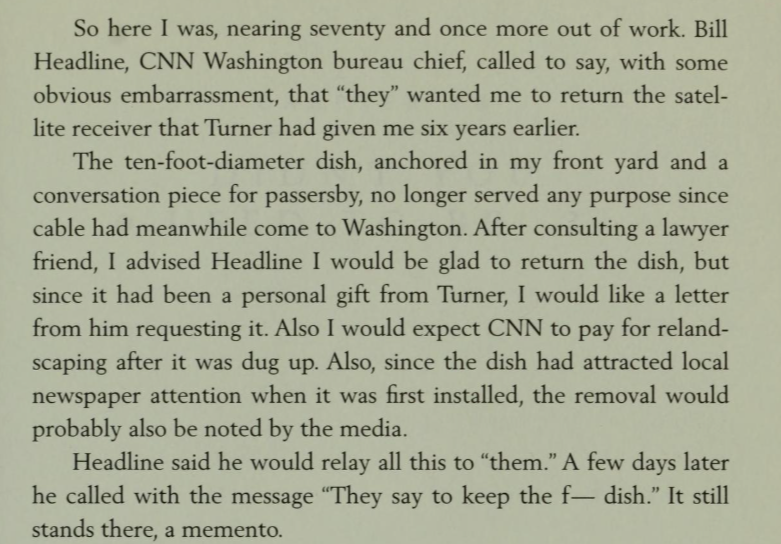
Back in the 80s, former CBS reporter Daniel Schorr was hired by CNN. At the time, they didn't have cable in DC, and Schorr lived in the District. It was also before DirecTV. So he had CNN pay for a "big ugly dish" on his front lawn. He was living in the ritzy Kalorama area of DC, so it really stood out. When he left CNN after a few years, they left the dish on his front lawn.
There's a picture of Schorr and his dish in his NPR obit:
The dish apparently wasn't popular with his neighbors, according to this story:
According to Schorr's biography Staying Tuned, the story of how he got to keep his dish wasn't all that simple:

K.M. Richards
Program Director, The Eighties Channel™
I presume that dish is long since removed, since Schorr died 15 years ago.
In the mid-80s, the makers of the British documentary series Television found a passionate New Yorker with a Big Ugly Dish attached to his apartment window:
Here's a 20/20 report from 1984 about people with backyard C-Band dishes:
The date on Home Team Sports Wire says it is 1985 not 1984.