
• Get involved.
    We want your input!
    Apply for Membership and join the conversations about everything related to broadcasting.

    After we receive your registration, a moderator will review it. After your registration is approved, you will be permitted to post.
    If you use a disposable or false email address, your registration will be rejected.

    After your membership is approved, please take a minute to tell us a little bit about yourself.
    https://www.radiodiscussions.com/forums/introduce-yourself.1088/

    Thanks in advance and have fun!
    RadioDiscussions Administrators

Streaming using a Starlink connection...

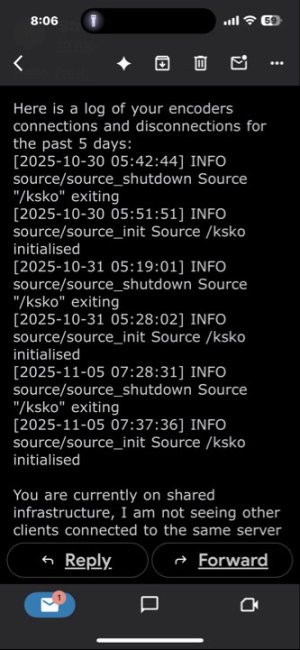
This might initially look like not much or too confusing but in reality, it's really good news/proof of how well streaming works on Starlink.

We use Starlink as the primary and only feed to our rebroadcast signals. they arent translators, but actual stations and could but don't carry their own programming.

We have the business priority account and a high performance dish at HQ which is what feeds the stream and this shows the stream connects/disconnects...... and this will show in the last week there's only been 3 drops.

I've been talking to one Aussie engineer who kinda kept an eye on us as an example of why this would make a great back up STL feed for their stations.


download (2).jpg
 
I have a Comrex Brick II running crosslock with the Hot swap function enabled so that if the primary ISP (Comcast fiber) fails the Comrex switches to the Starlink as a Backup ISP. I have a USB ethernet adapter enabled for the second Ethernet port. When the primary ISP fails there is less than a second of silence or a little Jitter and it switches to the Starlink. When things settle down it switched back to the Primary ISP. It does ping through the Starlink every so often to verify the path is still a viable, but does not start to really use data till it switches to Starlink. So far really happy with that set up.

This is an interesting set up because the Comcast fiber lands at our Transmitter site that is 1 mile down the road from the Transmitter site with the Starlink and Comrex with Hotswap enabled. The connection between the two sites for network transport is via a Ethernet DSL modem extender running on a Dry pair between the two sites. Sometimes the DSL connection will get upset during Pattern change and that's when the site running Hotswap switches to Starlink and doesn't disrupt programming. Most of the time the Comrex at the far end from the Comcast connection is running through Comcast so we have been able to use a lower tier Starlink account. If Comcast goes down totally we have firewalls at both sites configured to make Starlink the ISP for both sites running starlink ISP data back to the site where Comcast lands. Kinda complicated and Hats off to our IT department for making it work. Its a thing of beauty when seeing it in action.
 
I have a Comrex Brick II running crosslock with the Hot swap function enabled so that if the primary ISP (Comcast fiber) fails the Comrex switches to the Starlink as a Backup ISP. I have a USB ethernet adapter enabled for the second Ethernet port. When the primary ISP fails there is less than a second of silence or a little Jitter and it switches to the Starlink. When things settle down it switched back to the Primary ISP. It does ping through the Starlink every so often to verify the path is still a viable, but does not start to really use data till it switches to Starlink. So far really happy with that set up.

This is an interesting set up because the Comcast fiber lands at our Transmitter site that is 1 mile down the road from the Transmitter site with the Starlink and Comrex with Hotswap enabled. The connection between the two sites for network transport is via a Ethernet DSL modem extender running on a Dry pair between the two sites. Sometimes the DSL connection will get upset during Pattern change and that's when the site running Hotswap switches to Starlink and doesn't disrupt programming. Most of the time the Comrex at the far end from the Comcast connection is running through Comcast so we have been able to use a lower tier Starlink account. If Comcast goes down totally we have firewalls at both sites configured to make Starlink the ISP for both sites running starlink ISP data back to the site where Comcast lands. Kinda complicated and Hats off to our IT department for making it work. Its a thing of beauty when seeing it in action.

What station, if you care to share?

We have a Briclink 2 feeding the stream and Barix boxes doing the rec'v at the remote sites
 
KIRO 710 with it's transitter on Vashon Island. KTTH is the station a mile down the road where Comcast is at. The Starlink is at the 710 Transmitter. KIRO 710 is Sports with the Mariners and Seahawks, any disruption during Play by Play is annoying. The set up works great with little disruption to the audio.
 
I'm deploying a Starlink MicroMPX transmitter on top of a mountain in Rio de Janeiro, Brazil. Let's hope the satellite is steady enough to maintain a 320kbps constant stream. I'm gonna add additional streams through fiber optics if possible. micrompx is naturally multi-stream compatible. you can have multiple streams coming from different sources as redundancy and increased datastream stability.


Back
Top Bottom