
• Get involved.
    We want your input!
    Apply for Membership and join the conversations about everything related to broadcasting.

    After we receive your registration, a moderator will review it. After your registration is approved, you will be permitted to post.
    If you use a disposable or false email address, your registration will be rejected.

    After your membership is approved, please take a minute to tell us a little bit about yourself.
    https://www.radiodiscussions.com/forums/introduce-yourself.1088/

    Thanks in advance and have fun!
    RadioDiscussions Administrators

Television Factbook 1979 and ITM

Good morning, I am a social scientist from Harvard University and I am working on a project that uses the predicted signal loss from each TV antenna in the US as of 1979, using the Irregular Terrain Model. To do this, I have digitized the 1979 Television Factbook and I am now using the technical specifications of each antenna, as specified in the Factbook to predict the signal loss.

Not being an expert on TV broadcasting, I have a few questions on how the information contained in the Factbook and the ITM inputs relate and I was hoping that some of you could help.

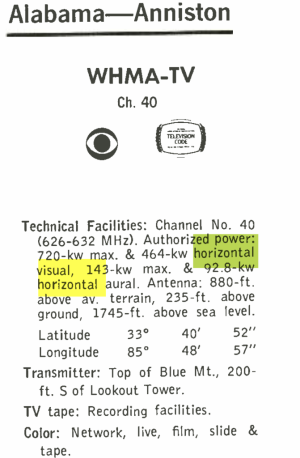
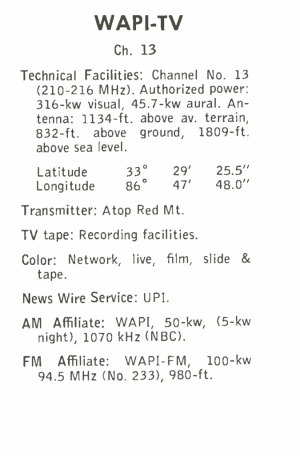
1. Power: the ITM uses frequency and elevation, as well as other inputs, to determine the signal power loss. Once we obtain the predicted signal loss, and after applying some transformations, we can compare it to the antenna's power. In the most common case, the Factbook reports visual and aural power (see example WAPI TV). However, in some cases, the Factbook reports two visual powers: max. and horizontal (see example WHMA TV). My question is:
1.a. Which power should we consider? Horizontal or max.?
1.b. Is considering visual and not aural the correct choice?

2. What should we consider the standard receiver height to be in the 70s?

Thank you so much in advance!
 

Attachments

  • Screenshot 2024-03-06 at 12.42.14 PM.png
    Screenshot 2024-03-06 at 12.42.14 PM.png
    194.6 KB · Views: 10
  • Screenshot 2024-03-06 at 12.42.29 PM.png
    Screenshot 2024-03-06 at 12.42.29 PM.png
    171.6 KB · Views: 10
Most TV stations, especially before DTV, were polarized in only one plane, commonly horizontal.
WHMA TV 40 in Anniston, Ala. clearly broadcast from a mountaintop site (note the high height above terrain and low height above ground), so they elected to broadcast in both horizontal and vertical polarization. This could improve reception when there were terrain obstacles (i.e. mountains) between the transmitter and the receiver(s).

The most effective power would probably have been horizontal and not the max, because any individual's receive antenna would have been H or V, not both. But that's probably somewhat controversial.

Visual and aural power were kind of unrelated. Under NTSC, Aural used Frequency modulation, and visual used amplitude modulation. In theory, the receiver would have different sensitivity to each. The FCC would have tried to set the powers so that both aural and visual could be received for a certain distance.

Back in the 70s, especially in rural areas, you would have often had outdoor antennas on the roofline of single family homes. So probably 4 or 5 meters. Closer to the transmitters you would have mostly had rabbit ears, which would have been more like 2m, assuming a first floor dwelling.
 
IIRC, the FCC considered the standard height for field strength measurements in the 70’s to be 30 ft. Almost everyone had an external antenna, if possible, not only to maximize signal strength but to minimize reflections which with the analog television system of that time created ghosting. Rabbit ears were more typically used with bedroom or portable TVs. To answer your questions:

1.a. - horizontal
1.b. - visual

2. - 30 ft.
 
That's a really long time ago. You might want to post on the TV sections on this site. There most likely are folks who worked TV back then frequenting those boards.

I am not sure of the date (late 70's or early 80's) channel 11 Atlanta started to use a really expensive circular polarized antenna. It really helped them in the suburbs with rabbit ear antennas users like my parents. IIRC it was cheaper to buy really high gain horizontal polarized antennas than buy and run bigger transmitters.

In the early 1960s, My Grandfather and several neighbors started a primitive cable Co-op so they could get TV due to mountains messing up TV stations 30 and 40 miles away. They managed to get the Pittsburgh VHF stations plus channel 5 Weston and 12 Clarksburg WV.
 
Good morning, I am a social scientist from Harvard University and I am working on a project that uses the predicted signal loss from each TV antenna in the US as of 1979, using the Irregular Terrain Model. To do this, I have digitized the 1979 Television Factbook and I am now using the technical specifications of each antenna, as specified in the Factbook to predict the signal loss.

Not being an expert on TV broadcasting, I have a few questions on how the information contained in the Factbook and the ITM inputs relate and I was hoping that some of you could help.

1. Power: the ITM uses frequency and elevation, as well as other inputs, to determine the signal power loss. Once we obtain the predicted signal loss, and after applying some transformations, we can compare it to the antenna's power. In the most common case, the Factbook reports visual and aural power (see example WAPI TV). However, in some cases, the Factbook reports two visual powers: max. and horizontal (see example WHMA TV). My question is:
1.a. Which power should we consider? Horizontal or max.?
1.b. Is considering visual and not aural the correct choice?

2. What should we consider the standard receiver height to be in the 70s?

Thank you so much in advance!
Good to see you joined here to ask your question.

David Eduardo (Gleason)
 
IIRC, the FCC considered the standard height for field strength measurements in the 70’s to be 30 ft.
Yes, that is correct. I wrote what I did on Wednesday because I think few households actually had 10m AGL antennas, despite that being how the FCC evaluated coverage area.
 
Yes, that is correct. I wrote what I did on Wednesday because I think few households actually had 10m AGL antennas, despite that being how the FCC evaluated coverage area.
More than you might imagine as chimney mounts for TV antennas were very popular then but few were at exactly 10 meters.
 
Dear all,

Thank you for the prompt and excellent replies. I am grateful and will definitely ask questions again in this forum, as you all seem to be extremely knowledgeable.

One quick follow-up question: where can I find a reference on the 30-ft being the standard height considered by the FCC? I have to include it in the paper.
 
Status
This thread has been closed due to inactivity. You can create a new thread to discuss this topic.


Back
Top Bottom