• Get involved.
    We want your input!
    Apply for Membership and join the conversations about everything related to broadcasting.

    After we receive your registration, a moderator will review it. After your registration is approved, you will be permitted to post.
    If you use a disposable or false email address, your registration will be rejected.

    After your membership is approved, please take a minute to tell us a little bit about yourself.
    https://www.radiodiscussions.com/forums/introduce-yourself.1088/

    Thanks in advance and have fun!
    RadioDiscussions Administrators

Tell Me About "Dual Call Signs"

I came across this whilst reading Wikipedia (on KFKX)

Until about 1930, Westinghouse's broadcasts from its Chicago station used the KYW call letters for most broadcasts, with KFKX used for agricultural programming, such as the Department of Agriculture's "farm radio service" program.

However, on May 15, 1933, the FRC requested that stations with dual-call signs that were using only one of their assigned call letters drop ones that were no longer in regular use

I have heard of two unrelated owners sharing a frequency but this sounds like the opposite, they have one owner and two call signs. Is this correct?

Can any one clue me in what was going on? And if it is one owner with two call signs, why?
 
Many stations shared time on a frequency in the beginning of radio. The latest example I know of is WBAP and WFAA in Dallas, which technically shared time from the 1920s until the 1969 or 1970.

KYW and KFKX shared time as well, although I'm not sure if this began before or after KFKX moved from Nebraska to Chicago. It's not two call signs, it was two separate licenses. They happened to both be owned by Westinghouse. Westinghouse probably chose to move KFKX to Chicago rather than surrender it, just in case it could be moved elsewhere or be sold.
All of this happened before the Communications Act of 1934, so there were not a lot of rules.
 
KYW and KFKX shared time as well, although I'm not sure if this began before or after KFKX moved from Nebraska to Chicago. It's not two call signs, it was two separate licenses. They happened to both be owned by Westinghouse. Westinghouse probably chose to move KFKX to Chicago rather than surrender it, just in case it could be moved elsewhere or be sold.
All of this happened before the Communications Act of 1934, so there were not a lot of rules.
Before the Act that established the FCC, we had the Federal Radio Commission from 1927 to 1934. That organization assumed the regulation of radio from the Commerce Department which worked under the 1912 act.

It was, in fact, the FRC that established what were the AM radio standards that resulted in the frequency assignments that endured, except for the NARBA realignment, up till today.

The best example, our of quite a few, of frequency sharing is 1240 AM in Chicago, which for decades had three separate licensees.
 
Many stations shared time on a frequency in the beginning of radio. The latest example I know of is WBAP and WFAA in Dallas, which technically shared time from the 1920s until the 1969 or 1970.

KYW and KFKX shared time as well, although I'm not sure if this began before or after KFKX moved from Nebraska to Chicago. It's not two call signs, it was two separate licenses. They happened to both be owned by Westinghouse. Westinghouse probably chose to move KFKX to Chicago rather than surrender it, just in case it could be moved elsewhere or be sold.
All of this happened before the Communications Act of 1934, so there were not a lot of rules.
WIBW in Topeka shared time with KSAC/KKSU (K-State’s station) from 1929 until November 2002. The second link talks about the other stations KSAC shared time with previous to 1929.
 
I have heard of two unrelated owners sharing a frequency but this sounds like the opposite, they have one owner and two call signs.
I've never heard of anything like that, either. That is what the Wikipedia article says. It must have been confusing, broadcasting one program with one call sign and another program with another call sign, but on the same frequency.
Have any of heard about anything like this? Is the Wikipedia article correct or did the wiki author get some facts wrong?
 
I've never heard of anything like that, either. That is what the Wikipedia article says. It must have been confusing, broadcasting one program with one call sign and another program with another call sign, but on the same frequency.
Have any of heard about anything like this? Is the Wikipedia article correct or did the wiki author get some facts wrong?
There were many shared time frequencies in the earlier days of AM radio.

Some were very limited, such as the one that shared with WLEE in Richmond, VA, on 1480 which only broadcast Sunday services.

The best known are WFAA and WBAP in Dallas / Ft Worth. They shared 570 and 820, with each getting part of the time on the better channel and the rest on 570.

New York City had several. such as WHBI and WOV on 1280. 1320 was shared with WBBR in Brooklyn, WEVD in NYC and WHAZ all the way up in Troy. 580 had two Kansas stations in Topeka and Manhattan sharing the channel. KFSG and KRKD shared 1150 in LA. And so on.
 
The way the article was written it sounds like Westinghouse was using two calls on one frequency. I can see a frequency being shared by two different owners but why would one company, in this case Westinghouse want to use two call signs?
 
Remember something else when reading a Wikipedia article on any subject: Just because someone wrote that something is a fact does not mean that it is, unless there is a citation attached to it in the footnotes.

The biggest problem with Wikipedia being "the encyclopedia anyone can edit" is that too many people add content which is based on what they think they know. Just as I have many times suggested here ... doing research before posting something you "know" will prevent someone from coming along and proving you wrong (usually someone like me who knows how to research).

And yes, I take my own advice whenever I am even slightly uncertain of something. With me it's usually having to doublecheck timelines.
 
Another related thought that may have had something to do with the confusion: When radio was first beginning (and was at that time regulated by the Commerce Department), everyone shared a single frequency for entertainment programming -- 360 meters, around 833kHz -- and the second, 485 meters (619kHz), was only to be used for farm and weather reports.

 
Remember something else when reading a Wikipedia article on any subject: Just because someone wrote that something is a fact does not mean that it is, unless there is a citation attached to it in the footnotes.

The biggest problem with Wikipedia being "the encyclopedia anyone can edit" is that too many people add content which is based on what they think they know. Just as I have many times suggested here ... doing research before posting something you "know" will prevent someone from coming along and proving you wrong (usually someone like me who knows how to research).

And yes, I take my own advice whenever I am even slightly uncertain of something. With me it's usually having to doublecheck timelines.
I have made enough errors to understand that there is a lot of misinformation out there. In the cases where I have made a mistake in a post, I assumed that I knew something to be a fact even though I was wrong.

The fist three letters of ASSumed say it all.
 
The best known are WFAA and WBAP in Dallas / Ft Worth. They shared 570 and 820, with each getting part of the time on the better channel and the rest on 570.
In the mid 1960s the WFAA/WBAP schedule on 50kw 820 was:

Midnight-7:30am WBAP
7:30am-12:30pm WFAA
12:30pm-5pm WBAP
5pm-Midnight WFAA

The 5kw 570 frequency was the reverse of 820.

The same transmitters remained constant on each frequency regardless of which station was using it. At swap times there would be a station ID, then five seconds of silence, then an ID from the other station, and programming would continue. No carrier drop.

The 820 frequency always had NBC news and programming while 570 had ABC, regardless of which station was on at a given time.

The only real advantage of 820 was at night with its huge skywave coverage. Listening in Austin during that era the 570 and 820 day signals were pretty much equal.
 
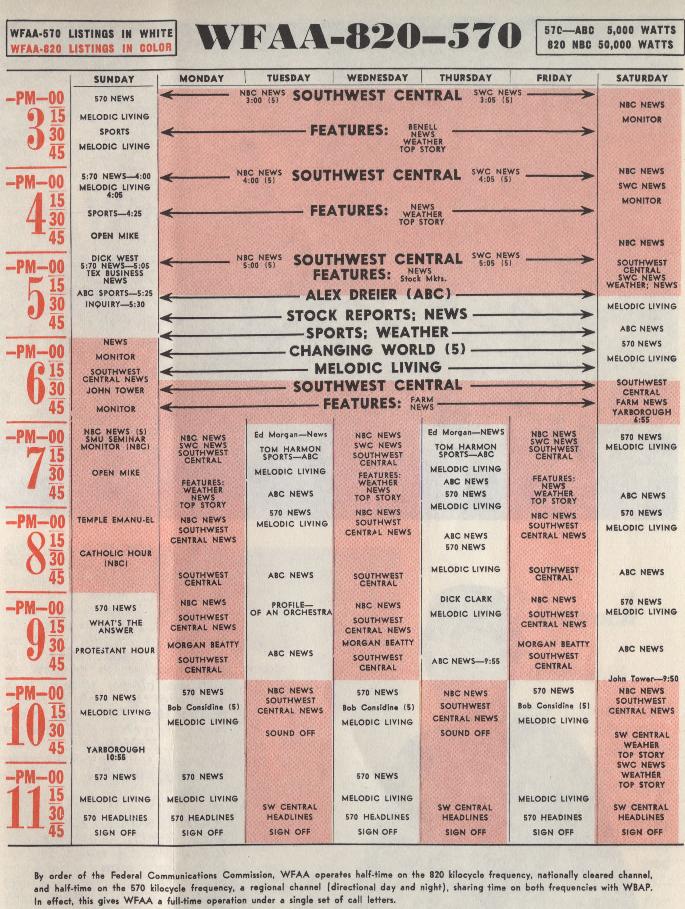
Here's the 3:00pm to midnight schedule for WFAA from sometime in the 1960s, showing how they had to change network programs whenever they traded places with WBAP:
WFAASched63.JPG
 
Here's the 3:00pm to midnight schedule for WFAA from sometime in the 1960s, showing how they had to change network programs whenever they traded places with WBAP:
WFAASched63.JPG
That appears to be from the beginning of the 1960s at the very latest. At a glance it would appear to be from the mid-1950s. From my own personal listening in the mid-1960s both 570 and 820 were on 24 hours a day, except for occasional Monday morning maintenance.
 
You're guess is as good as mine. Hard to tell from the programming.
 
The way the article was written it sounds like Westinghouse was using two calls on one frequency. I can see a frequency being shared by two different owners but why would one company, in this case Westinghouse want to use two call signs?
It looks like this was just the way it was done back in the late 1920s for regulatory expediency. I looked at some of the old FRC bulletins this morning and found several additional examples of other broadcast licensees doing the same:

In FRC Service Bulletin from 10/31/1928, No. 139:
KMOX -- Kirkwood-Mo.--St. Louis -- Add call signal KFQA"
KYW -- Chicago Ill -- Consolidated with KFKX, both calls to be used"

The KFQA call sign was apparently used when KMOX's facility broadcast religious services from the Christian Science church. A Christian Science college was a minority owner in KMOX at the time. KFQA - The Joe Btfsplk of St. Louis Radio Stations - St Louis Media History Foundation

More from 9/30/1927, No. 126:
WABO (Rochester, N.Y.) This station consolidated with station WHEC; Both call signals to be used; Owner Hickson Electric Co."
WARS (Brooklyn, N.Y.--Brighton Beach) -- This station consolidated with station WSDA; both call signals to be used; owner, Amateur Specialty Co.

I checked these because they had information on KYW-KFKX. I'm sure there were other examples in bulletins 127-138.
 
Another one: WIP-WFAN in Philadelphia. (No, sports fans, I am not making this up.) This dual call was used on 610 starting February 1, 1931, according to an Inquirer story of the previous day. A new corporation, the WIP-WFAN Broadcasting Company, was created to operate the combined station; the station was shown as owned by that business in following days in the paper's listings, while the city's other time shares (WLIT and WFI, and WHAT and WTEL) were still listed with separate schedules and separate owners. By March 22, 1933, the station was listed as WIP under the ownership of "Gimbels Store," although a display ad for a program on the station was still calling it WIP-WFAN.


Back
Top Bottom