
-
Get involved.
We want your input!
Apply for Membership and join the conversations about everything related to broadcasting.
After we receive your registration, a moderator will review it. After your registration is approved, you will be permitted to post.
If you use a disposable or false email address, your registration will be rejected.
After your membership is approved, please take a minute to tell us a little bit about yourself.
https://www.radiodiscussions.com/forums/introduce-yourself.1088/
Thanks in advance and have fun!
RadioDiscussions Administrators
You are using an out of date browser. It may not display this or other websites correctly.
You should upgrade or use an alternative browser.
You should upgrade or use an alternative browser.
TFT 8600 STL manual
- Thread starter Studio1
- Start date
Hi Tom,
I've had no exposure to TFT equipment before. This is the first piece of gear I've ever laid
eyes on so I am not sure if it's part of the 8300 series or not.
It's a 930 MHz transmitter and the label on the back has '8600' stamped under "Model No".
If it's a really big manual, the parts I'd like the most are schematic diagrams, frequency setting info and
block diagram.
I was hoping for a PDF of the whole manual, but from what I can see, manuals for the older TFT units
don't exist.
I've had no exposure to TFT equipment before. This is the first piece of gear I've ever laid
eyes on so I am not sure if it's part of the 8300 series or not.
It's a 930 MHz transmitter and the label on the back has '8600' stamped under "Model No".
If it's a really big manual, the parts I'd like the most are schematic diagrams, frequency setting info and
block diagram.
I was hoping for a PDF of the whole manual, but from what I can see, manuals for the older TFT units
don't exist.
Does it look like this:
http://www.tftinc.com/products/datasheets/stl8300.pdf
If it does, run, don't walk, away from it. You need a full test bench to even look at it, unless all you do is change filter caps.
Uses a couple of VCO's to get on frequency, next to impossible to work on.
http://www.tftinc.com/products/datasheets/stl8300.pdf
If it does, run, don't walk, away from it. You need a full test bench to even look at it, unless all you do is change filter caps.
Uses a couple of VCO's to get on frequency, next to impossible to work on.
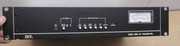
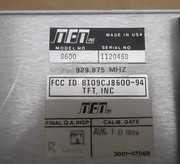

TFT does show a model 8600 though listed as obsolete. My guess is they didn't make many of them..you are probably stuck with buying the manual from them.
If the design is like the 8300 (and it may well be) you probably won't have much luck changing frequency with the dip switches. Also, on the 8300, the receiver needed a crystal change.
On the odd frequency--there are commercial channels in the 900 mhz. band that could be licensed for STL use. Didn't have the protection that the broadcast 950 band had, used a different licensing procedure but could be used as an alternative where the STL bands were very crowded.
If the design is like the 8300 (and it may well be) you probably won't have much luck changing frequency with the dip switches. Also, on the 8300, the receiver needed a crystal change.
On the odd frequency--there are commercial channels in the 900 mhz. band that could be licensed for STL use. Didn't have the protection that the broadcast 950 band had, used a different licensing procedure but could be used as an alternative where the STL bands were very crowded.
When I first came to work here at our station I noticed every time I closed the door, the damn TFT 8300 transmitter would drop off the air, and of course drop us off the air. Turns out they had so much trouble from the beginning with the unit they were sent when they built the station that they KEPT the loaner that seemed to work. Further investigation of why closing the back door on the rack knocked it off lead me to a piston capacitor that appearenlty had worn out due to frequency changes. I replaced that and have been luckly still running for several years now. I know of a vendor that literly will will not offer any value for this series. He doesn't want to be bothered with mad customers that he might re-sell them to because this model of STL is such a POS. Run like hell from them if you get a chance. LOL!
rfburns said:That unit isn't on a frequency for STL use in the USA. Where did it come from?
RFB
It's here with me in New Zealand. Our STL bands are in the low 400 MHz (only for difficult link paths/AM services/mono FM), various allocations in the 900-950 MHz region and more recently 845 - 849 MHz.
TomT said:TFT does show a model 8600 though listed as obsolete. My guess is they didn't make many of them..you are probably stuck with buying the manual from them.
If the design is like the 8300 (and it may well be) you probably won't have much luck changing frequency with the dip switches. Also, on the 8300, the receiver needed a crystal change.
On the odd frequency--there are commercial channels in the 900 mhz. band that could be licensed for STL use. Didn't have the protection that the broadcast 950 band had, used a different licensing procedure but could be used as an alternative where the STL bands were very crowded.
Thanks for the comments and suggestions. I guess I'll find out when the unit gets here. If it's as bad as you suggest, I'll simply move it on to a new home.
OKCRadioGuy said:When I first came to work here at our station I noticed every time I closed the door, the damn TFT 8300 transmitter would drop off the air, and of course drop us off the air. Turns out they had so much trouble from the beginning with the unit they were sent when they built the station that they KEPT the loaner that seemed to work. Further investigation of why closing the back door on the rack knocked it off lead me to a piston capacitor that appearenlty had worn out due to frequency changes. I replaced that and have been luckly still running for several years now. I know of a vendor that literly will will not offer any value for this series. He doesn't want to be bothered with mad customers that he might re-sell them to because this model of STL is such a POS. Run like hell from them if you get a chance. LOL!
Thanks for the heads-up. A picture is starting to emerge here and it's great to have the feedback from others as to the quality (or lack of) in these units. It will be interesting to see what's inside and how it's built, when it finally does get here later this week.
I'll take photos and post my findings back here, even if it's only for laughs.
I know it's LD from NZ, but if you really get stuck on that unit, I'd call Jim at J-Squared a call. He's about as good as they get on keeping those TFT units alive: http://www.tftinc.com/support/talksheets/Service Centers.pdf
Thanks OKC... I have corresponded with Jim before - good guy.
I don't think there's much (if anything) wrong with this unit. It came from a working environment and the initial plan was to set it up
as a stand-by unit.
I'll attempt to change the frequency to the desired one, then set it running on the bench for a week to see if it's stable and operating
as it should.
I don't think there's much (if anything) wrong with this unit. It came from a working environment and the initial plan was to set it up
as a stand-by unit.
I'll attempt to change the frequency to the desired one, then set it running on the bench for a week to see if it's stable and operating
as it should.
Good luck! Hopefully it'll be a smooth modification/tune-up  .
.
.
Since you may not have the "factory" test data, make note of the AFC loop test point voltages before changing frequency. However, you may have to experiment with the loop lock voltage windows after the change. The 8300 series had sweet spots that changed slightly with frequency.
Also be aware of the REV(ision) # on each board as there could be big differences between a (example) REV A and REV B schematic.
Still have two sets of 8300s' in operation that only require a shotgun capacitor change out every 5 to 10 years. Did take about 5 years to get them running reliably at first.
Also be aware of the REV(ision) # on each board as there could be big differences between a (example) REV A and REV B schematic.
Still have two sets of 8300s' in operation that only require a shotgun capacitor change out every 5 to 10 years. Did take about 5 years to get them running reliably at first.

I actually have a couple of sets of the 8600 units, a pair of which are still in use (sort of) as a backhaul from an AM transmitter site that we inherited.
These units were purchased new in 1987. I located the manuals and looked at the transmitter and receiver schematics. Appears that frequency is controlled by a crystal-referenced VCO, didn't look like there were any dip switches or similar mechanisms to reset frequency. It would appear that you need to change crystals in both transmitter and receiver to effect a frequency change.
If you do need to change frequencies, I would agree with other posters that J-Squared is the way to go. His stickers are on these units, so at least you know he's seen the type before.
These units were purchased new in 1987. I located the manuals and looked at the transmitter and receiver schematics. Appears that frequency is controlled by a crystal-referenced VCO, didn't look like there were any dip switches or similar mechanisms to reset frequency. It would appear that you need to change crystals in both transmitter and receiver to effect a frequency change.
If you do need to change frequencies, I would agree with other posters that J-Squared is the way to go. His stickers are on these units, so at least you know he's seen the type before.
Cheers guys. The 8600 arrived yesterday and I wasted no time in getting the cover off.
As suggested, it is rock-bound. I am not happy at all, given that the advice I got from TFT some weeks ago when I specifically
asked about this model was that the frequency was changed with dipswitches.
I have sent an email back to TFT asking them why they told me this when clearly it is incorrect.
Had I known it was not synthesised I would not have looked at it. I already have a shelf full of rock-bound STL transmitters.
As suggested, it is rock-bound. I am not happy at all, given that the advice I got from TFT some weeks ago when I specifically
asked about this model was that the frequency was changed with dipswitches.
I have sent an email back to TFT asking them why they told me this when clearly it is incorrect.
Had I known it was not synthesised I would not have looked at it. I already have a shelf full of rock-bound STL transmitters.
TomT said:on the other hand, it may actually come up and operate if you change the crystals. Unlike the 8300.
It's one option I am considering. These units were used by one of the country's biggest commercial radio networks and they wouldn't
be hanging on to or using equipment that didn't meet spec or wasn't able to be set up easily to do the job intended.
I just need to find whichever company can supply a crystal on the right frequency and knows the specs needed for the crystals used in these units.
If the cost of the crystal + postage is reasonable I may just do it, and use this machine as a standby.
jboyd said:International Crystal Manufacturing should be able to supply...JBI
Thanks, I'll follow that up.
- Status
- This thread has been closed due to inactivity. You can create a new thread to discuss this topic.