• Get involved.
    We want your input!
    Apply for Membership and join the conversations about everything related to broadcasting.

    After we receive your registration, a moderator will review it. After your registration is approved, you will be permitted to post.
    If you use a disposable or false email address, your registration will be rejected.

    After your membership is approved, please take a minute to tell us a little bit about yourself.
    https://www.radiodiscussions.com/forums/introduce-yourself.1088/

    Thanks in advance and have fun!
    RadioDiscussions Administrators

The Future - AM + Streaming only (no FM & HD)

Status
Not open for further replies.
wow, the OP is a genius!

Why didn't someone think of this earlier!

I think they should be the next nominee for the FCC, such knowledge and wisdom, in addition to their technical acumen would make them a great fit, along with the former nominees for the FAA ( nomination pulled because running an airport after running a bus company does not qualify you for the job), the current nominee for the Dept of the Interior who could not recall details of legislation she proposed while in office, and Gigi Sohn for the FCC was opposed by Democrats and Republicans alike.

OK lets look at the AM Band...

AM Stereo.... FAIL

IBOC.... all but abandoned

The Expanded band.... a effn joke

Handing economically challenged and other AM's Translators as a life line is only going to help so much...

Has anyone noticed the FCC is going to allow FM on Citizens Band frequencies?

So no more hetrodyning, the receiver section will only detect the strongest signal

no more people stepping on each other

clearer sound, even if it is still limited to 4 watts output

Now if only the FCC would follow the lead of other countries and go to DRM on the "AM" band.....

But the FCC has a long history of making bad decisions.... like IBOC vs Eureka 147

But we can skip over FM on the AM band for a bunch of reasons, the Eureka 147 system is OK but DRM is a much more efficient use of the bandwidth and uses a lot less electricity to broadcast ( hey it is green too!)

And it sounds pretty good, and many of us in the Boston DMA heard 1410's tests before the Late Alex Langer's family took the station dark after his death while they look for a buyer.

Not only did it sound good, but it covered a lot of ground too.

It is time to move on from Ancient Modulation ( as one Boston talker called it) and do DRM on AM, opening up all sorts of new
space.

 
I guess DHS and FEMA could have an "army" of drones that would fly over the affected (natural disaster/hacker "attack") areas and drop leaflets that say in part "I'm from the Government and I'm here to help you" if this AM radio based system wasn't implemented.

Keep in mind that phones aren't the only things affected by hurricanes or tornadoes. I've seen lots of AM towers destroyed by those same hurricanes and tornadoes. If the power goes out, it's likely an AM station with no revenue source won't have a generator to keep it on the air. It costs money to provide emergency services. At one time, radio stations had the money to do lots of things. That's starting to dry up. Now we see thousands of stations that have no staff and no local resources. All the money is with non-broadcast. That's why radio stations are shifting to streaming.
 
Keep in mind that phones aren't the only things affected by hurricanes or tornadoes. I've seen lots of AM towers destroyed by those same hurricanes and tornadoes. If the power goes out, it's likely an AM station with no revenue source won't have a generator to keep it on the air. It costs money to provide emergency services. At one time, radio stations had the money to do lots of things. That's starting to dry up. Now we see thousands of stations that have no staff and no local resources. All the money is with non-broadcast. That's why radio stations are shifting to streaming.
And I know of several 50kW AM stations who invested in multiple generators (main and backup), but who's towers today would likely fall over in an earthquake or hurricane. The intent at the time was to harden the site for such an emergency that never occurred. In the meantime the emergency equipment just gets old requiring replacement. Few stations in modern times are willing to dump the capex into equipment or maintenance that's been already proven unnecessary.
 
If the AM antenna issue could be resolved, Smartphones w/AM would explain to the user that the phones was receiving emergency info from a radio signal and that the Smartphone couldn't make or receive call at that time.

Far as we know, the antenna issue can't be resolved. We've had 100+ years to figure it out, and we haven't. If there is a way, we probably won't find it because there's no demand for it anymore. Again, technologies die. When the last AM station turns the transmitter off, we should just let it go and enjoy the fond memories.

AFAIK, only the CBC/Canada & the BBC are making some long range (a decade or three) plans for all wireless broadband distribution of their content (when no AM/FM/HD/DAB/TV stations would be on the air).

I don't think commercial broadcasters overall have made plans for the sunsetting of radio and TV, but I wouldn't say they've done nothing. That you can get their programming over apps, whether that's live streaming, podcasting, interviews, or whatever else they might be doing, shows they're not ignoring the changes. One could make the case that they're not innovative enough and aren't taking enough advantage of the technology and what it can do, but you can't say they're doing nothing.

I guess DHS and FEMA could have an "army" of drones that would fly over the affected (natural disaster/hacker "attack") areas and drop leaflets that say in part "I'm from the Government and I'm here to help you" if this AM radio based system wasn't implemented.

During disasters, few people tune to AM for information today. Again, you can make the case that AM radio doesn't do enough to cover disasters when they happen, but my local AM's will at least air TV audio if they don't go live. The idea that, after AM disappears, people will tune into it during a disaster doesn't square up with the fact that few people use it today. In the 1950's and 60's, the government came up with a system called "Conelrad" to warn the population in case of nuclear war. All but one or two stations in an area would go off-air, and people would tune to those stations in a national emergency. Of course, those stations would get out further because a large number of other stations on the same frequencies would go off-air. It was ultimately scrapped in the late-60's in favor of the EBS. One of the main reasons it was scrapped was because it wouldn't work in the real world. Your idea of an AM based emergency alerting system would have the same problems. Should radio as we know it go away, the proper way of addressing alerting people in an emergency should be addressed with the prevailing technology at the time. Backward evolution is rarely a viable solution to new problems.
 
Point of clarification - my proposed AM "ER" 50kW (Smartphone backup) radio network would not be commercial stations, all such AM stations would be Gov built and maintained, broadcasting audio from 1 or more cable news channels would just be a way to quickly verify that the ""ER" AM station is working during non-emergency times.

If the Smartphone detects no cell phone network, it would automatically switch over to AM with an on screen explanation of why the Smartphone is doing what it is doing.

Here, KC based WHB 810 AM claims their 50kW daytime signal reaches 5 states, in the event of a large scale natural disaster, with my idea, the options would be no info or info from a distant AM radio station (possibly weak and noisy, but still usable for emergency info).


Kirk Bayne
 
Trying to find a “new use” for AM radio is like trying to find a new use for 78 RPM records.

Too many of these proposals are based on nostalgia rather than any practical consideration going into the future. Shortwave has the same issue.
Now that you mention it, about 70 years ago, there was a new use for 78 rpm records! They were smaller in diameter and used for children's songs. I'm pretty sure that mine were yellow. They existed at least well into the 1960s.
 
Now that you mention it, about 70 years ago, there was a new use for 78 rpm records! They were smaller in diameter and used for children's songs. I'm pretty sure that mine were yellow. They existed at least well into the 1960s.
I had a bunch of those 78s as a '60s kid. My favorites, as a future communications geek, were part of a "How Does It Work" series sung and narrated by Paul Tripp ("Mr. I. Magination"). I've found a few of them on YouTube but not the ones I remember best, "How Does Television Work" and "How Does Radar Work."
 
I'm thinking of something like Wildfires that destroy the power and Internet systems, Earthquakes, a large number of Tornados in a moderate sized area, or some hackers taking down the power grid in a moderate size area for an extended time, a distant AM signal could all that's available for emergency info.

On the AM antenna in Smartphones - for a Country that sent Men to the Moon over 1/2 century ago, it absolutely, completely, and totally impossible to design an AM antenna that would work in a Smartphone?


Kirk Bayne
Thought the moon thing was done in Hollywood!
Radio got along fine way before smart phones ever existed...
 
Now that you mention it, about 70 years ago, there was a new use for 78 rpm records! They were smaller in diameter and used for children's songs. I'm pretty sure that mine were yellow. They existed at least well into the 1960s.

And to repeat: Mediumwave (AM) radio will not work in a smartphone, any more than trying to play vinyl records with that device.
 
Point of clarification - my proposed AM "ER" 50kW (Smartphone backup) radio network would not be commercial stations, all such AM stations would be Gov built and maintained, broadcasting audio from 1 or more cable news channels would just be a way to quickly verify that the ""ER" AM station is working during non-emergency times.

From a technical standpoint, it still wouldn't work very well. FM would be a preferable technical solution that could be put into play almost immediately. Of course, as we've already discussed, that ship has already sailed and won't be coming to port anytime soon.

If the Smartphone detects no cell phone network, it would automatically switch over to AM with an on screen explanation of why the Smartphone is doing what it is doing.

Bad idea. I've owned a smartphone for 14 years. I've lost my cell network signal countless times during those 14 years. I can tell you exactly how many times I've lost my cell signal due to a disaster: 0. You're assuming losing a cell network would have to mean a disaster is occurring. That's a rare reason for losing a cell signal.

Here, KC based WHB 810 AM claims their 50kW daytime signal reaches 5 states, in the event of a large scale natural disaster, with my idea, the options would be no info or info from a distant AM radio station (possibly weak and noisy, but still usable for emergency info).

Those might as well be the same option. Picking up an AM signal on the other side of the state on a smartphone isn't technically feasible. It's the equivalent of no info.
 
David, you made a brilliant point on another forum:
Think of AM as you think of incandescent light bulbs. Think of FM as fluorescent bulbs. Think of streaming as LED ones.
That analogy is spot on. OTA radio is gradually dying but the content will live on.
 
I can appreciate that you want to find uses for AM as it continues its slide to obscurity. If every AM station were to go away, the FCC wouldn't likely be able to auction that spectrum. It just doesn't have any business use. It really doesn't have much practical use of any kind. If/When AM finally goes away, it will be time to just let it go.
The Netherlands tried low-power AM stations, generally limited to 100 watts. When I was there last year, I found very few of them actually on the air. The only one that had a strong enough signal for me to listen to it was Radio 4 Brainport on 747* from the High Tech Campus west of Eindhoven. I split my time between the Eindhoven vicinity and Amsterdam; I couldn't pick up any low-power AM signals in Amsterdam (I was mostly in the Zuidas business district). Supposedly at least some of these stations are on the air, so one or more of several things could have been true: the online listings I was using were out-of-date; the low-power stations pop in and out as they are able or willing; some of the stations never went on the air; they don't have enough power to reach very far; etc. etc.
(* = how far has the mighty 747 frequency fallen!)
 
Now that you mention it, about 70 years ago, there was a new use for 78 rpm records! They were smaller in diameter and used for children's songs. I'm pretty sure that mine were yellow. They existed at least well into the 1960s.
I had them, too, as a child in the 1960s. Even had an RCA record player that would play them.
 
When a SHTF or TEOTWAWKI event happens, millions won't be prepared, AM radio or no AM radio.

You can try to persuade people to have some sort of preparedness, including communications preparedness, but you can't force them. This is one reason why FEMA estimated that 90% of the US population would be dead within a year or two of a major EMP event.

So, let's suppose that there were more AM radios in houses, or even stuffed inside a cell phone. Lets assume that an AM band-based emergency notification system worked. That doesn't mean that it would be used, any more than any other system, or any other form of disaster preparedness on the part of the general public. Any governmental attempts to inform the population to be prepared for adverse events is going to fall on deaf ears. It's just the way it is.

Even our nation's (and the world's, arguably) health care system wasn't prepared for a pandemic -- even after warnings by major influencers like Bill Gates concerning the potential for one, and previous scares like the Swine Flu epidemic, or SARS. My public, tax-supported hospital district was like most others in the region in 2020 -- virtually devoid of personal protection equipment when corona hit. They all apparently thought there would never be a need for it. And for the first 50 years the hospital district existed, that was indeed the case. No need. So, hey -- no worries.

In that respect they were no different than your average 9 to 5'er -- living day to day, blissfully unaware and -- for the most part -- serenely oblivious to the potential hazards that could strike at any moment. Maybe for good reason.
 
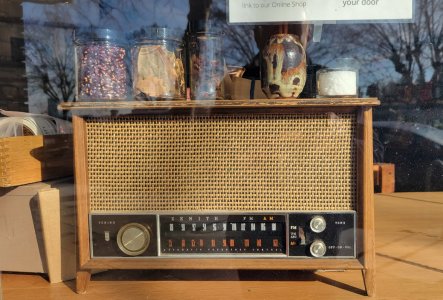
As perhaps a cautionary tale of the future of radio, the Oakland (California) Spice Shop across from Lake Merritt has had this display in its storefront windows for a couple of years.
 

Attachments

  • zenith-spice-rack.jpg
    zenith-spice-rack.jpg
    574.9 KB · Views: 17
Status
Not open for further replies.


Back
Top Bottom