
• Get involved.
    We want your input!
    Apply for Membership and join the conversations about everything related to broadcasting.

    After we receive your registration, a moderator will review it. After your registration is approved, you will be permitted to post.
    If you use a disposable or false email address, your registration will be rejected.

    After your membership is approved, please take a minute to tell us a little bit about yourself.
    https://www.radiodiscussions.com/forums/introduce-yourself.1088/

    Thanks in advance and have fun!
    RadioDiscussions Administrators

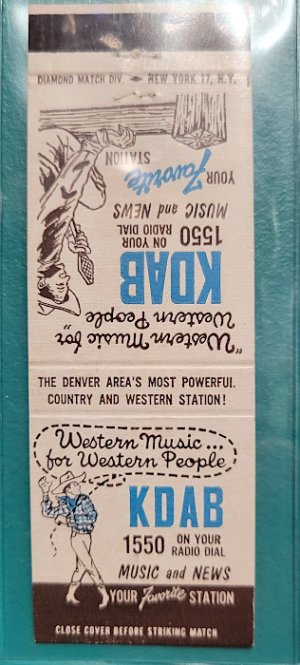
The story behind a matchbook cover

20250322_140604-resized.jpg
Amid a display of matchbook covers at the History Colorado museum in Denver, memorializing long-gone business along Colfax Avenue, I saw this cover for a long-forgotten radio station, KDAB.

KDAB broadcast at 1550. At first, I couldn't find an FCC history card for it, because the present occupant of 1550, KKCL in Golden, was established only in 2009, or shortly thereafter.

So time for some research! The resources at worldradiohistory.com, plus coloradohistoricnewspapers.org, were invaluable to filling in some of the blanks. (Wikipedia was not used.) I think this story shows how ephemeral radio can be, not just the programs we listen to but also the stations that broadcast them.

KDAB started out as KBRB, with a construction permit granted in 1960. The city of license was the western Denver suburb of Arvada. Before the station went on the air, though, it was sold to two women, Frances Gaugine and Bernice Schwartz, for just over $20,000. Remember the name Bernice Schwartz.

Under the women's ownership, KBRB changed calls to KDAB, for "Denver Area Broadcasters". The station was a daytimer licensed to the suburb of Arvada, with 10,000 watts. It took until January 1962 for KDAB to light up the airwaves. On January 11, newspapers ads featured a "get acquainted offer", giving away a record to the first 1,000 listeners who wrote in to P.O. Box 1 in Arvada. The station promoted its "New Sound in Western Music", promising that "You'll Thrill To Modern Music For The Modern West". Air personalities were Bill Western, Don Kallinger, and Ted Atkins.

In 1965, disaster struck the station. Broadcasting magazine reported that a flash flood on June 16 wiped out KDAB's transmitter site near the South Platte River. It wasn't the only station affected; KDKO (1510) also was flooded out. KDAB managed to get back on the air with a 250-watt transmitter two days later, but that transmitter failed. Several days later, a 5,000-watt transmitter was put into service.

Shortly after that, KDAB changed calls to KQXI. That would be the last call-letter change for decades.

KDAB/KQXI's owners tried several times to get nighttime service, but the FCC denied those applications, starting in 1968. Finally, in 1989, nighttime operation with 10,000 watts at night was granted, but apparently never built.

But I'm getting ahead of the story. In 1966, Schwartz and Gaugine hired a general manager, Dick McKee, and gave him an ownership share in the station. McKee wasn't just the general manager; he was also the sports director and made frequent play-by-play appearances on KQXI. In those years, KQXI broadcast Colorado State University sports, among other events.

KQXI changed format several times during the 1960s. It veered from country-and-western to easy listening to Top 40 back to country. It reported to the Billboard Top 40 charts for much of 1968. It even had its own plane, one of three Denver stations so equipped. KQXI promoted itself as "Tiger Radio". The challenge there was Top 40 giant KIMN. It would have been hard for a daytimer to compete with a fulltime station with a beefy signal. When KQXI switched to country, it was taking on Lakewood's KLAK (1600), which had the country reputation in the Denver market in those days.

(to next post)
 
(part 2)

Schwartz bought out her partners for $115,000 in 1969. In 1970, the station reportedly switched to a gospel format. Or did it? KQXI got into some hot water with the FCC for apparent lack of candor about exactly when the switch from country to gospel happened. I found newspaper ads from 1971 that still advertised the KQXI "Ranch Hands". KQXI got a short-term renewal in 1976, which apparently concluded the matter. Regardless, in the 1970s, the station became a gospel station, mostly featuring preaching.

Here's why I said to remember Bernice Schwartz's name. She was the wife of Harold Schwartz, owner of several religious-formatted stations, including St. Louis' KXEN. Is it reasonable to assume that Harold at least gave Bernice some advice in the face of KQXI's multiple format changes? I suspect we'll never know.

In any event, by 1980, Bernice Schwartz transferred control of the station to the Schwartz family trust, which owned the other Harold Schwartz stations. One of the trustees was Burt Kaufman.

KQXI found a niche in gospel programming and stuck with it for decades. In the 1990s, when the FCC extended the AM band to 1700, KQXI was awarded the 1690 frequency under the calls KAYK.

In the late 1990s, as children's radio became a trend for otherwise struggling AM stations, Radio Disney began snapping up some of those stations. One of them was KQXI (along with KAYK), which it bought in 1998 for $3.5 million. KQXI became KADZ; KAYK became KDDZ. The stations simulcasted for several years, as indicated by newspaper announcements of local events sponsored by Denver's Radio Disney.

With that information, one has the key to unlocking the FCC history card for the 1550 frequency in Arvada: DKADZ. Via the call-letter record at fccdata.org, we can tell when KADZ was deleted: November 18, 2003. The surviving station was KDDZ (now KDMT).

That wasn't the end of broadcasting on 1550 in the Denver area. This was revived through an FCC auction and the winner's decision to have Golden as the city of license, making the new station Golden's first broadcast service. The story appears more complex than that, but this was the outcome.

KKCL is licensed today, though it's had to find a new transmitter site and is on an STA at low power. I can't receive it at my location on the other side of the Denver metropolitan area, though it does have an FM translator at 96.9 that I can sort-of receive. Its programming is mostly contemporary music filler with local ads targeted toward a Jefferson County (west side of the Denver metro) audience.

That's the story behind that matchbook cover in a historical museum. Finding stories like this is what I think makes radio history engaging.
 
Status
This thread has been closed due to inactivity. You can create a new thread to discuss this topic.


Back
Top Bottom