The legendary top 40 in KC was WHB 710, one of the original Storz stations. They switched to oldies sometime in the 80's. KCMO 810 was playing MOR music in the 70's as I recall. Both WHB and KCMO were audible where I lived in Tulsa at that time. What's confusing about this is that the WHB calls are now on 810 and KCMO is now 710! I've noticed that Wikipedia editors for the 2 stations are somewhat confused about this...KCMO was never, ever, a top-40 station. At most it was an adult contemporary station at times as it drifted from format to format in the 1970s. It continued with music after adding news blocks in morning and afternoon drive in March 1980 and later eliminated the music. KCMO also picked up the CBS radio affiliation at that time, which KMBZ had dropped a few months early, while retaining ABC affiliation, enabling it to continue to run Paul Harvey's programs.
KCMO already had a strong news department (the one thing it was really noted for) before the addition of longer news blocks in 1980 though certainly they did draw on the resources of KCMO-TV before the radio stations split from Channel 5 late in 1982.

-
Get involved.
We want your input!
Apply for Membership and join the conversations about everything related to broadcasting.
After we receive your registration, a moderator will review it. After your registration is approved, you will be permitted to post.
If you use a disposable or false email address, your registration will be rejected.
After your membership is approved, please take a minute to tell us a little bit about yourself.
https://www.radiodiscussions.com/forums/introduce-yourself.1088/
Thanks in advance and have fun!
RadioDiscussions Administrators
You are using an out of date browser. It may not display this or other websites correctly.
You should upgrade or use an alternative browser.
You should upgrade or use an alternative browser.
Top-40 AMs transition in the 80s.
- Thread starter CentralFL
- Start date
I happened to be tuned in to 1090KY the night they switched over. I think it was 1984. The last song was the Circle Game by Joni Mitchell before at the stroke of midnight Central Time, they became the Power and The Glory K-A-A-Y Little Rock. During that last night, there was at least one competitor Top 40 that advertised for listeners to join them for the hits the following day and wishing 1090 good luck with their new format.Two i can think of is WCFL and KAAY
Although I am not sure if was the same day they switched, I remember being in Jacksonville one weekend visiting my brother stationed at Mayport, when 690 had the now-inappropriate jingle repeating between tunes: "The Big Ape's Goin' Country, The Big Ape's Goin' Country, Gonna Run Them Fagg--s Outta Town!"
Not an AM switch, but also significant - I was in Tampa Bay the weekend Q105 dropped Rock at 1:05 in the afternoon to go Country as W-Garth. They played Garth Brooks all day (or at least in heavy rotation) as they became B105. I think that was around 1990.

Although I am not sure if was the same day they switched, I remember being in Jacksonville one weekend visiting my brother stationed at Mayport, when 690 had the now-inappropriate jingle repeating between tunes: "The Big Ape's Goin' Country, The Big Ape's Goin' Country, Gonna Run Them Fagg--s Outta Town!"
I mean, it was then, too.

The KCMO-WHB frequency switch happened in 1997. The 810 nighttime pattern resulted in poor reception in the fastest growing parts of the metro area, particularly in Kansas. KCMO (810) dropped from 10 kw to 5 kw at night around 1979 to reduce the nulls to the west and east, especially to the west.The legendary top 40 in KC was WHB 710, one of the original Storz stations. They switched to oldies sometime in the 80's. KCMO 810 was playing MOR music in the 70's as I recall. Both WHB and KCMO were audible where I lived in Tulsa at that time. What's confusing about this is that the WHB calls are now on 810 and KCMO is now 710! I've noticed that Wikipedia editors for the 2 stations are somewhat confused about this...
I left Kansas City late in 1996. I still have trouble thinking of 710 as "KCMO". WHB (710) used to have a great signal to the north and south of Kansas City; not so much to the east. Reception is much worse these days.
While WHB was the Top 40 leader in the 1960s and early 1970s, the advent of KBEQ(FM) had a big effect on WHB. WHB survived, first by adopting a more oldies-lean, and then going to an oldies format outright. That lasted until KCMO-FM went to oldies later in the 1980s.
Last edited:
Memphis
WMPS went country in 1978, after 23 years as Top 40. They fired Rick Dees in 1976 who crossed the street to WHBQ and that pretty much ended a Top 40 battle that been going on since the 1950s.
Dees left for Los Angeles in 1979. FM 100 which had gone top 40 the previous summer immediately in one book became the number one top 40.
WHBQ in 1980 shifted to AC with a heavy oldies emphasis before going talk in 1983.
Nashville
The market’s original AM top 40, WKDA went country in 1970 leaving WMAK alone in the format. WMAK would have shares in the 20s in the early 1970s.
WLAC became competition in 1972, switching from news/talk. But for a few years, kept their long running R&B shows at night. By the late 1970s, they had soundly beat MAK and were number one overall. In the Fall of 1978, WWKX a FM move in from nearby Gallatin went CHR, hurting WLAC enough that they went back to news/talk in the Fall of 1980.
WMAK had gone all disco in 1978, AC in 1980, eventually becoming religious WNQM.
New Orleans
WNOE went country in 1981 to match their FM which had gone country the year before.
WTIX started becoming more AC and oldies oriented in 1983, eventually going talk and various other formats by the end of the 1980s.
St. Louis
For awhile in the 1960s, had a 3 way battle between WIL, KXOK and KWK.
KWK went MOR around 1962, R&B in 1969, off the air in 1973, came back as rock in 1978 with a FM and then oldies and various other formats.
WIL went MOR in 1966, then all news in 1967, before adopting a long time country format in 1968 that lasted to the late 1980s.
KXOK won the St. Louis battle with a far superior signal at 630 and Storz ownership. Was an early casualty of FM when KSLQ came on as a CHR in 1972. Evolved to AC with oldies in 1979 before going talk in 1983.
There was also starting in the late 1960s, suburban daytime KIRL. I’m not sure how much of an impact they had but they stayed top 40 until going country in 1977.
WMPS went country in 1978, after 23 years as Top 40. They fired Rick Dees in 1976 who crossed the street to WHBQ and that pretty much ended a Top 40 battle that been going on since the 1950s.
Dees left for Los Angeles in 1979. FM 100 which had gone top 40 the previous summer immediately in one book became the number one top 40.
WHBQ in 1980 shifted to AC with a heavy oldies emphasis before going talk in 1983.
Nashville
The market’s original AM top 40, WKDA went country in 1970 leaving WMAK alone in the format. WMAK would have shares in the 20s in the early 1970s.
WLAC became competition in 1972, switching from news/talk. But for a few years, kept their long running R&B shows at night. By the late 1970s, they had soundly beat MAK and were number one overall. In the Fall of 1978, WWKX a FM move in from nearby Gallatin went CHR, hurting WLAC enough that they went back to news/talk in the Fall of 1980.
WMAK had gone all disco in 1978, AC in 1980, eventually becoming religious WNQM.
New Orleans
WNOE went country in 1981 to match their FM which had gone country the year before.
WTIX started becoming more AC and oldies oriented in 1983, eventually going talk and various other formats by the end of the 1980s.
St. Louis
For awhile in the 1960s, had a 3 way battle between WIL, KXOK and KWK.
KWK went MOR around 1962, R&B in 1969, off the air in 1973, came back as rock in 1978 with a FM and then oldies and various other formats.
WIL went MOR in 1966, then all news in 1967, before adopting a long time country format in 1968 that lasted to the late 1980s.
KXOK won the St. Louis battle with a far superior signal at 630 and Storz ownership. Was an early casualty of FM when KSLQ came on as a CHR in 1972. Evolved to AC with oldies in 1979 before going talk in 1983.
There was also starting in the late 1960s, suburban daytime KIRL. I’m not sure how much of an impact they had but they stayed top 40 until going country in 1977.
Times change, obviously. There are a lot of posts on this thread about the vivisection of tape getting done to fix 'Brown Eyed Girl' and 'Kodachrome'. WAPE possibly joined them in those efforts back then, but if I am recalling correctly (and I am pretty sure I am), they introduced their new Country format with jingles like that. Kodachrome would fly just fine today as originally written. The WAPE jingle would not. To take it back another notch, I was looking at an article on the start of AFRN in the 1940's. Brown Eyed, Kodachrome, and the jingle would never have flown on commercial radio back then. (Would they have been acceptable on AFRN? Private Snafu got away with a lot not safe for movie theaters.) Amos N' Andy was acceptable then but would not have in 1970's or 80's (or today).I mean, it was then, too.
Times change, obviously. There are a lot of posts on this thread about the vivisection of tape getting done to fix 'Brown Eyed Girl' and 'Kodachrome'. WAPE possibly joined them in those efforts back then, but if I am recalling correctly (and I am pretty sure I am), they introduced their new Country format with jingles like that. Kodachrome would fly just fine today as originally written. The WAPE jingle would not. To take it back another notch, I was looking at an article on the start of AFRN in the 1940's. Brown Eyed, Kodachrome, and the jingle would never have flown on commercial radio back then. (Would they have been acceptable on AFRN? Private Snafu got away with a lot not safe for movie theaters.) Amos N' Andy was acceptable then but would not have in 1970's or 80's (or today).
There's a big difference between saying "making love" or "crap" in a song and promoting your radio station as "running the f*****s outta town."
There is no point at which saying you're "running someone" out of an American city or town based on their sexual orientation---or any other characteristic--- would have been appropriate, and certainly not 1981.
Last edited:
I went to high school in St. Charles County. KIRL, which was based near St. Charles, was popular among my cohort. At the time, there were five main public high schools in the county, all but one of them straining from rapid growth. The result: a solid teen audience. There were frequent promotions with local businesses...the I-70 Drive-In in St. Peters had a lot of them...and a little bit of local news and some traffic reports. St. Charles County was beginning to grow in those days, fueled in part by "white flight" from the northern St. Louis County suburbs. It was a popular place for McDonnell-Douglas employees to settle. This put a lot of pressure on the two bridges that crossed the Missouri River between North County and St. Charles County at the time, hence the traffic reports.St. Louis
{...}
There was also starting in the late 1960s, suburban daytime KIRL. I’m not sure how much of an impact they had but they stayed top 40 until going country in 1977.
KIRL was a replacement station for KADY, which went on the air as the first station licensed to St. Charles in 1958. Shortly thereafter, the KADY owners put KADI-FM on the air, licensed to St. Louis. The stations ran into financial difficulties and went off the air in January 1965. The FM survived but the AM didn't, possibly helped by its St. Louis city of license, though the FCC history cards indicate that it was off the air for much of 1965 and 1966. KADI-FM was sold for $45,000 in November 1965, around the time that Mike Rice of Webster Groves applied for a new station that would replace KADY, which the FCC granted the next year.
KADY(AM) may have had the dubious distinction of being the first station ever fined for not maintaining its tower lights. This happened in February 1966. As the St. Louis Post-Dispatch reported at the time:
An FCC spokesman said it was the first time the commission ever ordered a station to forfeit money for failure to maintain tower lighting.
KADY, while still off the air and about to lose its license, was fined $500.
The new KIRL, broadcasting from the same site north of St. Charles that KADY had used, came on the air August 1968 with a Top-40 format. At first, there were two DJs, Mike Rice, also the owner, and Dave Scott. While the 5,000-watt signal made it into St. Louis just fine, it was still a daytimer. There was some attempt to appeal to St. Louis audiences, but the station's base was really in St. Charles County.
KSLQ(FM) arrived with its Super Q format in September 1972. As mentioned, KXOK was the main victim of KSLQ's success. KIRL was affected as well. Not often mentioned in these discussions, there was also audience loss that resulted from male listeners gravitating toward progressive stations KSHE and KADI-FM. KADI-FM by then was owned by Richard Miller, who owned soul station KXLW(AM).
In late 1972, there was another change: KWK went off the air. After a long license-revocation proceeding in the 1960s resulting from conducting fradulent "treasure hunt" contests, a minority-owned Detroit company was granted a replacement license in 1968. The station changed to R&B, ran into financial difficulties, and went bankrupt. There were two contestants for the KWK license: Doubleday and Bronco Broadcasting, owned by St. Louis football Cardinals players.
Fast forward to 1978. FM was becoming the choice of more and more listeners. KIRL changed its format to country in March 1978. However, that put KIRL in direct competition with Warrenton's KWRE(AM), which had been programming country music since Missouri obtained statehood. While just 1,000 watts, KWRE is on 730 and has good coverage of much of east-central Missouri. I don't know how many listeners KIRL pulled away from KWRE, but I suspect KWRE held much of its audience. Bronco was scouting around for another station to acquire after the KWK license was awarded to Doubleday. Rice and Bronco made a deal. Rice got a tax break for selling to a minority-owned company. Early in 1980, Bronco took over KIRL, programming a black gospel format, which endured for a quarter-century. KIRL is now KHOJ, airing Catholic-oriented programming.
I mentioned KXLW. In 1975, Miller dropped the soul format for a simulcast with KADI-FM. Then, in July or August 1978, Miller put a separate format on the AM station: Top-40. KKOJ, "OJ 13". What timing. I've never heard any explanation for that format change. A possible theory is that Miller saw an opening with the departure of KIRL from the Top-40 format. Just as KIRL was, KXLW/KADI/KKOJ was a daytimer. Fourteen months later, KKOJ became KADI(AM) again, simulcasting the FM as it did before.
The web of connections is notable here: KIRL was the successor of KADY, which started KADI-FM, whose later owner's AM station also tried Top-40 programming; while the company that wanted to own KWK(AM) ended up owning KIRL.
Doubleday's KWK didn't stay Top-40 for very long. It had also bought WGNU-FM, becoming WWWK-FM and later KWK-FM when it won its fight with the FCC to get a "K" call despite a city of license in Illinois. In 1980, it took direct aim at KSHE with an album-rock format. KSHE outlasted KWK, but there was quite a fight between the stations in the early 1980s. Somehow, KADI-FM wasn't nearly as competitive by then.
Disclaimer: I worked summer/vacation relief at KWRE in 1976 and 1977.
Actually, here's what happened: in September 1982, KSLQ changed calls to KYKY, promoting itself as "adult rock: between rock and a soft place". Before that switch, the station was an adult-contemporary format with a heavy focus on personalities. That focus continued into change in positioning, though I wouldn't have called it an actual format change. The apparent feeling at the time was that the "Q" identity made people think of the Super Q days that the station had left behind years earlier.KXOK won the St. Louis battle with a far superior signal at 630 and Storz ownership. Was an early casualty of FM when KSLQ came on as a CHR in 1972. Evolved to AC with oldies in 1979 before going talk in 1983.
A slight tweak on this comment.I mentioned KXLW. In 1975, Miller dropped the soul format for a simulcast with KADI-FM. Then, in July or August 1978, Miller put a separate format on the AM station: Top-40. KKOJ, "OJ 13". What timing. I've never heard any explanation for that format change. A possible theory is that Miller saw an opening with the departure of KIRL from the Top-40 format. Just as KIRL was, KXLW/KADI/KKOJ was a daytimer. Fourteen months later, KKOJ became KADI(AM) again, simulcasting the FM as it did before.
KXLW made a shift from Soul to Top-40 to AOR between the spring and summer of 1975, and became KADI-AM around August of that year. The station had separate programming from their FM, with the exception of their Sunday "Original Oldies Show."
Around May of 1978, KADI-AM dropped their AOR format and went Top-40, becoming KKOJ "OJ-13" in July of that year. Doubleday's KWK returned to the air with tests in October 1978 and officially went on the air 16 November 1978. KKOJ lasted about a year, and resumed the rock format of KADI-FM. KADI-FM shifted from AOR to a mellow AOR in the fall of 1979, and then went AC in 1981. KADI-AM went Oldies in January 1980, eventually simulcasting with its FM before its sale to Bott in 1982, becoming KSIV.
With KADI and KWK, St. Louis had a distinction of having two AOR formatted stations on AM, which was unusual.
There's a big difference between saying "making love" or "crap" in a song and promoting your radio station as "running the f*****s outta town."
There is no point at which saying you're "running someone" out of an American city or town based on their sexual orientation---or any other characteristic--- would have been appropriate, and certainly not 1981.
I'm gonna circle back to this. Greaseman was held over for a year as the morning man after the flip to Country. @SCMcKinney, is it possible that you heard a thing on his show?
It would be no more appropriate, no more acceptable, but it would make a lot more sense coming from Greaseman than from WAPE as a whole.


I bet you said to yourself, "What the hell, Mann?!"I remember when pioneering Seattle Alternative KZAM 1540 flipped to Jazz as KJZZ in 1981. Rather abruptly. Fell asleep to The Sex Pistols, woke up to Herbie Mann......

K.M. Richards
Program Director, The Eighties Channel™
I remember when pioneering Seattle Alternative KZAM 1540 flipped to Jazz as KJZZ in 1981. Rather abruptly. Fell asleep to The Sex Pistols, woke up to Herbie Mann......
I bet you said to yourself, "What the hell, Mann?!"
I want to know how someone can fall asleep listening to the Sex Pistols.
I want to know how someone can fall asleep listening to the Sex Pistols.
By 1981, there was little as boring as the Sex Pistols.
K.M. Richards
Program Director, The Eighties Channel™
By 1981, there was little as boring as the Sex Pistols.
I was thinking in terms of sheer noise and volume.
My current sleep therapy/relaxation music is Cannibal Corpse's Greatest Hits. With headphones on. Loudly.I want to know how someone can fall asleep listening to the Sex Pistols.
What is mellow AOR?KADI-FM shifted from AOR to a mellow AOR in the fall of 1979
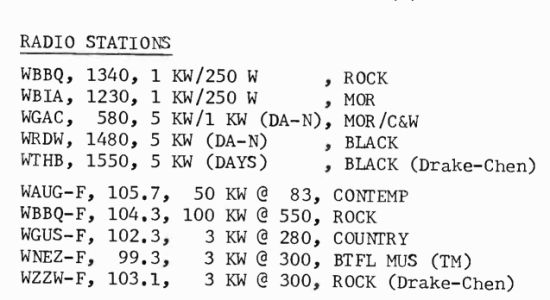
I wonder if it's anything like "beautiful rock" which is what one Augusta GA station was playing according to Broadcasting Yearbook.
What is mellow AOR?
I wonder if it's anything like "beautiful rock" which is what one Augusta GA station was playing according to Broadcasting Yearbook.
Not knowing what Augusta was doing, let me just drop an unscoped aircheck of the pioneer of the "Mellow AOR" format---KNX-FM in Los Angeles, near its peak:
Wikipedia is of no help with the Augusta station. The station I believe is the correct one has no format listed for the time period.

Here's how James Duncan listed the major players in Augusta in 1979... he used standard format definitions for his directories, not self-reported descriptors like Broadcasting Yearbook, so his tend to be the most accurate for the time period. (Rock = CHR/Top 40, Contemp = AC, Adult Top 40)