
• Get involved.
    We want your input!
    Apply for Membership and join the conversations about everything related to broadcasting.

    After we receive your registration, a moderator will review it. After your registration is approved, you will be permitted to post.
    If you use a disposable or false email address, your registration will be rejected.

    After your membership is approved, please take a minute to tell us a little bit about yourself.
    https://www.radiodiscussions.com/forums/introduce-yourself.1088/

    Thanks in advance and have fun!
    RadioDiscussions Administrators

Tower resistance

Here's your technical question of the week
You have an AM uniform cross section tower sitting on a base insulator. All the guy wires are insulated. Across the base is a matching network so that an FM coax can cross the base without loading the tower. In addition, a cable to power the tower lights enters the tower through the middle of the RF feed line and is insulated from the tower all the way up to the lights which are also insulated.

When working properly the tower resistance is about 80 ohms. One day my engineer notes the transmitter is no longer loading properly to the antenna and measures about 200 ohm resistance antenna resistance . He believes the lighting line has shorted to the tower . I suggest he disconnect the lighting line and the FM coax and the AM feed line and measure the tower with them disconnected. It's my contention if the lighting line is bad and the tower is floated above the insulator it should read 80 ohms because the lighting line is floating too.

Am I on track on this one? Thanks in advance.
 
Here's your technical question of the week
You have an AM uniform cross section tower sitting on a base insulator. All the guy wires are insulated. Across the base is a matching network so that an FM coax can cross the base without loading the tower. In addition, a cable to power the tower lights enters the tower through the middle of the RF feed line and is insulated from the tower all the way up to the lights which are also insulated.

When working properly the tower resistance is about 80 ohms. One day my engineer notes the transmitter is no longer loading properly to the antenna and measures about 200 ohm resistance antenna resistance . He believes the lighting line has shorted to the tower . I suggest he disconnect the lighting line and the FM coax and the AM feed line and measure the tower with them disconnected. It's my contention if the lighting line is bad and the tower is floated above the insulator it should read 80 ohms because the lighting line is floating too.

Am I on track on this one? Thanks in advance.
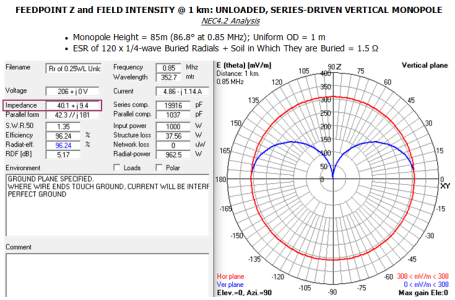
If the isocoupler for the FM or the tower lighting choke was shorted, the impedance should be lower, not higher. I’m suspecting a problem in the AM ATU.
 
Below is a NEC4.2 calculation of a generic, ~1/4-wave, MW tower showing the "natural" feedpoint Z and radiated field at 1 km radius using 1 kW applied power. No attachments to the tower or feed system such as an ATU, FM isocoupler, or tower lighting are included.

The feedpoint Z and field intensity agree well with their predicted, theoretical values when using a (nominal) 1/4-wave tower, for the conditions stated.

This may be helpful here, as a baseline.

Feedpoint Z & Field, 0.25WL Vert Monopole System; Avg Soil.png
 
Last edited:
Thanks for the response I know I can always get an interesting look from all angles here. But I guess I didn't express my question as clearly as I could have. Let me try again. Basically what I'm saying is could the impendence of the tower change that much by a change in the lightening feed line ( it's normally insulated from the tower) such as a short to the tower at some point if the tower impendence is measured on the tower while it is floated (floated meaning all lines disconnected from the tower and the only thing connected to it would be the bridge)?
 
Post some pictures.
The site is three and a half hours away so I can't get them for a few days but thanks. It's a tower sitting on an insulator with all guys insulated (floating) . Nothing is connected to his tower except an impendence bridge. The question is if any existing wires presently on the tower are moved about the tower, but not to ground, will this change the impendence being read while the tower is floating? . I don't think so because these wires are not connected to the ground in any way and are floating just like the tower is floating. Am I wrong?
 
Last edited:
Let me try again. Basically what I'm saying is could the impendence of the tower change that much by a change in the lightening feed line ( it's normally insulated from the tower) such as a short to the tower at some point if the tower impendence is measured on the tower while it is floated (floated meaning all lines disconnected from the tower and the only thing connected to it would be the bridge)?
What's a "lightening feed line"? Are you talking about the tower lighting choke? When you say the only thing connected is a bridge, are you talking about an actual impedance bridge, or an ammeter? Is the bridge a 'hot bridge', or a 'cold bridge'? If it's a hot bridge like a Delta inline bridge, you would usually connect that between the ATU and the TX line coming from the transmitter or phasor. If a cold bridge, that's commonly connected between the tower and ATU for measuring tower resistance and reactance for determining settings of the ATU using an accompanying signal generator. Keep in mind, you'll want the TX line connected to the ATU, because the line itself acts as a transformer/50 ohm termination.
Either way; it's difficult to determine what you're talking about textually via some discussion board. I recommend you consult someone knowledgeable in tuning up AM transmission systems that can teach you what goes where in person with what you're working on. Otherwise, you're just flailing around and likely could make things worse.
 
What's a "lightening feed line"? Are you talking about the tower lighting choke? When you say the only thing connected is a bridge, are you talking about an actual impedance bridge, or an ammeter? Is the bridge a 'hot bridge', or a 'cold bridge'? If it's a hot bridge like a Delta inline bridge, you would usually connect that between the ATU and the TX line coming from the transmitter or phasor. If a cold bridge, that's commonly connected between the tower and ATU for measuring tower resistance and reactance for determining settings of the ATU using an accompanying signal generator. Keep in mind, you'll want the TX line connected to the ATU, because the line itself acts as a transformer/50 ohm termination.
Either way; it's difficult to determine what you're talking about textually via some discussion board. I recommend you consult someone knowledgeable in tuning up AM transmission systems that can teach you what goes where in person with what you're working on. Otherwise, you're just flailing around and likely could make things worse.
In my experience, the best use is to use a cold bridge to measure the tower itself before designing the ATU (or diplekxer/ATU for two or more signals on the same tower) and then use the operating impedance bridge on the ATU input(s). Generally, the cold bridge is only used once when the tower is built and then, later, if there is a major change such as replacing the ground system, adding any side-mounted non-AM antennas, etc.

I agree that the OIB needs to have the transmission line and transmitter hooked up to work accurately and then done best with open, un-modulated carrier. Trying to do that with modulation is not a good idea.

I have seen cases where bad connections affected the tower resistance and reactance. A cold solder connection, corroded bolts and connection components and even had to spot lightning damage to coils or caps in the ATU can mess everything up.

I had one difficult case with a tiny contamination inside a vacuum cap that made it temperature sensitive, going crazy on warm afternoons. In other words, sometimes if you hear hoof beats, it really is a zebra.

Also had a case where varmints had been digging and gnawed on the coax... very hard to spot unless you do an above-ground run of temporary coax to try to find the problem... costly if you are over 1 kw, too.
 
Last edited:
I have seen cases where bad connections affected the tower resistance and reactance. A cold solder connection, corroded bolts and connection components and even had to spot lightning damage to coils or caps in the ATU can mess everything up.
I've seen even crazier where the tower is effectively changing length with wind coming from a particular direction. In this example; I determined the tower sections had been painted before being erected, leaving paint on both sides of the attachment flanges. Over time, two things occurred: the paint chipped away causing the section bolts to loosen. As the temperatures changed and wind wiggled the tower, there were intermittent connections all over the tower, making the electrical length and impedance move suddenly, then back to normal. It took me climbing the tower and inspecting all the joints to determine what was going on.
 
I've seen even crazier where the tower is effectively changing length with wind coming from a particular direction. In this example; I determined the tower sections had been painted before being erected, leaving paint on both sides of the attachment flanges. Over time, two things occurred: the paint chipped away causing the section bolts to loosen. As the temperatures changed and wind wiggled the tower, there were intermittent connections all over the tower, making the electrical length and impedance move suddenly, then back to normal. It took me climbing the tower and inspecting all the joints to determine what was going on.
/Disgusting on

I had a tower guy who had a solution for that kind of problem with aluminum towers which were locally used up to about 250 feet. He'd drink a lot of "water" (funny, the bottle said "Pilsner") and climb the tower, taking a leak at every section's bolted unions. The bolts were galvanized.

When he got down, the tower was stable for a year or more.

/Disgusting off
 
The old KBOI 4 tower array would change some when it rained.
When 3 of the old towers were dropped (5 new ones went up) the flange welds were nothing more than cups where the upper section sat in it.
Towers just fell apart as they came down.
 
You say your engineer measured the tower and found it to be 200 ohms rather than 80. I assume thats the REAL part of the base impedance. I would expect a change in reactance as well but your comments do not mention this.

You mention a network to get the FM line across the base gap. Is this a simple coax coil or are there other components involved which would not be part of the simple AM atu were it not for the presence of the FM?. A CLOSE scrutiny of those components, whatever they are, is strongly indicated.

An INCREASE in base resistance is highly unusual. Generally lighting or wind damage will cause some form of a shunt change lowering base resistance if there are other appurtenanances on a tower.

HOWEVER i am assuming your engineer measured the tower AT THE TOWER AFTER THE ATU. If a series blocking cap on the output of an ATU gets lit up by too big a strike, it can change value drastically and go UP in complex impedance. If you measure the ATU INPUT you'll see this effect. I almost always check Caps in an ATU when something changes and nothing is obvious (like a severely compressed coil.)

If all else fails, divide and conquer. Disconnnect EVERYTHING that goes across the base and measure the tower,and then start reconnecting stuff (fm coax, lighting, STL lines, and optionally any aboriginal flora which has grown up across the base) and see which is the offender.

Also, regarding bridges: the above comments on use of bridges is quite valid. I would add this: Hot Bridges ( e.g. Delta OIB's) have a minor insertion effect since they are subtituted in line. Cold Bridges (GR 916/1606 or W/K 500/600's) avoid this although generally the effect is slight. However, when I make an INITIAL measurement on a tower for license filing purposes, or a measurement for a change to be filed I prefer a GR 1606 (above 600 khz) or a 916 (below 600khz). If a tower has "shifted" significantly from a licensed value I go with the GR and a synthesizer for troubleshooting first. (The 1606 bridge transformer has lower loss above 600khz, hence the choice versus frequency).
 
AN FYI;

for those who would question my choice of GR bridge versus frequency I refer you to the article announcing the introduction of the GR 1606 bridge in the June 1955 GR "Experimenter " available at the IET labs website. They give some exposition on the transformers and include a graph which compares same.

not be be argumentative but informative
 
Status
This thread has been closed due to inactivity. You can create a new thread to discuss this topic.


Back
Top Bottom