• Get involved.
    We want your input!
    Apply for Membership and join the conversations about everything related to broadcasting.

    After we receive your registration, a moderator will review it. After your registration is approved, you will be permitted to post.
    If you use a disposable or false email address, your registration will be rejected.

    After your membership is approved, please take a minute to tell us a little bit about yourself.
    https://www.radiodiscussions.com/forums/introduce-yourself.1088/

    Thanks in advance and have fun!
    RadioDiscussions Administrators

Trump to PBS and NPR: I’m cutting you off…

NPR doesn't need to reorganize or be reborn. It has millions in private funding. This defunding was of local stations, many of which are owned by red state governments. If the goal of the republican party is to get government out of broadcasting, how do states such as Oklahoma, Nebraska, West Virginia, Kentucky, Georgia, Louisiana, South Carolina and more justify their ownership and full funding of public media in their states?

In the case of many, if not all, of these states, the networks were originally intended to deliver in-school video instruction during the school day, something which AFAIK is very rare nowadays. I am old enough to remember the big, institutional black-and-white sets up on tall carts, and I was expert enough even at that age to adjust the loop or bowtie antenna, tune to the UHF channel using those old continuous knobs (not always easy), and so on. That was always my job.

In-class video can be a useful tool even today. I have homeschooled my son for the past seven years (we are within days of completing the high school curriculum), and quite often, I have found YouTube videos very helpful in delivering instruction and resources far more easily than I can do it myself. It's especially useful for such things as classical symphonies for music class, math lessons, and so on. You didn't have video on-demand in those days, no, the teacher got the weekly schedule in the mail and used it as desired.
 
In the case of many, if not all, of these states, the networks were originally intended to deliver in-school video instruction during the school day, something which AFAIK is very rare nowadays.

I agree. Most if not all of those stations have refocused on becoming standard NPR & PBS affiliates. They still do a lot of local news, but the in-school programming has been disbanded. In fact all this changed over 30 years ago. However, some of these stations are still owned by local school boards, WABE Atlanta GA and WLRN Miami are two examples. These stations had millions of dollars in federal funding cut. The programming they do is seen as educational and informational, not political.
 
In the case of many, if not all, of these states, the networks were originally intended to deliver in-school video instruction during the school day, something which AFAIK is very rare nowadays. I am old enough to remember the big, institutional black-and-white sets up on tall carts, and I was expert enough even at that age to adjust the loop or bowtie antenna, tune to the UHF channel using those old continuous knobs (not always easy), and so on. That was always my job.

In the Boston area, we in the public schools watched WGBH on Channel 2, but at the same time, the Archdiocese of Boston operated WIHS on Channel 38 with educational programming presented by nuns, which, I'd imagine, was watched by the parochial school kids. With my fine tuning skills, honed as a shortwave listener from the age of 9, I'd have been a rock star in a Catholic school classroom!
 
There's even talk the NPR styled format may work as a commercial format.
There are a multitude of reasons why this wouldn't work.

Firstly, let's look at (mostly) conservative issues oriented commercial talk radio. Do they dare criticize who sponsors them? That format literally got taken over by where the money was (MAGA) and sidelined others who disagreed. Same with Fox News. Why would the dynamic be any different with an advertiser supported version of NPR styled talk?

KIRO in Seattle tried to "smarten" their tone about a decade and some change ago. They changed the presentation of the morning news, updated the bumper music to sound more like the selections you'd hear on KEXP, and allowed left-leaning hosts, developed a show called TBTL, had local shows on music, cooking, gardening and even pets.

Now TBTL is a successful podcast, the anchor of that morning news show is a KUOW contributor, and the talk lineup tries to "moderate" by not "offending" the audience the majority of their market isn't a part of, from sheer voting numbers. Because what makes great talk radio is, of course, being very concerned about not "offending" people who disagree with the hosts.

Commercial radio (and I do love and listen to all forms of radio) is not set up for an NPR styled product. The majority of the commercial radio sector is not in the frame of mind to create it, it would take too much time to grow to fit an iHeart's budget, the potential sponsors would water it down or affect what was covered, and above all, they can't afford it and wouldn't staff it properly.

I had hopes for BIN, an iHeart project. I've listened. It's not a stellar product, to be candid. It's not moving the needle in most markets. I have no reason to think Audacity or iHeart would culturally understand or be willing to sustain some form of "commercial" "NPR" and you'd also be working from a point of audience skepticism.

Sure, dismiss NPR listeners as a bunch of "liberals" all one likes but at the core, it isn't just politics. It's presentation. It's cultural. And it's also why someone like my elderly father, who at times found Rush Limbaugh too "liberal" on certain things, listened to All Things Considered on his commutes through his career, and still trusts the PBS News Hour. It was because of the presentation. It was because there was actual journalism and a tone that, even if you thought you detected a "leaning" you could still take seriously and have some trust in the facts of the reporting.

Commercial media for the most part, apart from the local news departments that some stations like KFI, KIRO, and WWL still retain, gave up on that. And even the ones that retain it are very constrained by the clock. Like AAA, classical, and jazz, commercial radio is rarely suited to handle those formats anymore because of two things - culture and cost.

Public radio has managed to build something that keeps people engaged with radio on air and on line. Their audience (despite the culture war cartoon depictions of them) are educated, engaged adults who actually care about their communities, current events and culture. Many of these listeners are incredibly passionate about their stations, regardless of income.

Radio is not in a situation where we can afford to, or should be okay with, losing those people. And we won't preserve that type of radio or retain that audience by attempting to drag it back into another model of broadcasting that's economically challenged (and arguably in decline) and not a cultural fit for what public radio needs to be doing to fulfill its mission.

 
There's even talk the NPR styled format may work as a commercial format.

What are you talking about? Have you ever listened to America In The Morning? That is commercial radio's version of Morning Edition. It's been on the radio for over 35 years. This Morning With Gordon Deal is another. The thing they have in common is they don't have loud obnoxious hosts who promote political conspiracy theories. Not very popular on commercial radio. But they exist.

The sad thing is commercial radio is in financial trouble. Advertisers are cutting back, and that means less money for programming. Now that problem has arrived at public radio. But the solution isn't to become like commercial radio. 20 minute spot breaks, VT hosts, limited playlists, and bankrupt owners. That's really not the model anyone wants to copy.
 
I was referring to articles I have seen where a magazine or two has looked at the format on commercial radio. As far as I know America In The Morning and Morning wih Gordon Deal is not a 24/7 format. I do assume from your hyperbole, they have two or three 20 minute stop sets an hour since they're on commercial radio. If only they could do 4 but alas, they haven't the time.
 
Last edited:
So, these are 24/7 formats? I thought these were syndicated programs.

Again, what are you talking about? NPR is not a 24/7 format. It never has been. NPR produces two syndicated news programs: Morning Edition and All Things Considered. They also do weekend versions of them. It also distributes a couple of locally produced talk shows.

NPR has at least two competitors in the public radio programming business. One is American Public Media. The other is PRX. A lot of the programming people hear on local public stations come from those two companies. They all once received funding from CPB.

The public radio satellite radio distribution system is owned by the stations and funded by a grant from CPB. That will need to be addressed at some point.

I doubt anyone will attempt to do a 24/7 commercial version of what's heard on public radio. There isn't much program development money right now. It's all aimed at podcasting and streaming.

I do assume from your hyperbole, they have two or three 20 minute stop sets an hour since they're on commercial radio. If only they could do 4 but alas, they haven't the time.

They have the standard syndicated commercial spotload. If you have a link to the articles you referenced, I'd appreciate it. The commercial companies that do 24/7 formats have been cutting back quite a bit. Maybe you can be more specific.
 
Last edited:
Again, what are you talking about?

I think -- as convoluted as this discussion has become, with practically everyone talking in shorthand instead of completely saying what they mean, which is leading to misinterpretation, (which gives me a headache in trying to sort out), I cannot say definitively -- he means that he interpreted your next-to-last post as saying those two syndicated programs (which he already identified as such, so he took it as a correction) were actually part of a 24/7 syndicated format.

I (again) think the confusion came because he had identified them as what they are, but when you brought them up again in context it became muddled.

This has become WAY too complicated a discussion.

Here are the facts:
CPB has been defunded, by someone (see thread title so I don't have to use his name) who mistakenly equates them with NPR and PBS, both of which he personally hates. Not a rational move, but look who we're talking about.
Public radio is going to be the hardest hit by this, because CPB funding made up huge chunks of their operating budgets. NPR (the actual target) will be indirectly affected by the result because their money has come from those stations.
There are formats that have a home only on public radio, because they are not commercially viable. Until this crisis, we accepted that as a fact ... and it is. But if a station's budget is cut, those unique formats and programs are in danger. It's not just news/talk (which seems to be what this has devolved to) but also music programming which may not be able to continue because the licensing fees were managed by CPB. Two examples I can think of locally here in SoCal are KKJZ in Long Beach, which programs Jazz, and KCSN in Northridge, which has a AAA format. Neither of those are going to find a home on commercial radio. Both are in danger of extinction.

So discussing political orientation of news/talk between commercial and non-commercial stations is, at best, a distraction from the real issue.

I say this in hopes of getting us back on the main track, because this siding has gone on too long.
 
I'm familiar with NPR and APM. The NPR format I describe is flanked with NPR drive time programming and pretty much a small number of other progrms tht prety much fill out a lineup until around 10:06pm (following the hourly NPR News at :01). There's typically a daytime locally originated program in there. That's the NPR format I'm describing: what might be called News/Talk. In other words, duplicate the same style programming for commercial radio. The print articles I read discussed this. I think the programming is worth considering but you'd need an owner that isn't looking for a 12 month payback.
 
The NPR format I describe is flanked with NPR drive time programming and pretty much a small number of other progrms tht prety much fill out a lineup until around 10:06pm (following the hourly NPR News at :01).

Okay, point of clarification. NPR is not a format. It is a programming supplier to public radio. If you continue to misidentify it, we are never going to get out of this endless loop.

And that, more than anything else other than over-politicizing, is a good thread-killer.
 
The print articles I read discussed this. I think the programming is worth considering but you'd need an owner that isn't looking for a 12 month payback.

Once again, please post links or quotes. Anything specific. I can't respond to generalities. I'm pretty familiar with all the major national syndicators. None are looking to expand their news programming to 24/7. Everyone seems to be abandoning 24/7 linear radio programming now. If you have specifics, let me know. America In the Morning and Gordon Deal are the only ones I know about. I'm sure stations would love free barter content.
 
It has been some time since I came across the articles, perhaps 2 or 3 years ago. I doubt commercial big boys would consider this but a well funded, long haul smaller company might. Radio Ink was one, I think.
 
It has been some time since I came across the articles, perhaps 2 or 3 years ago. I doubt commercial big boys would consider this but a well funded, long haul smaller company might. Radio Ink was one, I think.

Two or three years ago is an eternity in this business.

And I can't see some "smaller company", no matter how well-funded, to become the white knight in this scenario.
 
In the case of many, if not all, of these states, the networks were originally intended to deliver in-school video instruction during the school day, something which AFAIK is very rare nowadays. I am old enough to remember the big, institutional black-and-white sets up on tall carts, and I was expert enough even at that age to adjust the loop or bowtie antenna, tune to the UHF channel using those old continuous knobs (not always easy), and so on. That was always my job.

In-class video can be a useful tool even today. I have homeschooled my son for the past seven years (we are within days of completing the high school curriculum), and quite often, I have found YouTube videos very helpful in delivering instruction and resources far more easily than I can do it myself. It's especially useful for such things as classical symphonies for music class, math lessons, and so on. You didn't have video on-demand in those days, no, the teacher got the weekly schedule in the mail and used it as desired.
My school would use Sesame Street and Square One Television as a part of the daily schedule then (and i'm talking about a primary school, ca 1990). I am old enough to remember the big, institutional color sets up on tall carts so that we could watch Sesame Street and Square One Television then. i could see the Archive of Public broadcasting adding Square One Television to use as a teaching tool for math classes (which is what we did in 1990-91.)
 
It's not going to be long at this rate before we all start sounding like North Korean State Radio if this industry doesn't start getting serious and bringing it home to listeners of what this regi-er, administration is doing to this industry.

Oh, the shareholders are going to be nervous about that? Would they like a stock market at all??

I mean, we still have 3 1/2 more years to go of this guy. And already, look what's happened.....
 
I remember when PBS affiliates were more known for educational content and got their Telecourse programming from Annenberg Learner. This was how some cities and counties were permitted to get OTA licenses back then under educational foundations. I don't know for sure how many local PBS affiliates will shut down in response to the CPB shutdown. But in some places these were secondary PBS stations like KCSM-TV San Mateo (Now KPJK-TV Santa Rosa) they were known for airing instructional programming. The College of San Mateo sold KCSM-TV to Northern California Public Media (Owners of KRCB-TV and KRCB-FM Santa Rosa) because of budget issues College of San Mateo had at the time of sale and that the majority of Public Media Audiences in the San Francisco Bay Area donate to KQED Public Media the primary PBS and NPR affiliate in the Bay Area.
 
But in some places these were secondary PBS stations like KCSM-TV San Mateo (Now KPJK-TV Santa Rosa) they were known for airing instructional programming. The College of San Mateo sold KCSM-TV to Northern California Public Media (Owners of KRCB-TV and KRCB-FM Santa Rosa) because of budget issues College of San Mateo had at the time of sale and that the majority of Public Media Audiences in the San Francisco Bay Area donate to KQED Public Media the primary PBS and NPR affiliate in the Bay Area.

There was more to it than that, as I know from updating an article at the UHF History site where KCSM-TV had been part of the timeline of the station I had written about.

However, whatever the reason(s) were for the sale, the key point is indeed that many public television stations exist because of the need for instructional programming. If I may take Los Angeles as a good example (not just because I live here but because I believe it helps to make your point):

Our first non-commercial public television station predates not only CPB but PBS. KCET/28 went on the air in September 1964 and did broadcast what was then called "in school" programming in the mornings and early afternoons. Four years later, they applied for the second "educational" channel, at one point negotiating with the Los Angeles Unified School District to channel share by moving the daytime programming to the new station -- at the time, the District had not only used KCET but also leased time on the commercial VHF independents (notably KCOP/13) --but programming evening hours themselves.

The negotiations were unsuccessful, KCET then dropped out, the third applicant was given a new allocation on channel 68, and the District signed on KLCS/58 in November 1973*, with a secondary PBS affiliation to cover the hours when school was not in session. (Even today, what little PBS programming they carry airs at different times than on the now-primary PBS affiliate, KOCE/50.)

[*-Yes, it was a comparative hearing that lasted four years.]

Right now, the daytime schedule is filled with programming from PBS Kids and other kid-friendly science series, but when school is in session, KLCS schedules live programming in the late afternoons under the banner "Homework Hotline", concentrating on a single subject per hour, rotating among the basics, with a credentialed educator responding to student questions.

I don't know if losing CPB funding completely dooms KLCS, but being owned by LAUSD, it's probably in the District's overall budget and I worry that the daytime programming will be adversely affected. Absent that true service to the community, what reason will they have to not either sell channel 58 to a non-profit or take it permanently dark?
 
Interesting thread, both the main and the side issues. My thoughts on the subject, given what I know and conjecture:

1) Public television will take the largest hit, and that hit will be felt before the changes to public radio will be felt. As TheBigA pointed out in another thread, the producers of public TV got their money directly from CPB, and it's going to be very difficult for them to find other sources.

2) Putting together shows with audio and video is much more expensive than putting on shows with just audio. When the money isn't there for the video, the betting is that the public shows that rely on that will be gone pretty quickly.

3) Public radio stations with primarily music formats will likely be the first casualties on the radio, though the casualty probably won't be to the over-the-air signals, at least not immediately. CPB had been paying the music stations' SoundExchange fees so they could simulcast their over-the-air and HD signals on the Internet. With CPB gone, the question will be if there is enough funding from other sources to pay for the streaming fees. Right now, my best guess is no, meaning that one should see music-only and primarily music-only public stations stop their streaming efforts during the fall of this year.

4) The news-and-talk stations are likely to have the most survival legs, though even they are not completely out of the woods. Public radio stations paying local reporters to cover state and local politics may now be in jeopardy because of the loss of CPB funding.

This brings me to the posts where B-Turner was talking about a "public radio format". While Radiolocator, Tunein, and some other webcasting sites use the term, the fact is that there is really no one public radio format. In Phoenix, for example, KJZZ, though listed as having a public radio format because of its NPR and other affiliations, can actually programming could really be described as being mostly news/talk from NPR, the BBC, and other sources with a few musical interludes (actually the station only has one now, the locally-produced "Low-Down Blues," with Bob Koridor (and I'm probably misspelling his last name) that airs on Sunday nights.

The real threat to everything right now is the economy and with the current POTUS firing the Board of Labor's head because of a bad report Friday, businesses and others who rely on those economic numbers are concerned about administration involvement in future report releases. But it's what actually happens to that economy that may well determine the ultimate fate of public radio!
 
Depends on the market. The support in Boston is very good. Like commercial stations, public stations have combined their memberships so that the news station helps support the classical. The real direction for all of this is online, so the broadcast stations are part of an overall package.


Once again, depends on the market. WXPN Philadelphia is a ratings and funding powerhouse. Their World Cafe syndicated show is heard on over a hundred stations. In Seattle, KEXP gets great ratings, often beating most of the commercial stations in the market in key demos. The format fits the image public radio wants of attracting college-educated listeners. The non-coms in Boston have made the rock format unviable for any commercial outlet. Same with WFUV in New York. All of these stations contribute to the viability of broadcast radio as a platform, employ citizens who pay taxes and contribute to the artistic community. If the goal of the rescission was to damage NPR, it was not successful. It will instead mobilize a broad range of educated people who feel that the music they love has been attacked.


NPR doesn't need to reorganize or be reborn. It has millions in private funding. This defunding was of local stations, many of which are owned by red state governments. If the goal of the republican party is to get government out of broadcasting, how do states such as Oklahoma, Nebraska, West Virginia, Kentucky, Georgia, Louisiana, South Carolina and more justify their ownership and full funding of public media in their states? The states obviously don't share the views of the president on this subject. It's why they supported federal funding for almost 60 years: To provide money for state government owned media. They will now be faced with multi-million dollar funding gaps that will hurt their ability to provide other services to their citizens. These states are going to find a way to return federal funding in some way.


The point is the government is still in media, spending taxpayer money on radio & TV. If the goal was to get the federal government out of media, it didn't. If spending taxpayer money on radio & TV is waste, fraud, and abuse, then so are these DHS spots.
In your whole post you name the rare exceptions to the decline of specific formats as evidence. Good for those stations; they found an audience and a purpose. Most in those formats did not.

The Federal Government is getting out of broadcasting, period. Your attempt to claim that they are still involved because they buy paid ads on radio and TV makes no sense:

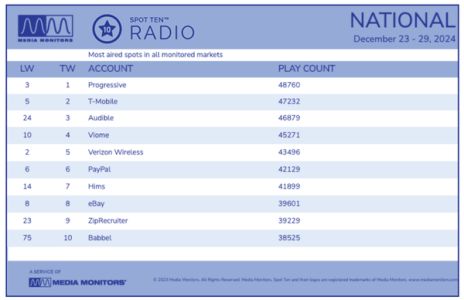
1754350515499.png

These are last year December's biggest buyers of radio advertising. Are they "station owners" too? All that the INS and many other federal agencies do is buy ads, generally through an ad agency. Buying ads does not imply ownership.


Back
Top Bottom