• Get involved.
    We want your input!
    Apply for Membership and join the conversations about everything related to broadcasting.

    After we receive your registration, a moderator will review it. After your registration is approved, you will be permitted to post.
    If you use a disposable or false email address, your registration will be rejected.

    After your membership is approved, please take a minute to tell us a little bit about yourself.
    https://www.radiodiscussions.com/forums/introduce-yourself.1088/

    Thanks in advance and have fun!
    RadioDiscussions Administrators

TV Guide editions and online resources

The history of Australian TV is fascinating. It's the only major country I can think of where commercial and government TV were both created simultaneously - at the dawn of TV there in 1956, the biggest cities each had two commercial operators and ABC.

The modern Seven, Nine and Ten networks accreted gradually, starting with informal connections between the big-city commercial stations and eventually adding affiliations with smaller independent stations around the country.

In the last 25 years or so, it's turned into a mirror of Canada: each of the commercial networks ended up owning its stations in the big cities (Sydney, Melbourne, Adelaide, Perth) and in some cases the rural affiliates as well, so most of the old local brandings went away and everything is "Seven Darwin" or "Nine Canberra." There's local news in the big cities and not much else local left out there.

And the channel assignments are strange, too - there was the old channel 0 (which largely got moved to 10), plus the weirdness of channel 5A.

It's still a little unusual on a global level in that a lot of the DTV transmitters are on high-VHF (which starts on channel 6 there) instead of being exclusively UHF.

I'd love to do some tower hunting there!

I'm assuming that with the advent of digital, the affiliates of the respective "number networks" have PSIP mapping to the appropriate channel number, such that all Seven affiliates, regardless of OTA channel, show up as PSIP 7, Nine as PSIP 9, and so on. Is that the case?

I'm also assuming that they do have PSIP in Australia.
 
I'm assuming that with the advent of digital, the affiliates of the respective "number networks" have PSIP mapping to the appropriate channel number, such that all Seven affiliates, regardless of OTA channel, show up as PSIP 7, Nine as PSIP 9, and so on. Is that the case?

I'm also assuming that they do have PSIP in Australia.
Sort of - it's a different kind of virtual channel setup in which each broadcaster has a block of channel numbers it uses.

So yes, Seven usually shows up as 7, but it also has a block of channels in the 70s that includes the HD version of the main channel as well as what we'd call "subchannels" on 70, 71, 72 etc.

Same with Nine on 9 and 90-99 and so on.

There's a decent list here:

 
Sort of - it's a different kind of virtual channel setup in which each broadcaster has a block of channel numbers it uses.

So yes, Seven usually shows up as 7, but it also has a block of channels in the 70s that includes the HD version of the main channel as well as what we'd call "subchannels" on 70, 71, 72 etc.

Same with Nine on 9 and 90-99 and so on.

There's a decent list here:

Makes sense. I wouldn't have thought of that kind of arrangement.
 
In the last 25 years or so, it's turned into a mirror of Canada: each of the commercial networks ended up owning its stations in the big cities (Sydney, Melbourne, Adelaide, Perth) and in some cases the rural affiliates as well, so most of the old local brandings went away and everything is "Seven Darwin" or "Nine Canberra." There's local news in the big cities and not much else local left out there.7

The remaining local news output is usually centralized in hubs. For instance, most of WIN Television's "regional" (non-metropolitan) local newscasts are pre-recorded at WIN's Wollongong facilities. Only reporters and camera crews remain based in the local markets.

It's still a little unusual on a global level in that a lot of the DTV transmitters are on high-VHF (which starts on channel 6 there) instead of being exclusively UHF.

In part because the regulator was determined to protect the vested TV interests, UHF only came to Australia in the 1980s and even then on a limited basis. When multiethnic SBS Television launched, this film explained how viewers could tune into the new band:

 
Last edited:
On a vaguely related note from the other side of the globe: In the 1980s and early '90s, the Independent Broadcasting Authority in the UK would regularly air IBA Engineering Announcements, first on ITV and later on Channel 4. The segment, about ten minutes in length, informed professional and general audiences about new transmitters, frequency allocations, radio stations, broadcasting technologies, etc. Sometimes, questions from the public were answered on the segment.

Here's a sample broadcast from 1990:

 
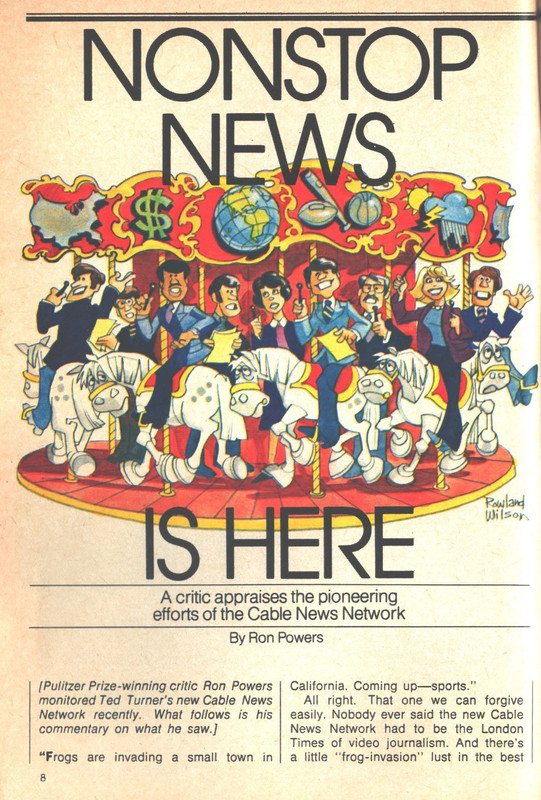
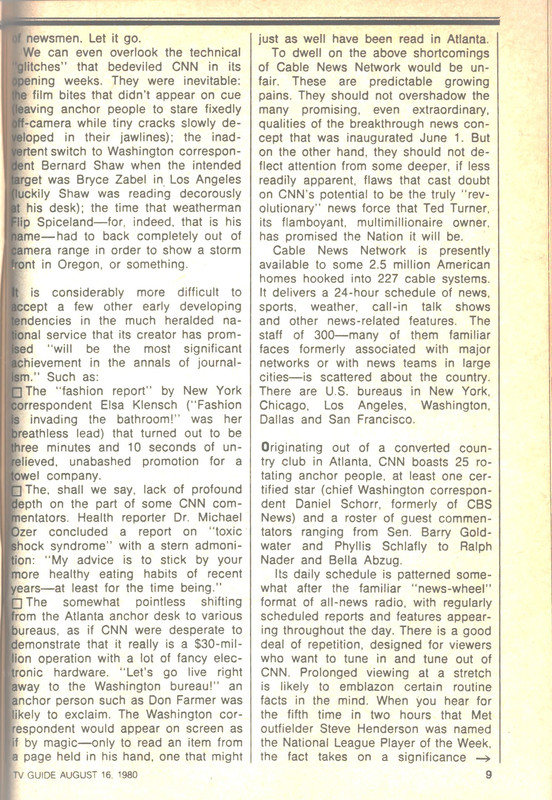
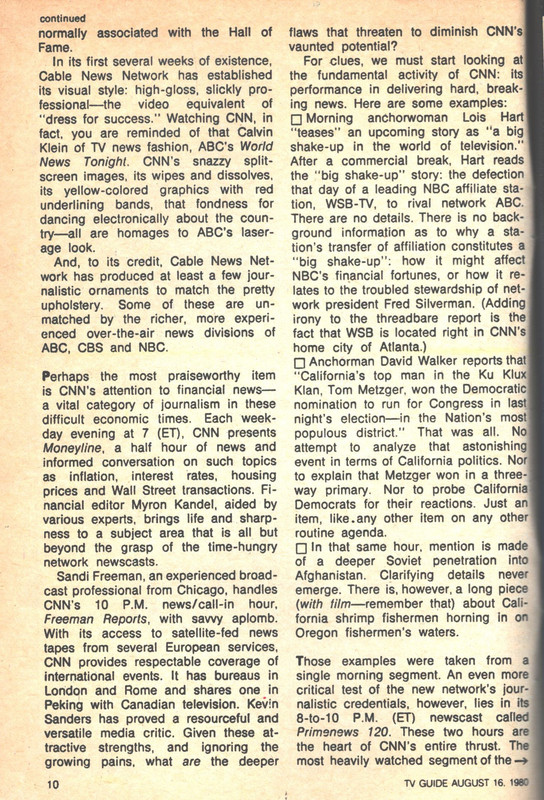
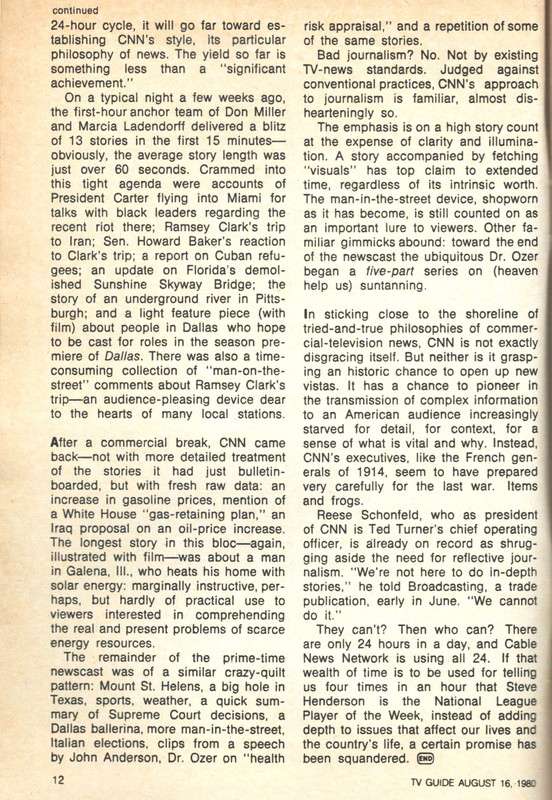
In a 1980 edition of TV Guide I happen to own, media critic Ron Powers takes a look at a brand new cable channel--CNN:


From CNN's second hour on the air, a tour of the channel's facilities:

Behind the Scenes of CNN, June 1; 1980

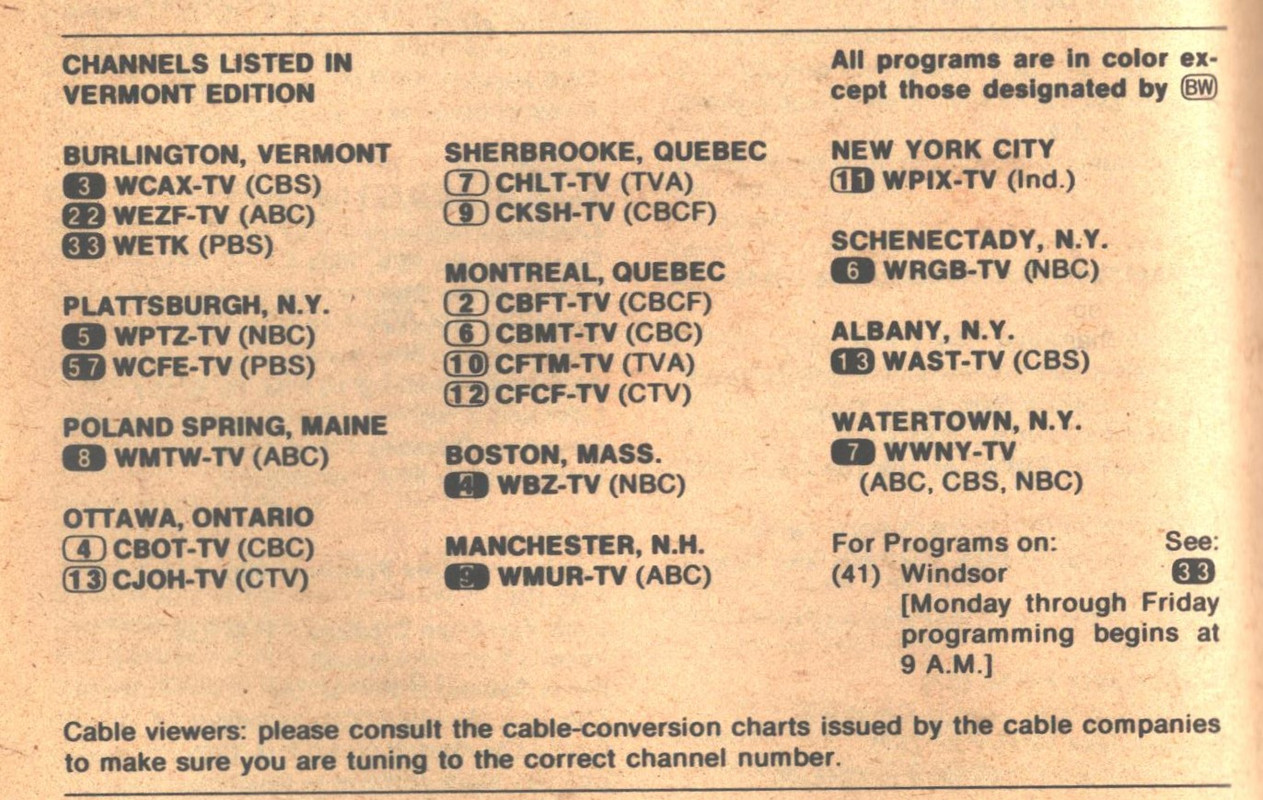
By the way, the TV Guide I scanned above is a Vermont edition. Here's the channel lineup:


I find it interesting that CJOH was listed under its Ottawa channel number when most people in Vermont who could watch it OTA likely did so via the channel 8 Cornwall signal. Did CBOT have any cable carriage in Vermont? I know CJOH did.
 
I find it interesting that CJOH was listed under its Ottawa channel number when most people in Vermont who could watch it OTA likely did so via the channel 8 Cornwall signal. Did CBOT have any cable carriage in Vermont? I know CJOH did.
The Vermont edition was distributed into northern NY as well, and that's why the Ottawa stations are in there. If you were in Massena or Potsdam, you got the Burlington/Plattsburgh stations, Ottawa, WWNY from Watertown and not much else. CJOH from Cornwall didn't have any significant OTA reach into Vermont itself because WMTW had such a monster of a signal on 8.
 
I'd love to do some tower hunting there!
I´ll contribute the first Benjamin Franklin to your trip! I'd love to see towers of some of the early commercial stations like 2SM and 3KZed.
 
The Vermont edition was distributed into northern NY as well, and that's why the Ottawa stations are in there. If you were in Massena or Potsdam, you got the Burlington/Plattsburgh stations, Ottawa, WWNY from Watertown and not much else. CJOH from Cornwall didn't have any significant OTA reach into Vermont itself because WMTW had such a monster of a signal on 8.

I wonder why WBZ was the only Boston station listed. Wouldn't Vermont viewers who could receive WBZ (presumably in the southeastern corner of the state) also be able to receive the other Boston VHFs?
 
I wonder why WBZ was the only Boston station listed. Wouldn't Vermont viewers who could receive WBZ (presumably in the southeastern corner of the state) also be able to receive the other Boston VHFs?
Boston to southeastern Vermont is quite a schlep, and not over the best terrain. I'm assuming that WBZ was made available on cable to the exclusion of other Boston stations, possibly for legacy reasons.

Reminds me a bit of how WKYT is carried in portions of northeastern Kentucky while the other Lexington stations aren't. That terrain, too, is unforgiving.
 
The Vermont edition was distributed into northern NY as well, and that's why the Ottawa stations are in there. If you were in Massena or Potsdam, you got the Burlington/Plattsburgh stations, Ottawa, WWNY from Watertown and not much else. CJOH from Cornwall didn't have any significant OTA reach into Vermont itself because WMTW had such a monster of a signal on 8.
WMTW covered over half of New England, as well as much of the more heavily populated part of Quebec. It functioned as the default ABC affiliate for a huge area, similar to WLOS Asheville which had similar coverage due to sheer height (Mt Washington and Mt Pisgah respectively). Neither station had an especially tall tower, they were just up on top of very high mountains. WLOS got all the way from southeastern Kentucky (carried on translators as far north as Corbin and London) down to the edge of the Columbia market and the outskirts of Charlotte.

I can't imagine WLOS's signal was all that good by the time it reached London KY, but in those times, and in those parts, viewers tended to be very forgiving of a suboptimal picture.
 
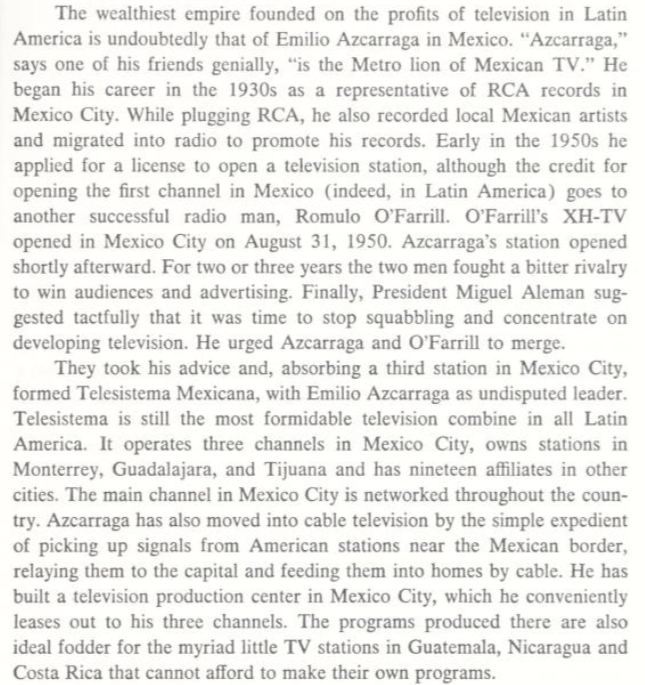
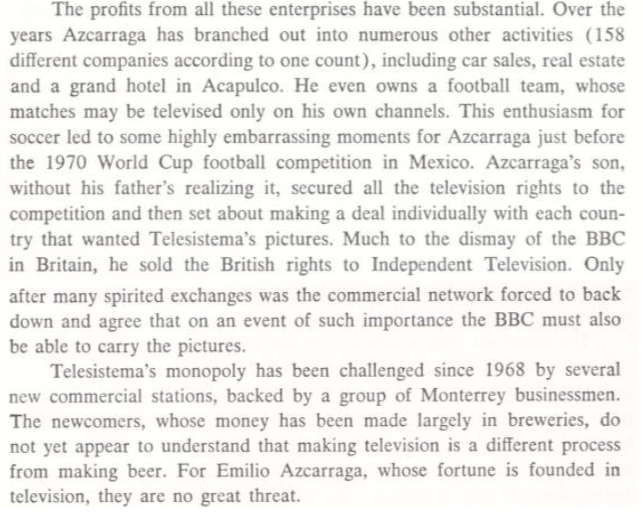
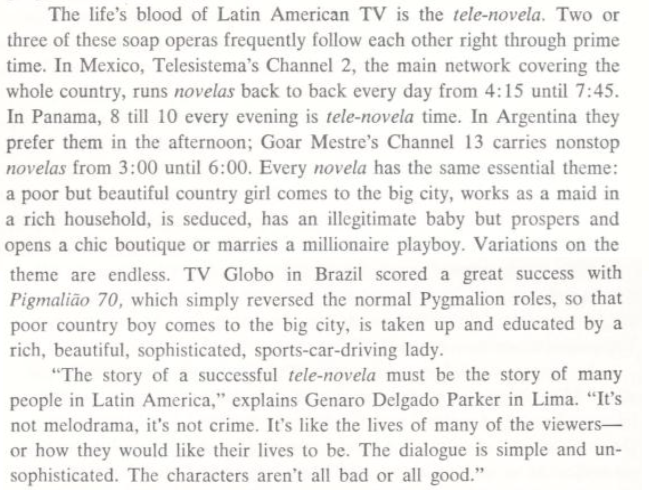
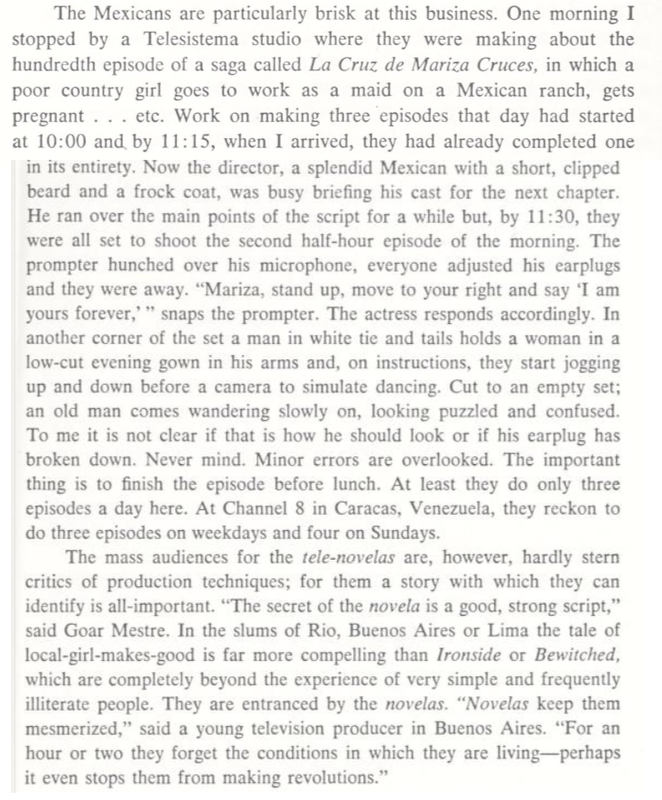
Here are some extracts about Mexican TV from Timothy Green's aforementioned 1972 book about television around the world:


As a kind of side note, are the major US TV networks still carried on cable in Mexico City? I haven't been able to find out anything one way or the other. And would they be the RGV stations (nearest ones), or larger stations via satellite, such as New York or Miami? Providing RGV stations using microwave would seem kind of primitive in 2024.
 
Boston to southeastern Vermont is quite a schlep, and not over the best terrain. I'm assuming that WBZ was made available on cable to the exclusion of other Boston stations, possibly for legacy reasons.

Reminds me a bit of how WKYT is carried in portions of northeastern Kentucky while the other Lexington stations aren't. That terrain, too, is unforgiving.

In the TV Factbook, WBZ usually had a 25-49% coverage in Caledonia County in northeast Vermont while the only other Bostons to occasionally show up in coverage data for Caledonia County were WSBK and possibly WLVI. NBC in that area tended to be a sloppy mix of WBZ, WPTZ, and WCSH, much different than the dominant CBS (WCAX) and ABC (WMTW) affiliates in that area.

Speaking of WCAX, it was also the de facto CBS affiliate for northern New Hampshire in the 70s and 80s as both Boston and Portland had very weak CBS affiliates.
 
How did advertising in TV Guide work? I recall as a kid, I lived in the Chicago suburbs and had a subscription to TV Guide, but one time, for some reason, instead of getting the Chicago edition I got a TV guide mailed and it contained stations from the Quad Cities, Quincy, IL and I think at least one more market. I recall this as there was a big ad for "Laverne and Shirley" and the ad had three channel numbers in it. It was listed as something like ABC-TV and the three channel numbers, no call signs or anything else.

Now I would assume, though I could be wrong, something like that would be ABC network just taking out a national ad for "Laverne and Shirley" and then TV Guide simply inserting channel numbers, which would be a lot easier than call letters.

I know in the Chicago editions, they ran a lot of local ads, so any information about how TV Guide worked advertising by TV stations would be interesting to me.
 
How did advertising in TV Guide work? I recall as a kid, I lived in the Chicago suburbs and had a subscription to TV Guide, but one time, for some reason, instead of getting the Chicago edition I got a TV guide mailed and it contained stations from the Quad Cities, Quincy, IL and I think at least one more market. I recall this as there was a big ad for "Laverne and Shirley" and the ad had three channel numbers in it. It was listed as something like ABC-TV and the three channel numbers, no call signs or anything else.

Now I would assume, though I could be wrong, something like that would be ABC network just taking out a national ad for "Laverne and Shirley" and then TV Guide simply inserting channel numbers, which would be a lot easier than call letters.

I know in the Chicago editions, they ran a lot of local ads, so any information about how TV Guide worked advertising by TV stations would be interesting to me.
Just guessing, I would say that it was exactly like that, the networks taking out national ad space, and each local edition inserting the appropriate channel numbers. I have seen, from time to time, only in-market stations being listed that way, or for some reasons, some out-of-market stations being included but not others (included in the listings for those programs, but not included in the ads). Don't know what was up with the latter.

If I'm understanding the situation correctly, stations could place their own ads in TVG (some of those ads were painfully primitive, evidently created in-house by whomever they could get to make them, with predictable results), in exchange for running commercials for TVG during local programming. One time in West Virginia, I was watching WTAP Parkersburg, and they ran the same TVG ad over... and over... and over, like it was caught in a loop or something. I have to wonder if they owed TVG some ad time, and were just getting it out of the way all at once. WTAP was a low-budget station in a tiny market, anything's possible.

Here's a sample of what those ads looked like, cool synthesizer music:

 
How did advertising in TV Guide work? I recall as a kid, I lived in the Chicago suburbs and had a subscription to TV Guide, but one time, for some reason, instead of getting the Chicago edition I got a TV guide mailed and it contained stations from the Quad Cities, Quincy, IL and I think at least one more market.
Probably the Western Illinois edition which had the Quad Cities, Hannibal, MO-Quincy, IL, Ottumwa, MO-Kirksville, MO, Peoria, IL, and Springfield, IL.

This was also the edition sold in much of northeast Missouri as well as west-central Illinois.
 
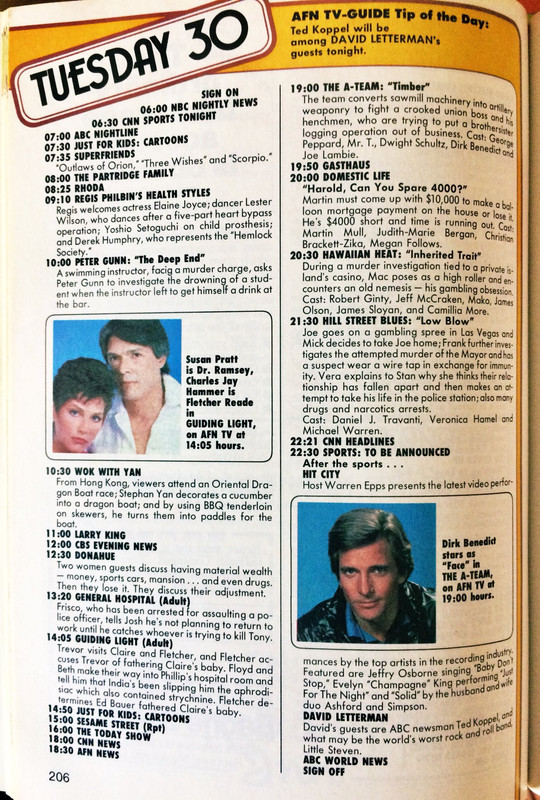
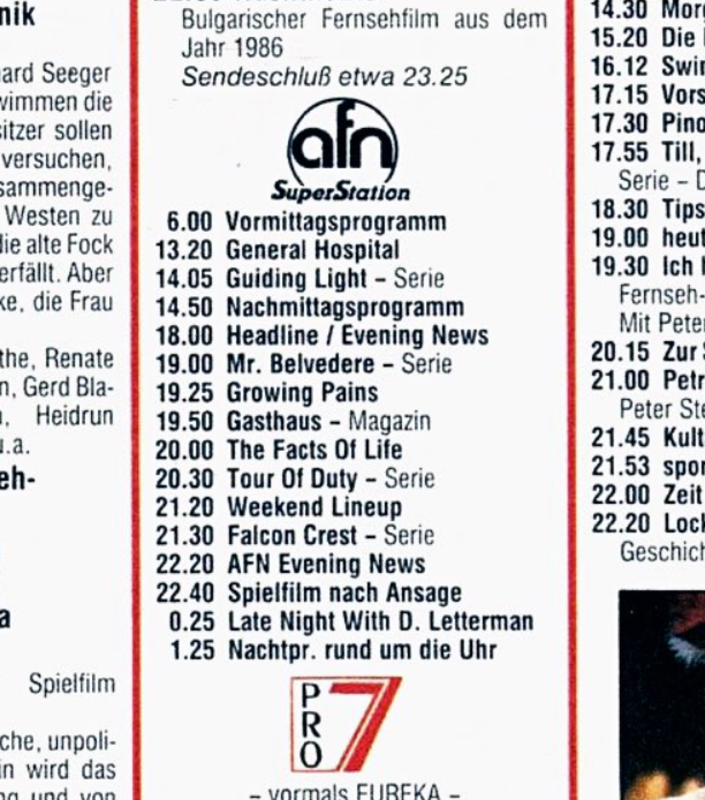
Here's some 1985 listings for the American Forces Network (AFN) TV in Germany as seen as AFN TV-Guide, reproduced here with permission of Claus Grimm on Twitter. Intended for U.S. military personnel and their families, the network also had a strong following among European viewers who watched the NTSC signal in black-and-white. In fact, several German listings magazines (and there were are are many of them!) also carried AFN TV listings, albeit in less detail. AFN TV-Guide itself was also available to German subscribers.


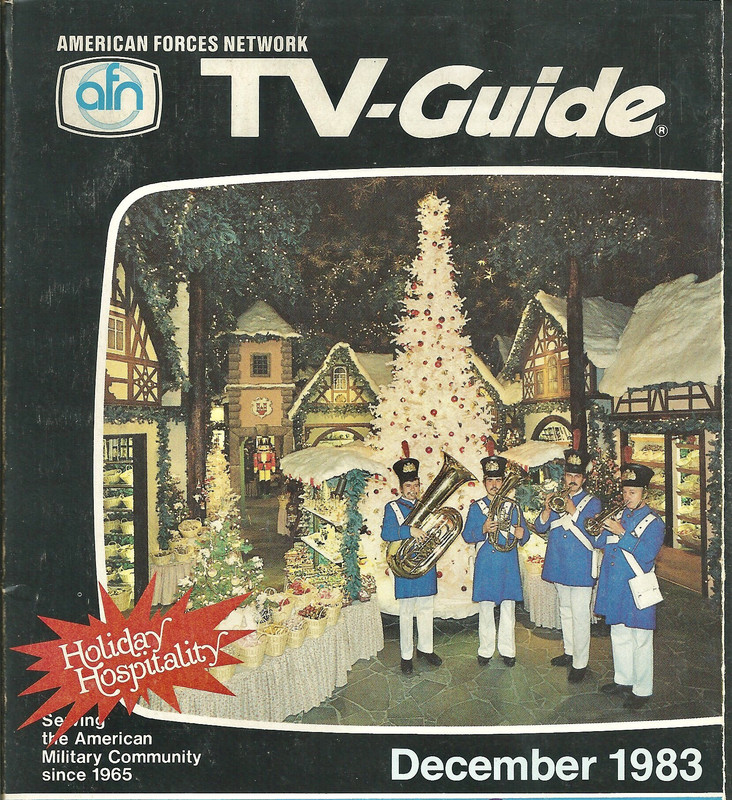
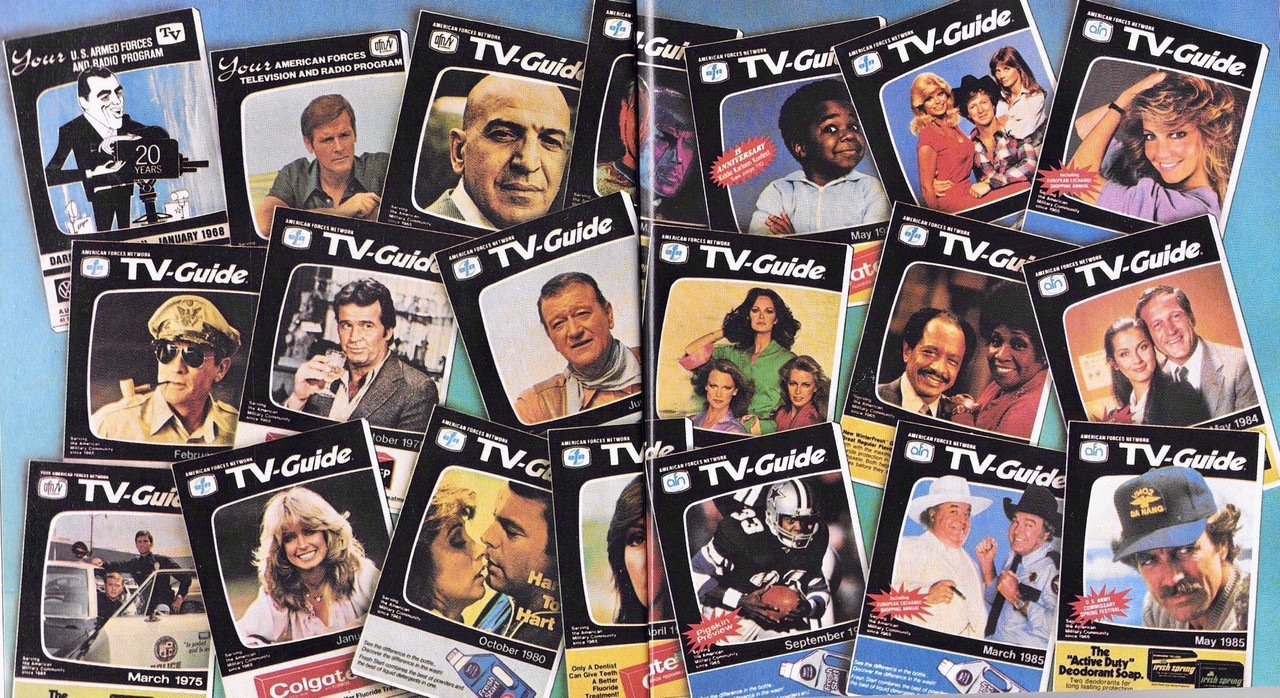
Some AFN TV-Guide covers, also courtesy of Claus Grimm:


I have a couple of AFN TV Guides from the '90s. I don't know if they had a separate TV Guide for the Far East Network, as it covers the European broadcasts.


Back
Top Bottom