Canadian satellite TV (Shaw Direct and Bell Satellite TV) carries every broadcast station in Canada nationwide. You can watch local news from Newfoundland in Vancouver and vice versa, and everything in-between. Great for time-shifting CBC, CTV and Global programs. The birds also carry American network affiliates from the Eastern (Detroit/Rochester or Boston) and Pacific (Seattle) time zones as well (subject to simsub rules), including PBS, plus WSBK, WPIX, WGN and KTLA, all of which were once heavy on sports and now take care of CW. WTBS was there as well back in the day.As a kind of side note (though not totally unconnected), I have noticed in Canadian TV listings that cable companies often carry stations from all throughout Canada, usually on higher channels. I'd like to see that in the US, at least from certain cities. As I've noted before either on here or another forum, I really don't think people would quit watching local stations in favor of those from (for instance) New York, Chicago, Denver, or Los Angeles. It would afford the opportunity for time-shifting if nothing else.
The only place you would run into problems, is if viewers were placed in a DMA that is different from the stations they would actually prefer to watch if they could get them, then DMA boundaries could eventually shift to the detriment of the losing market. Everything in Kentucky south of Boone, Kenton, and Campbell counties, and east of I-75, would be the Lexington market if all of those stations were available in tandem with the out-of-state markets (but then there's Mason County, Maysville, which has cultural and historic ties to both Lexington and Cincinnati, they get stations from both cities but land in the Cincinnati market). Further east, only WSAZ would hold any interest for viewers within commuting distance of Huntington, Charleston might as well be in a foreign country.

-
Get involved.
We want your input!
Apply for Membership and join the conversations about everything related to broadcasting.
After we receive your registration, a moderator will review it. After your registration is approved, you will be permitted to post.
If you use a disposable or false email address, your registration will be rejected.
After your membership is approved, please take a minute to tell us a little bit about yourself.
https://www.radiodiscussions.com/forums/introduce-yourself.1088/
Thanks in advance and have fun!
RadioDiscussions Administrators
You are using an out of date browser. It may not display this or other websites correctly.
You should upgrade or use an alternative browser.
You should upgrade or use an alternative browser.
TV Guide editions and online resources
- Thread starter IM42A
- Start date

K.M. Richards
Program Director, The Eighties Channel™
As a kind of side note (though not totally unconnected), I have noticed in Canadian TV listings that cable companies often carry stations from all throughout Canada, usually on higher channels. I'd like to see that in the US, at least from certain cities. As I've noted before either on here or another forum, I really don't think people would quit watching local stations in favor of those from (for instance) New York, Chicago, Denver, or Los Angeles. It would afford the opportunity for time-shifting if nothing else.
The stumbling block to making that happen is that the stations being carried would, under the FCC's rules on carriage, be entitled to demand compensation for that out-of-market viewing. As it is, cable companies already pass on that expense to the subscribers; do you want your cable bill to go sky high just so you can time shift? A TiVo would be cheaper in the long run.
The stumbling block to making that happen is that the stations being carried would, under the FCC's rules on carriage, be entitled to demand compensation for that out-of-market viewing. As it is, cable companies already pass on that expense to the subscribers; do you want your cable bill to go sky high just so you can time shift? A TiVo would be cheaper in the long run.
Dumb question, maybe, but would they be able to waive compensation in return for being carried out of market, in a scenario where that were made possible by relaxed regulation? Put another way, "you can carry us for free if you'll carry us", thereby getting their advertising (which is what drives all commercial television in the first place) in front of people who wouldn't otherwise see it. Some advertising is localized, but some of it is not.
It's not going to happen, but it's an interesting hypothetical to consider.
K.M. Richards
Program Director, The Eighties Channel™
Dumb question, maybe, but would they be able to waive compensation in return for being carried out of market, in a scenario where that were made possible by relaxed regulation? Put another way, "you can carry us for free if you'll carry us", thereby getting their advertising (which is what drives all commercial television in the first place) in front of people who wouldn't otherwise see it. Some advertising is localized, but some of it is not.
They probably could, under some variant of opting for must-carry status under whatever change in the regulations that would make your scenario possible ... but would they?
You're right that there's no benefit to having their local commercials carried in a distant market. Someone in Des Moines isn't going to patronize a business in Houston. But the national advertising is controlled by the agencies and they base their buys on the local viewership numbers. They're not going to increase their orders for the Detroit station just because it can be seen in Seattle.
And the odds go even lower when you replace the major markets with the lesser ones.
It's not going to happen, but it's an interesting hypothetical to consider.
Yes on the first half of that sentence, but no on the second. I, for one, don't waste my time hypothesizing about something that will never be more than a pipe dream.
Yes on the first half of that sentence, but no on the second. I, for one, don't waste my time hypothesizing about something that will never be more than a pipe dream.
I enjoy it myself, everyone is different. There are many forms of mental recreation that make use of hypothetical scenarios, such as alternative history and fantasy football.
I'm just thinking they make it work in Canada, but in that respect (and in many others), Canada and the US are two very different countries. (And there may be a sense of wanting to foster national cohesion that doesn't exist here in the US. If people in Vancouver can hear about what's going on in Newfoundland, and vice versa, so much the better towards that end.)
And one thing to consider, which probably isn't an issue in Canada, is that having major-market network affiliates freely available nationwide, could chip away at markets that are adjacent to them. Markets such as Cheyenne-Scottsbluff, Casper, Grand Junction, and Rapid City probably wouldn't want to lose counties to Denver, those markets are small enough (population-wise anyway) as it is.
K.M. Richards
Program Director, The Eighties Channel™
I think your own observations in your second and third paragraphs are exactly why that proposal would never get traction. The smaller market affiliates would lobby heavily against any regulatory change to accomplish it, and could rightly claim that such a change would doom their viability.
I think your own observations in your second and third paragraphs are exactly why that proposal would never get traction. The smaller market affiliates would lobby heavily against any regulatory change to accomplish it, and could rightly claim that such a change would doom their viability.
I have to think that the main appeal of having local stations in markets such as those, is the local news factor, no place wants to be a TV news desert. That said, there are some areas where no station is really "local", and given the choice, many viewers would prefer to watch stations from a larger market, especially one in-state or of great regional significance. Case in point, Prowers County in Colorado, on the Kansas state line. They are probably too far away from Colorado Springs and Pueblo for those cities to have any real connection to their lives, so they land in the Denver market where, presumably, the Denver stations have always been available via cable or satellite (too far for OTA reception). Montezuma and La Plata counties (Durango area) would probably be in the Denver market if it weren't for KREZ being a satellite of KRQE Albuquerque. (Too bad one of the Denver stations didn't snap it up when KREX sold it.) At one time the Albuquerque market extended even deeper into Colorado.
K.M. Richards
Program Director, The Eighties Channel™
I can't help but notice that your examples are in the Mountain Time Zone. That's always been a difficult region to serve, since the beginning of television.
Aside from Denver, Phoenix, Salt Lake City and Albuquerque -- maybe also Boise, Tucson, and Cheyenne -- everything is a small market. In many of those markets, the only way the big four networks are represented in total is via .2 and .3 subchannels and/or translators/LPTVs.
I know there are also wide expanses in the Central Time Zone, but aside from those sparsely populated areas, the local stations are still very much local. And they would be the stations most hurt by your idea.
Aside from Denver, Phoenix, Salt Lake City and Albuquerque -- maybe also Boise, Tucson, and Cheyenne -- everything is a small market. In many of those markets, the only way the big four networks are represented in total is via .2 and .3 subchannels and/or translators/LPTVs.
I know there are also wide expanses in the Central Time Zone, but aside from those sparsely populated areas, the local stations are still very much local. And they would be the stations most hurt by your idea.
The market that amazes me that it still exists is Glendive, Montana. They only have the one station, KXGN, which recently dropped its NBC subchannel while keeping CBS. They have no local news unless it would be some very brief cut-ins (I honestly don't know) and limited public-affairs programming. I guess it's a case of a few thousand people being fiercely loyal to their local station, and getting infill from other markets for the remaining networks.I can't help but notice that your examples are in the Mountain Time Zone. That's always been a difficult region to serve, since the beginning of television.
Aside from Denver, Phoenix, Salt Lake City and Albuquerque -- maybe also Boise, Tucson, and Cheyenne -- everything is a small market. In many of those markets, the only way the big four networks are represented in total is via .2 and .3 subchannels and/or translators/LPTVs.
I know there are also wide expanses in the Central Time Zone, but aside from those sparsely populated areas, the local stations are still very much local. And they would be the stations most hurt by your idea.
K.M. Richards
Program Director, The Eighties Channel™
Back in the analog days, KXGN was affiliated with all three networks, co-existing on a single channel. IIRC, they ran CBS from 6:00 to 9:00pm using the Eastern/Central feed, then switch to the Pacific feed of NBC from 9:00pm to midnight, with only a handful of ABC shows on tape delay.
I think their local news consists mainly of simulcasts with KTVQ in Billings; I seem to recall that at one point they also had a five-minute cast focusing on eastern Montana.
I think their local news consists mainly of simulcasts with KTVQ in Billings; I seem to recall that at one point they also had a five-minute cast focusing on eastern Montana.
Back in the analog days, KXGN was affiliated with all three networks, co-existing on a single channel. IIRC, they ran CBS from 6:00 to 9:00pm using the Eastern/Central feed, then switch to the Pacific feed of NBC from 9:00pm to midnight, with only a handful of ABC shows on tape delay.
I think their local news consists mainly of simulcasts with KTVQ in Billings; I seem to recall that at one point they also had a five-minute cast focusing on eastern Montana.
That actually would work, six hours in all of prime-time programming. I wouldn't have thought of that. I'd like to see a Montana TV Guide from that time.
I'm wondering what they did about Johnny Carson. The TVG would tell me that.
Next stop, eBay.
(Edited to add, there actually is a 1973 Montana TVG for sale, but with shipping it's almost $20. I'd like to know but not for that price. I can always see if I can find some listings on newspapers.com.)
Here is KXGN's schedule for Wednesday 5 November 1975 (from the Billings Gazette 31 October):
7:00 Today
9:30 Hollywood Squares
10:30 Bingo
11:00 As The World Turns
11:30 Days Of Our Lives
12:30 The Doctors
1:00 Another World
2:00 The Young and the Restless
2:30 The Price Is Right
3:30 Match Game
4:00 Lidsville
4:30 CBS News
5:00 Local News
5:30 NBC News
6:00 M*A*S*H
6:30 To Protect A Mighty River
6:45 Ready Or Not
7:00 Little House on the Prairie
8:00 Doctors Hospital
9:00 Cannon
10:00 News
10:30 Kate McShane
It's about evenly split between CBS and NBC. The Eastern/Pacific prime-time split must have taken place prior to this. They didn't carry The Tonight Show.
7:00 Today
9:30 Hollywood Squares
10:30 Bingo
11:00 As The World Turns
11:30 Days Of Our Lives
12:30 The Doctors
1:00 Another World
2:00 The Young and the Restless
2:30 The Price Is Right
3:30 Match Game
4:00 Lidsville
4:30 CBS News
5:00 Local News
5:30 NBC News
6:00 M*A*S*H
6:30 To Protect A Mighty River
6:45 Ready Or Not
7:00 Little House on the Prairie
8:00 Doctors Hospital
9:00 Cannon
10:00 News
10:30 Kate McShane
It's about evenly split between CBS and NBC. The Eastern/Pacific prime-time split must have taken place prior to this. They didn't carry The Tonight Show.
K.M. Richards
Program Director, The Eighties Channel™
It's about evenly split between CBS and NBC. The Eastern/Pacific prime-time split must have taken place prior to this.
I think you're probably right with that conclusion. Maybe the locals were tired of prime-time starting at 6:00p, and lasting twelve hours.
I pulled out the Castleman/Podrazik book and looked up the network schedules for 1975, just to take an educated guess of which feeds KXGN was using:
Today is a mystery to me. It was live from 5:00am to 7:00am Mountain Time and the Pacific zone refeed would have been at 8:00am MT. Maybe they tape delayed the second hour from the east coast feed and then took the first hour from the west coast feed ... but what happened to that missing half-hour?
Hollywood Squares would have been an in-pattern carriage (11:30am ET). And then we have another missing half-hour. Bingo had to have originated locally.
As The World Turns had to be on a one-day delay as it was directly opposite Days Of Our Lives @ 1:30pm ET. The Doctors and Another World follow in-pattern but The Young And The Restless was on at 10:00am MT from the east coast feed and 1:00pm on the west coast, and The Price Is Right was 8:00am east/11:00am west so that had to also be tape-delayed. Ditto Match Game (1:00/4:00). Lidsville would have been in syndication as it was originally in the 1970-71 season.
I believe the network news had multiple feeds, with the first feed being at 4:30pm MT, so KXGN must have run Dan Rather live and delayed Tom Brokaw.
Lots more tape delaying ... M*A*S*H was on Fridays at 8:30pm, Little House On The Prairie was on Wednesdays at 8:00pm followed by Doctors Hospital at 9:00. And Cannon was also on Wednesdays at 9:00pm followed by Kate McShane at 10:00, so none of those match up when adjusted for Mountain Time on either feed.
KXGN must have had three VTRs, at a minimum, to run that schedule.
K.M. Richards
Program Director, The Eighties Channel™
BTW, since I have the book out already, here's what the prime-time schedule would have been if they were still doing three hours of CBS followed by three hours of NBC, no tape delays:
6:00 Tony Orlando & Dawn
7:00 Cannon
8:00 Kate McShane
9:00 Little House On The Prairie
10:00 Doctors Hospital
11:00 Petrocelli
I think they actually made a few bad choices in cherry picking from the schedules.
6:00 Tony Orlando & Dawn
7:00 Cannon
8:00 Kate McShane
9:00 Little House On The Prairie
10:00 Doctors Hospital
11:00 Petrocelli
I think they actually made a few bad choices in cherry picking from the schedules.
Don't you mean six hours?I think you're probably right with that conclusion. Maybe the locals were tired of prime-time starting at 6:00p, and lasting twelve hours.
I pulled out the Castleman/Podrazik book and looked up the network schedules for 1975, just to take an educated guess of which feeds KXGN was using:
Today is a mystery to me. It was live from 5:00am to 7:00am Mountain Time and the Pacific zone refeed would have been at 8:00am MT. Maybe they tape delayed the second hour from the east coast feed and then took the first hour from the west coast feed ... but what happened to that missing half-hour?
Hollywood Squares would have been an in-pattern carriage (11:30am ET). And then we have another missing half-hour. Bingo had to have originated locally.
As The World Turns had to be on a one-day delay as it was directly opposite Days Of Our Lives @ 1:30pm ET. The Doctors and Another World follow in-pattern but The Young And The Restless was on at 10:00am MT from the east coast feed and 1:00pm on the west coast, and The Price Is Right was 8:00am east/11:00am west so that had to also be tape-delayed. Ditto Match Game (1:00/4:00). Lidsville would have been in syndication as it was originally in the 1970-71 season.
I believe the network news had multiple feeds, with the first feed being at 4:30pm MT, so KXGN must have run Dan Rather live and delayed Tom Brokaw.
Lots more tape delaying ... M*A*S*H was on Fridays at 8:30pm, Little House On The Prairie was on Wednesdays at 8:00pm followed by Doctors Hospital at 9:00. And Cannon was also on Wednesdays at 9:00pm followed by Kate McShane at 10:00, so none of those match up when adjusted for Mountain Time on either feed.
KXGN must have had three VTRs, at a minimum, to run that schedule.
I wondered about the Today show too. Some of these programs, such as M*A*S*H and LHOTP, were carried by other stations in the listings at the same time, so I'm wondering if KXGN could have simply captured a feed or signal from another station (such as in Billings or Great Falls) and rebroadcast it, with the taping perhaps being done by one of those stations with more resources and somewhat deeper pockets. To this day, the CBS and NBC affiliates in Montana are interconnected in regional networks. LHOTP was also carried at the same time on CJOC-7 in Lethbridge, Alberta, which appears in the listings as well.
As to late-night, the Glendive market is deep in rural agricultural and ranching country, where folks tend to stir early, so I have to wonder if there would have been sufficient viewership to justify carrying The Tonight Show. And keep in mind that Glendive viewers got stations from other markets on cable. In 1972 Glendive cable carried KUMV Williston, CJOC Lethbridge, and KCPX and KUTV from Salt Lake City (as well as KUED). The 1977 Television Factbook (which I contributed to the World Radio History site) has the same lineup minus CJOC. Kind of strange that KXGN was the only Montana station on cable, despite his best efforts (and he did a great job with the shoestring resources he had to work with), Ed Agre couldn't have provided the depth of coverage of in-state news that a Billings or Great Falls station could have.

I believe the network news had multiple feeds, with the first feed being at 4:30pm MT, so KXGN must have run Dan Rather live and delayed Tom Brokaw.
Wait... Wouldn't that have been Cronkite and Chancellor?
K.M. Richards
Program Director, The Eighties Channel™
Don't you mean six hours?
It probably felt like twelve to the viewers.
I wondered about the Today show too. Some of these programs, such as M*A*S*H and LHOTP, were carried by other stations in the listings at the same time, so I'm wondering if KXGN could have simply captured a feed or signal from another station (such as in Billings or Great Falls) and rebroadcast it, with the taping perhaps being done by one of those stations with more resources and somewhat deeper pockets. To this day, the CBS and NBC affiliates in Montana are interconnected in regional networks. LHOTP was also carried at the same time on CJOC-7 in Lethbridge, Alberta, which appears in the listings as well.
Since we don't have a way to tell for certain how KXGN got its network feeds, they may well have not been directly interconnected and had to take feeds from other stations and then be subject to those stations' schedules. That happened quite a bit in the pre-satellite years; I came across those circumstances several times when researching some of the UHF History site articles.
Since we don't have a way to tell for certain how KXGN got its network feeds, they may well have not been directly interconnected and had to take feeds from other stations and then be subject to those stations' schedules. That happened quite a bit in the pre-satellite years; I came across those circumstances several times when researching some of the UHF History site articles.
Martin Mayer touches on these arrangements when describing KAYS in Hays, Kansas (in his book About Television, as mentioned upthread):
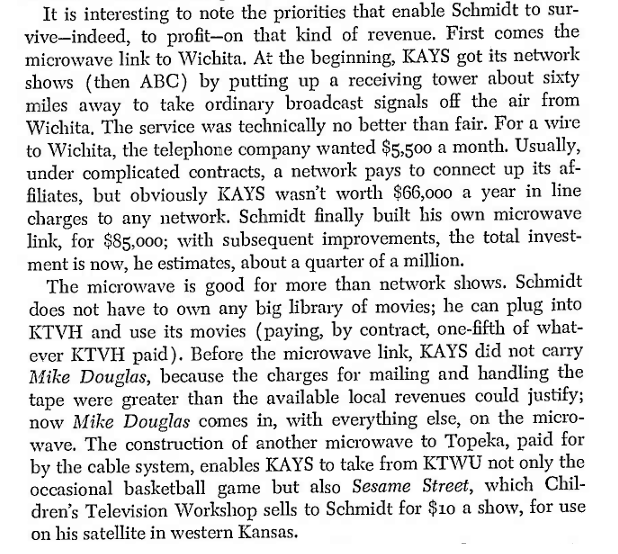
Since we don't have a way to tell for certain how KXGN got its network feeds, they may well have not been directly interconnected and had to take feeds from other stations and then be subject to those stations' schedules. That happened quite a bit in the pre-satellite years; I came across those circumstances several times when researching some of the UHF History site articles.
In retrospect, I can see that the discussion would have been helped if I'd noticed that KXGN's schedule for both CBS and NBC programming largely mirrored that of KTVQ Billings and KRTV Great Falls, both of which had a dual CBS/NBC affiliation at the time. The only difference I notice off the top of my head is the NBC evening news, where KXGN runs local news at 5:00 pm and then presumably airs NBC on a tape delay of a half-hour (KTVQ/KRTV carried CBS and NBC news back to back), and various tape-delayed programming in the 10:30 hour when both of those stations are running The Tonight Show. A few programs were unique to KXGN.
I can only say in my defense that the listings in the Billings Gazette weekly TV magazine are very hard to read, in that they have a hodgepodge of channel slugs (rounded-off TV Guide-like, as well as thin squared-off slugs, with no consistent pattern as to black or white background), not unlike the way the actual Montana "real" TV Guide was cluttered, and any pattern of common scheduling escaped my notice. The "clutter factor" as to TV Guide channel slugs got worse as the years went by, and stations were added. That edition would have benefited from TV Guide's listings editors sitting down, taking a deep breath, and saying "okay, let's redo the channel slug arrangement so that, at the very least, all stations in a market have the same style of slugs". By the 1990s the Montana TV Guide had descended into a hellscape of black, white, and split slugs with no real rhyme or reason, and somewhere along the line, the Salt Lake City stations, with their white numbers on striped backgrounds, such that the channel numbers seem to jump out at you in 3-D from the background and grab your attention, fell out of the lineup entirely.
TLDR, KXGN was basically a semi-satellite of whichever station, KTVQ or KRTV, was the mothership of the multi-station network serving Montana, with local programming and a bit of syndication (such as Lidsville) inserted here and there. This picture one might get (no pun intended) of this tiny little station, deep in the prairie, frantically chasing after multiple feeds, and running VTRs to beat the band, isn't quite accurate.
K.M. Richards
Program Director, The Eighties Channel™
Wait... Wouldn't that have been Cronkite and Chancellor?
You're going to make me pull out the TV Schedule Book again, aren't you ...
... and yeah, I read the Saturday row instead of weeknights.
TLDR, KXGN was basically a semi-satellite of whichever station, KTVQ or KRTV, was the mothership of the multi-station network serving Montana, with local programming and a bit of syndication (such as Lidsville) inserted here and there. This picture one might get (no pun intended) of this tiny little station, deep in the prairie, frantically chasing after multiple feeds, and running VTRs to beat the band, isn't quite accurate.
I can only say that what little media coverage there was about KXGN at the time omitted much of what you said as well.