
• Get involved.
    We want your input!
    Apply for Membership and join the conversations about everything related to broadcasting.

    After we receive your registration, a moderator will review it. After your registration is approved, you will be permitted to post.
    If you use a disposable or false email address, your registration will be rejected.

    After your membership is approved, please take a minute to tell us a little bit about yourself.
    https://www.radiodiscussions.com/forums/introduce-yourself.1088/

    Thanks in advance and have fun!
    RadioDiscussions Administrators

TV Moments in Analog

The WTFDA was around even back in the '60s. DXers maintained contact with others via the Worldwide TV FM DX Association and the National Radio Club (NRC). They would routinely monitor analog channel 2 from May to August (or 3 if 2 was occupied) for the rolling bars that usually meant Eskip. Some called other DXers to remind them that the FM or VHF TV bands were open for DX. Some were hams and monitored 6 meters AND analog TV. For tropo events, they would look at the upcoming weather forecasts for temperature inversions, and often had contact with nearby DXers in other states if the tropo event was large. William Hepburn's charts (DXinfocentre) are the best source for finding out about Tropo now.
Here's an example from August 1987 of the VUD...1987 was a great year for E skip DX.

Oh and BTW, the late Jeff Kadet (K1MOD) in Illinois was one of the greatest TV DXers of all time. He caught 1800 TV stations I think? Mostly tropo of course, but tons of E-skip too. He had a multitude of antennas and could see 750w to 1KW UHF translators from 600 miles away if the opening was strong enough.
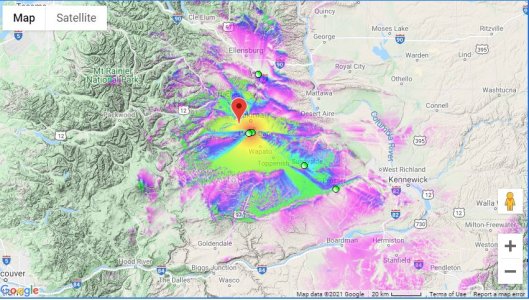
 
I wish there was a website database like Radio Locator that has projected signal contour maps for television stations. Seems to me that is a database that would be very useful.
 
You have your wish granted. TV Fool offers those. You search your address.
Here's a signal contour map for KYVE (DT 21, PBS Yakima WA).kyve map.JPG
 
Analog TV will always be something very special to me. As I recall, I was dxing television stations from a very young age, even though I had no concept of what I was actually doing. My parents always had cable, but my grandparents lived in the country and used a Channel Master rooftop antenna. I have vivid memories of watching VHF band signals from out-of-market television stations when the tropo effect carried the signals much further than their predicted contour. Specifically, channels 2 through 6 always brought new images to the TV screen. I wasn't aware of e-skip at the time, so unfortunately I didn't get the chance to pick up anything too distant before the digital transition occurred. If I could go back and invest in some better equipment, I bet I could receive a myriad of different signals. Maybe that's a bit ambitious, but it definitely seems like I would have figured it out if I had some more time to learn about dx before the transition happened.

I appreciate what digital television has to offer, but it will never evoke the same feeling that a snowy or ghosted picture could. Similarly, it will never be as reliable. You could ALWAYS count on a low VHF station to come in. Sure, picking up channel 2 from a tropo signal yielded an extremely snowy picture, but it wasn't half bad for 200-300 miles away. The audio was there and I had enough of a visual picture to understand what was going on. I'd actually say it was quite watchable much of the time. With the help of the very large channel master antenna, local channels 4 and 5 where always crystal clear at my grandparent's house, while all of the other stations had severe ghosting issues. They lived in a fairly rural area where UHF signals really struggled, but this was definitely not the case for low-band VHF. After the transition, they never picked up the stations that used to occupy channels 4 and 5 ever again. While they gained a few stations with the help of digital subchannels, it doesn't really make up for what was lost. I'm sure that most people would disagree with me, but from my experiences the VHF band absolutely blew ALL DTV out of the water. To this day, the only stations that I receive consistently with my DTV setup are stations that retained their VHF channel. It's actually a little weird to think back to the days of being able to watch any over-the-air channel I wanted in my local area, for I would always be able to pick up enough signal to watch the program. With digital, many external factors determine whether or not you're going to see anything other than a black screen.
 
Last edited:
In the 80's. How did people know about E-Skip & Tropo?

Were there like a TV & Radio Club by Mail?
Yes, the Worldwide TV FM DX Association and other DX clubs existed. If you had a VHF (2-6) station in your market, you might experience E skip. I can remember receiving stations with a graphic or announcement "some of our viewers may be receiving skywave interference".
 
There are still groups that exist for TV and FM DX. I subscribe to TeleRadio News (TRN), which is published in the UK. There used to be a lot of mags for DX'ers (even satellite), but much of it has gone on-line. There seems to be less of a market for it in the US, since "TV went off the air when it all went HD" (that's what many people tell me 🙄). But, there are clubs and information available from many countries.
 
Yes, the Worldwide TV FM DX Association and other DX clubs existed. If you had a VHF (2-6) station in your market, you might experience E skip. I can remember receiving stations with a graphic or announcement "some of our viewers may be receiving skywave interference".
I recall watching WBBM 2 in Chicago do this a couple of times during heavy Es times on its 6 or 10 p.m. news. I think they had the weather guy explain it. But when I saw the 'venetian blinds' on 2, I was usually off to 3 or 4 to see what was coming in.
 
I remember when the three commercial stations in Salt Lake City were all low-band VHF: 2, 4 and 5.
Summer was mostly spent answering the phones, as tropo created havoc on inputs to the translator network. Not only did many sites receive from SLC directly, but many output channels fed downstream sites on VHF, too. Lots of translators were VHF. It took putting a UHF station on Farnsworth Peak experimentally, to convince anyone that UHF worked in the mountains.
 
The 4 VHF Charleston stations (2, 4, 5 and 7) were audible at least 80-90 miles out in normal conditions. But I recall if there was ANY tropo at all stations would come in from all over on my Walkman. 3/11 from Savannah were very frequent catches during the summer, much like Savannah FM stations coming in all the time. I’d hear WFTV Orlando as well. WIS from Columbia on Channel 10 came in frequently. WTLV Jacksonville on 12 too.

Channels 3 and 6 was a treasure trove, especially 6. Depending on the day you’d either get WECT Wilmington, WJBF Augusta, or WKMG Orlando, and when there was DX, almost anywhere in the country could be heard. I recall one time hearing KOTV Tulsa there. 3 was usually open, but WSAV/WWAY would come in frequently, and I’d hear DX from OK and TX.

8 and 13 were the only real true ”open” channels. UHF was wilder. During good tropo I’d get it up through the 50s. Out to Columbia, Jacksonville and eastern NC. The last night of analog TV (6/11/09) I remember getting WBTW and WCTI through my rabbit ears.
 
Speaking of hearing TV channels, a police scanner was great for the low UHF channels since they shared the frequency. It's the only way I ever picked up WFIE 14 Evansville, Ind., from my neck of the woods near Chicago. Neither the big antenna on the tower nor my hand-held Casio with the 1-inch screen (great for finding hot spots) nor anything in between could get WFIE, but the Radio Shack scanner did, along with 15, 16 and however far that utility band went.

Likewise, the car radio was great for 6 / 87.75 at the bottom of the FM dial. One had to be north of Lafayette, Ind., before WRTV Indianapolis got interference from Milwaukee or Davenport. In Chicago, 6 still is useful for FM audio with WRME-LP sitting there, and from the top of the Hancock building, it really gets out, even with 3 kW.
 
Status
This thread has been closed due to inactivity. You can create a new thread to discuss this topic.


Back
Top Bottom