
• Get involved.
    We want your input!
    Apply for Membership and join the conversations about everything related to broadcasting.

    After we receive your registration, a moderator will review it. After your registration is approved, you will be permitted to post.
    If you use a disposable or false email address, your registration will be rejected.

    After your membership is approved, please take a minute to tell us a little bit about yourself.
    https://www.radiodiscussions.com/forums/introduce-yourself.1088/

    Thanks in advance and have fun!
    RadioDiscussions Administrators

Understanding HD channels and audio quality

davideduardo

Moderator/Administrator
Staff member
I asked a friend who is brighter than I am to explain HD channels and bandwidth as the subject has come up several times recently with considerable confusion.

This article shows how HD can be used:

High Quality, Consistent Multicast Engineering - HD Radio

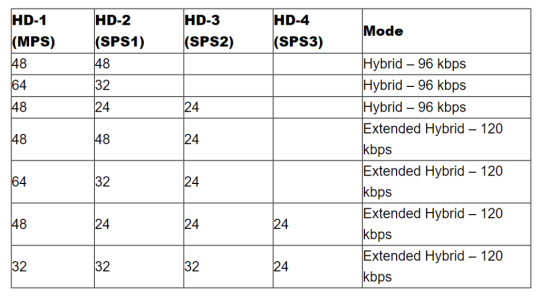
Here is a chart:
1726617362116.png
There are several alternative modes, too:

There is an MP11 mode that is being tested in some markets:
The Story of the FM IBOC MP11 Mode - Radio World

And... Hubbard tested an HD5 (technically it is possible to have HD1 through HD8):
Hubbard Turns on an HD5 Audio Channel - Radio World

My point is to show that the quality of each HD channel can be selected, with HD-1 always having the highest or equally highest of all channels.

So, when comparing the quality of individual channels on one station, we have to know that each station gets to choose within some limits, the "amount" of quality each HD channel gets. I read these articles and realized I was pretty significantly wrong in my understanding of this subject, so I decided to 1) admit my stupidity and 2) post some interesting articles under the "sharing is caring" theory.
 
Some of the newer HD exporters use a range of statistical multiplexing, where bits that aren't being used in the HD1 can be shifted to HD2 or HD3 as the need dictates.
DTV does something similar.
 
What's the minimum audio bitrate that could be used for an HD Radio subchannel? Is it possible, for example, to have a 64 kbps main channel and seven 8 kbps (I know it's awful, but it could be used for feeding translators) subchannels?
 
How many people care or know sub channels exist. Are there ratings on sub channels and why not just focus on making the main channel sound as good as possible.
 
How many people care or know sub channels exist. Are there ratings on sub channels and why not just focus on making the main channel sound as good as possible.
I'm getting a new radio with HD subchannels on it, because the translators aren't powerful enough to cover the whole city.
 
My point is to show that the quality of each HD channel can be selected, with HD-1 always having the highest or equally highest of all channels.
A higher bitrate does not necessarily mean higher quality. It also depends a lot on the source material and the processing. A 64 kbps HD1 channel that's taking a lossy-compressed network feed and heavily processing it may end up sounding worse than a 32 kbps HD2 channel that's just a lightly-processed jukebox playing uncompressed WAV files.
 
I asked a friend who is brighter than I am to explain HD channels and bandwidth as the subject has come up several times recently with considerable confusion.
Thanks for sharing these great reads, David. I went through a bunch of IBOC standards documents not long back, and was able to absorb even more information from yours in particular. The MP11 mode mentioned in the PDFs I had found made me feel like I could one day be a fan of HD radio, but I came away having little hope for it ever "making it" considering at least one of the standards documents was pointing out that support for it was lacking in many existing tuners. That made me fear its future was about as likely as the future of an expanded FM band using VHF-Low (the whole "who buys new radios anymore, except when buying new cars?" problem). But it's good to see that an effort is now being made to start actively using it in practice, even if it will still take luck (or a miracle) to get compatible receivers into most peoples' hands. The 98 kbit/s ceiling in the current, widely-used MP1 mode simply isn't enough for good audio quality to those with good hearing, which automatically means virtually everyone who's young, and they're the most sought-after listeners. Dividing that bitrate into two or three just makes things hard to listen to for any length of time. 146 kbps, on the other hand, would be fully satisfactory to 95% of listeners, in cases of stations that only operated a single digital channel. Even a 122 kbit/s HD1 coupled with a 24 kbit/s talk HD2 aimed at older conservative demographics with less discriminating hearing would be very workable.

The one major downside I foresee to this is that MP11 requires 400 kHz of spectrum. In smaller markets without many stations competing for space on the dial -- including after all the AMs have put up their translators or full power FM simulcasts, that won't be a serious problem. But what about those of us living in places where the FM dial is already packed? The locations where having higher fidelity would lure in the most extra listeners would be shut out.
 
Last edited:
A higher bitrate does not necessarily mean higher quality. It also depends a lot on the source material and the processing. A 64 kbps HD1 channel that's taking a lossy-compressed network feed and heavily processing it may end up sounding worse than a 32 kbps HD2 channel that's just a lightly-processed jukebox playing uncompressed WAV files.
In deed. That's another reason that even the 98 kbit/s maximum of current HD systems isn't enough. Processing increases density and greater density (more audible sounds at more frequencies simultaneously) leaves an encoder with essentially more total fourier components it believes it needs to preserve, causing that bitrate to be spread thin. You hear much less artifacting on highly open, dynamic material at 98 kbit/s than you do on dense, rich, processed audio at that same bitrate. It's the audio equivalent of Youtube's notoriously low video bitrates yielding acceptable video for most types of scenery, but throwing an ocean of macroblocks at you the moment a close-up of running water, rain, snow, or a wind-whipped lake surface comes into view.
 
Adding one more thought to the post directly above this one, I'd speculate that the main reason low bitrates got good reputations back in the seminal days of lossy coding was that the people who invented the technology naturally wanted to test their creation on the highest quality music they could obtain -- thinking that would be the best way of proving the quality of their product. So imagine them throwing Telarc CDs and classical chamber music at their MP3 encoders, and for the lack of extremely high compression-created spectral density, and/or the multiple layers of color/distortion typical of popular and rock music, they ended up writing things like this into their documentation (source: a late 1990s Fraunhofer IIS-A readme.txt):
mp3enc30docs.png
I believe had they spent equal time listening to fine quality recordings as to heavily compressed synthy stuff like the Pet Shop Boys or even heavy metal, the figures seen on the left would have been made a lot higher. Sadly, claims like those, that 128 kbit/s equaled "CD quality," really stuck in people's minds and influenced the encoding quality decisions of an entire generation of music enthusiasts. A lot of people still have otherwise unsourcable unobtanium imprisoned in that bitrate floating around in their collections to this day. And I wonder how heavily initial assertions from authorities like these went on to influence, and continue to influence, the bitrate choices of services like XM/Sirius, IBOC, and modern radio streaming on the internet. 64 kbit/s ain't FM quality.
 
DAB over in Europe is just as bad. The switch from MP2 to AAC with DAB+ was supposed to increase audio quality, but broadcasters just took advantage of it to make their bitrate even lower to fit in more channels.
I remember that video and how bad I felt for them. Legend always taught me the Europeans were more evolved than us yanks. They evaluated NTSC, said "this blows chunks," and invented PAL, after all.

Alas, according to the Hubbard link in the original post, it seems the same thinking is happening here. They apparently think HD5s are good ideas, instead of giving existing channels more bits to work with.
 
Status
This thread has been closed due to inactivity. You can create a new thread to discuss this topic.


Back
Top Bottom
