• Get involved.
    We want your input!
    Apply for Membership and join the conversations about everything related to broadcasting.

    After we receive your registration, a moderator will review it. After your registration is approved, you will be permitted to post.
    If you use a disposable or false email address, your registration will be rejected.

    After your membership is approved, please take a minute to tell us a little bit about yourself.
    https://www.radiodiscussions.com/forums/introduce-yourself.1088/

    Thanks in advance and have fun!
    RadioDiscussions Administrators

Unemployed Air Talent

Agree. I can count the number of times over the last year I listened to commercial AM/FM on my hand... "0"
Face it, radio left us.

On the other hand, commercial AM/FM radio primarily targets people between the ages of 25 to 54. That's the age group the majority of advertisers wants. So if you're outside that target, you're the one who changed. Nothing wrong with that. Non-commercial radio is just fine with older listeners, as long as they're members. Same with satellite radio. Also if you're older, advertisers know they can reach you on TV, because you're more likely to watch TV than listen to the radio. They're just playing the law of averages.
 
Non-commercial radio is just fine with older listeners, as long as they're members.
This past weekend I was working in the garage with WAMU (local NPR affiliate) playing. They were having their quarterly 'begathon'. One of the begathon hosts for that hour, while making the case why listeners should be subscribers, called anyone who hadn't become a sustaining member "a deadbeat". I damn near choked on my iced tea.

Tip to WAMU: Not a good idea to call your listeners pejorative names.
 
Tip to WAMU: Not a good idea to call your listeners pejorative names.

What does it take to convert someone from listener into member. Stations have found the the harder they pound, the more likely the listener is to give. The gentle approach does not work. Guilt works. Stations also find that members resent the people who don't give. So the use of negative names is popular among those who donate.
 
What does it take to convert someone from listener into member. Stations have found the the harder they pound, the more likely the listener is to give. The gentle approach does not work. Guilt works. Stations also find that members resent the people who don't give. So the use of negative names is popular among those who donate.
Speaking personally and anecdotally, anyone infers that I'm somehow a deadbeat can count on me not donating. At least 30% of the WAMU revenue comes from enhanced underwriting. I for one wouldn't want to risk losing underwriting by alienating my audience through childish name calling. Public stations should be above that.
 
Speaking personally and anecdotally, anyone infers that I'm somehow a deadbeat can count on me not donating. At least 30% of the WAMU revenue comes from enhanced underwriting.

The reason for the reliance on underwriting is because of the low level of giving by regular listeners. But there's no worry about alienating the non-givers, since they usually avoid listening during the "begathons," as you call it.
 
I disagree that low listener membership is why underwriting is sought. I have noted entities like Minnesota Public Radio's annual report showed almost 29 million from listener donations and about 31 million from national and regional underwriting. Then comes grants and CPB monies. It seems that much like commercial radio, the more you can take in the better. At least with public radio, they have to spend that somewhere and that's typically by on programming, staff and serving more people through adding new stations. For some reason radio has (and quite wisely) operated under the attitude there's never enough money coming in.
 
It seems that much like commercial radio, the more you can take in the better. At least with public radio, they have to spend that somewhere and that's typically by on programming, staff and serving more people through adding new stations. For some reason radio has (and quite wisely) operated under the attitude there's never enough money coming in.
You make a good point. Certainly not all, but many larger market public stations are better equipped technically and have larger staffs than even a group of commercial stations in the same market. Well heeled public stations like WAMU in D.C. have, in my opinion, a glut of special management positions not typically found in most commercial, let alone non-comm radio stations. I guess it they can afford it, go for it. Although, getting on the air for a solid week and acting like their world will end, or calling your listeners "deadbeats", when a standalone station has positions like: "Associate General Manager", or "Chief Engagement Officer"? You won't find those well paid positions at other stations across town.
 
Last edited:
Begathons on stations of which I do not support annoy me BUT...
Begathons on stations of which I do support turn me into an excited cheerleader.
I make sure to listen to as many of their pledge drives as I can.
 
maybe
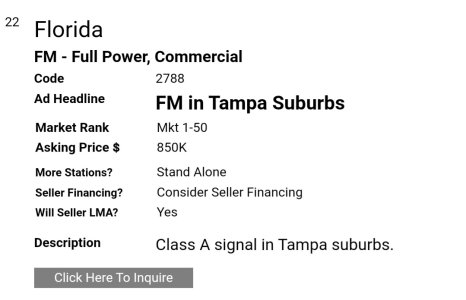
7 - 10 radio pro's pool some money
and resurrect the passion of the pig
- and - the vibe of AM talk when it was something to talk about
 

Attachments

  • Screenshot_20210628-131407_Chrome.jpg
    Screenshot_20210628-131407_Chrome.jpg
    78.1 KB · Views: 2
how does 97.1 tampa's alt station be legit with ONE on air host ??

wonder if COX radio would ever sell that as as a stand alone to pay down debt ?
 
Status
This thread has been closed due to inactivity. You can create a new thread to discuss this topic.


Back
Top Bottom