It took me a while to make sense of this, and realize it's an AM (Mediumwave)-only radio. No frequencies, just call letters!
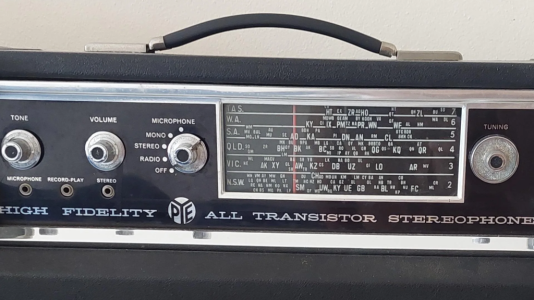

I recognise a lot of those. Some have evolved, some disappeared.Wonder if @leethalweapon recognizes any of these stations….

At the time that the radio was built, Australia has 10 kHz increments just like the US. They much later changed to the 9 kHz interval system used outside the Americas.That is great. It looks like the dial is "backwards" with the lower frequencies on the left. 4AK is 1242. 4KQ is 693.
They much later changed to the 9 kHz interval system used outside the Americas.
Also note that the commercial stations were limited to 5000 watts while the ABC stations were allowed much higher power.This happened in 1978.
The other thing you will notice is all the ABC (Local) capital city stations were, and still are located between 567 anf 1026, as these were clearer signals.
The lower frequencies are on the right. Normally the lower frequencies are on the left, regardless of 9 vs 10 khz intervals.At the time that the radio was built, Australia has 10 kHz increments just like the US. They much later changed to the 9 kHz interval system used outside the Americas.
Not always. In the earlier days of radio, many receivers went from the shortest wavelength to the longest, not the other way around. In fact, some radio had neither wavelength nor frequency... just a scale. People bought logbooks where they could put their dial setting(s) to find the station again.The lower frequencies are on the right. Normally the lower frequencies are on the left, regardless of 9 vs 10 khz intervals.
Depends on how the tuning capacitor(s) were built or wired. I remember a few transistor radios in the 1960s that tuned "backwards." There weren't many, but there were some.The lower frequencies are on the right. Normally the lower frequencies are on the left, regardless of 9 vs 10 khz intervals.
Not common in the U.S. but decades ago wavelength was widely used to denote a station’s place on the radio spectrum. This was especially true on shortwave; I recall in the 1960s and 70s that SW stations would use both frequency and wavelength in their transmission announcements. This pretty much disappeared sometime in the 1980s with frequency becoming the standard, although “meter bands” would give a general reference along with specific frequencies.Not always. In the earlier days of radio, many receivers went from the shortest wavelength to the longest, not the other way around. In fact, some radio had neither wavelength nor frequency... just a scale. People bought logbooks where they could put their dial setting(s) to find the station again.
The first transistor radio I bought as a kid with my own money was a Sears Silvertone model 4201, and it had the “backward” dial. That was in 1964. A few years later my grandparents passed down a GE model P-725A from 1957 that also had the “backward” tuner on the side of the radio.Depends on how the tuning capacitor(s) were built or wired. I remember a few transistor radios in the 1960s that tuned "backwards." There weren't many, but there were some.

