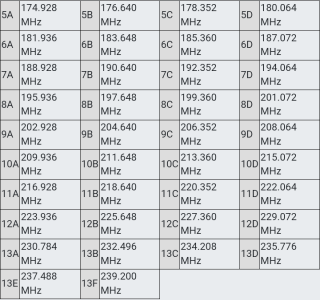
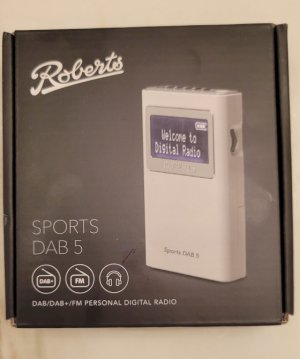
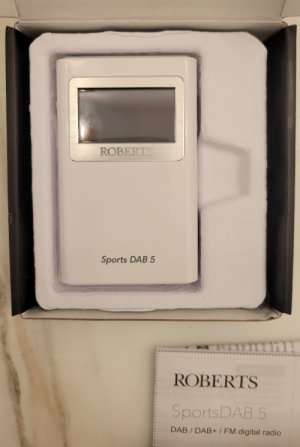
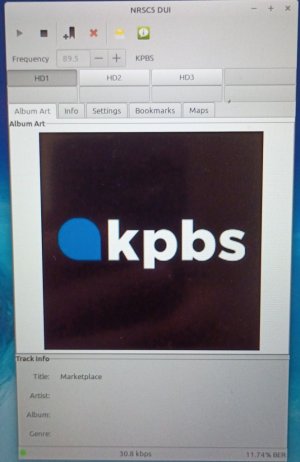
A recent trip to the Netherlands, Switzerland, and Germany gave me the opportunity to use a DAB+ digital radio. I acquired one last December after my November trip to the UK and the Netherlands (see https://radiodiscussions.com/threads/london-radio-for-christmas.774210/post-6777112 for background). The trip last month was my first opportunity to use it to tune to DAB+ stations. DAB+ isn't used in the United States; instead the HD hybrid in-band on-channel (IBOC) system is used. DAB+ uses frequencies in and above the frequencies used in the U.S. for VHF television channels 7-13.
DAB+ transmitters transit a group of stations in what's officially called an "ensemble", informally referred to as a "multiplex". It appears there are around 10-20 stations per ensemble, depending upon the bitrates of the channels in the ensemble.
The Sony XDR-S40DBP radio I was using scans the available ensembles in an area and then groups the stations by name. In other words, you tune stations by name and not by frequency. Menu items provide access to codes that can tell you which ensemble you're listening to, but you have to reference a site such as wohnort.org to look up the code and match it to the transmitter being used. Scanning isn't automatic but is easily initiated.
The first experience with the radio was in the Netherlands. Most analog FM stations have DAB+ channels as well. This includes local channels in various cities such as Centraal+ in Leiden and Den Haag FM in The Hague. At least one low-power AM has a DAB+ channel as well: Radio 4 Brainport in Eindhoven. Arrow Rock, which had been on medium-wave in the past, is now DAB+ only. Other national channels, both public and private, had higher bitrates than the local channels. (Information on bitrates, etc., is at wohnort.org, which can get very detailed. I'm just hitting the highlights here.) Bitrates of 72 kbps and above generally didn't bother me; at 48 kbps, there were severe artifacts. For example, Centraal+ had a 48 kbps channel. Fortunately, it also had an FM presence which sounded much better, at the cost of a little noise. Public and other national channels offered additional programming on DAB+ as well.
Next we went to Switzerland, first in the Italian-speaking area (Ticino), then to Zermatt and Interlaken, and finally in Zurich. Except for Zurich, most FM broadcasting in Switzerland has ceased. Public broadcasting services aren't present at all on FM except in Zurich. Lugano (the capital of Ticino) and Interlaken had two stations remaining on FM. Zermatt had only one. In Lugano, Italian FM stations could be received from Milano, and the Milano DAB+ ensembles could also be received. On DAB+, all Swiss public broadcasting services - four in French, four in German, three in Italian - were on the ensembles in each of our locations. There were regional (or cantonal) services. An Albanian-language station, Albradio, was also available in all four places but may not be national in nature. In the German-speaking areas, the regional broadcaster Radio Rottu Oberwallis (Oberwallis = Upper Valais) also offered a channel of traditional Swiss music, going by the name "Swiss Melody" (the name was in English!). Bitrates seemed to be distributed more equitably in Switzerland, with just a hint of digital artifacts in most cases.
In Zurich, there's more FM broadcasting, including some of the public broadcasting services. I don't know if this is because Zurich was considered more of an international city than the others.
Our trip wrapped up with a couple of days in Mainz, near Frankfurt. FM broadcasting in Germany is alive and well with most stations also represented on DAB+, including public broadcasters HR (Frankfurt) and SWR (Mainz). A few broadcasters from other states also have DAB+ channels available in the area. I had less radio-listening time in Germany than elsewhere.
I don't know how DAB+ performs in automobiles; I haven't tried it in that kind of environment.
The following observations aren't necessarily scientific or even conclusive. They're mostly impressions. Comparing DAB+ to HD, I felt DAB+ had better audio quality *when* a bitrate greater than 96 kbps was used, but that wasn't always the case. DAB+ uses AAC+ compression; I believe HD uses something very similar. At lower bitrates, especially less than 72 kbps, it seemed to me that HD sounded a little better. The artifacts on DAB+ at 48 kbps were particularly bad. An equivalent HD channel would have some artifacts but still would be acceptable to many people.
The other advantage HD has is that, at least for the HD-1 channel, there's always an analog fallback. There's no fallback for DAB+ reception: either you get it or you don't. There's an implicit fallback in that the DAB+ standard requires radios to be equipped for FM reception as well, but if there's not an equivalent FM station to the DAB+ channel that you want, then there's still no real fallback.
Even so, I think American broadcasters missed the boat here, another example of their failure to prepare for the future. DAB+ has become a worldwide standard except in North America. It separates the responsibility for programming from the responsibility for transmission, putting all stations in a given area on a mostly equal footing, freeing up stations to focus on programming. Sure, it comes at a cost - stations essentially become renters of their transmission facilities. But, first, how is that different from streaming? And, second, so many U.S. stations, especially those from the big chains, have sold off their transmitting towers to operators such as Vertical Bridge. They've already become renters.
It's doubtful DAB+ will be adopted or even considered in the U.S. The VHF range used by DAB+ is still in use for television in the United States, and that's likely to remain the case for the forseeable future. HD has mostly become a means of feeding translators; HD radios are available and are mostly of good quality, but the market for them has proven to be small. Getting Americans to buy an entirely new kind of radio would be an uphill proposition.
DAB+ transmitters transit a group of stations in what's officially called an "ensemble", informally referred to as a "multiplex". It appears there are around 10-20 stations per ensemble, depending upon the bitrates of the channels in the ensemble.
The Sony XDR-S40DBP radio I was using scans the available ensembles in an area and then groups the stations by name. In other words, you tune stations by name and not by frequency. Menu items provide access to codes that can tell you which ensemble you're listening to, but you have to reference a site such as wohnort.org to look up the code and match it to the transmitter being used. Scanning isn't automatic but is easily initiated.
The first experience with the radio was in the Netherlands. Most analog FM stations have DAB+ channels as well. This includes local channels in various cities such as Centraal+ in Leiden and Den Haag FM in The Hague. At least one low-power AM has a DAB+ channel as well: Radio 4 Brainport in Eindhoven. Arrow Rock, which had been on medium-wave in the past, is now DAB+ only. Other national channels, both public and private, had higher bitrates than the local channels. (Information on bitrates, etc., is at wohnort.org, which can get very detailed. I'm just hitting the highlights here.) Bitrates of 72 kbps and above generally didn't bother me; at 48 kbps, there were severe artifacts. For example, Centraal+ had a 48 kbps channel. Fortunately, it also had an FM presence which sounded much better, at the cost of a little noise. Public and other national channels offered additional programming on DAB+ as well.
Next we went to Switzerland, first in the Italian-speaking area (Ticino), then to Zermatt and Interlaken, and finally in Zurich. Except for Zurich, most FM broadcasting in Switzerland has ceased. Public broadcasting services aren't present at all on FM except in Zurich. Lugano (the capital of Ticino) and Interlaken had two stations remaining on FM. Zermatt had only one. In Lugano, Italian FM stations could be received from Milano, and the Milano DAB+ ensembles could also be received. On DAB+, all Swiss public broadcasting services - four in French, four in German, three in Italian - were on the ensembles in each of our locations. There were regional (or cantonal) services. An Albanian-language station, Albradio, was also available in all four places but may not be national in nature. In the German-speaking areas, the regional broadcaster Radio Rottu Oberwallis (Oberwallis = Upper Valais) also offered a channel of traditional Swiss music, going by the name "Swiss Melody" (the name was in English!). Bitrates seemed to be distributed more equitably in Switzerland, with just a hint of digital artifacts in most cases.
In Zurich, there's more FM broadcasting, including some of the public broadcasting services. I don't know if this is because Zurich was considered more of an international city than the others.
Our trip wrapped up with a couple of days in Mainz, near Frankfurt. FM broadcasting in Germany is alive and well with most stations also represented on DAB+, including public broadcasters HR (Frankfurt) and SWR (Mainz). A few broadcasters from other states also have DAB+ channels available in the area. I had less radio-listening time in Germany than elsewhere.
I don't know how DAB+ performs in automobiles; I haven't tried it in that kind of environment.
The following observations aren't necessarily scientific or even conclusive. They're mostly impressions. Comparing DAB+ to HD, I felt DAB+ had better audio quality *when* a bitrate greater than 96 kbps was used, but that wasn't always the case. DAB+ uses AAC+ compression; I believe HD uses something very similar. At lower bitrates, especially less than 72 kbps, it seemed to me that HD sounded a little better. The artifacts on DAB+ at 48 kbps were particularly bad. An equivalent HD channel would have some artifacts but still would be acceptable to many people.
The other advantage HD has is that, at least for the HD-1 channel, there's always an analog fallback. There's no fallback for DAB+ reception: either you get it or you don't. There's an implicit fallback in that the DAB+ standard requires radios to be equipped for FM reception as well, but if there's not an equivalent FM station to the DAB+ channel that you want, then there's still no real fallback.
Even so, I think American broadcasters missed the boat here, another example of their failure to prepare for the future. DAB+ has become a worldwide standard except in North America. It separates the responsibility for programming from the responsibility for transmission, putting all stations in a given area on a mostly equal footing, freeing up stations to focus on programming. Sure, it comes at a cost - stations essentially become renters of their transmission facilities. But, first, how is that different from streaming? And, second, so many U.S. stations, especially those from the big chains, have sold off their transmitting towers to operators such as Vertical Bridge. They've already become renters.
It's doubtful DAB+ will be adopted or even considered in the U.S. The VHF range used by DAB+ is still in use for television in the United States, and that's likely to remain the case for the forseeable future. HD has mostly become a means of feeding translators; HD radios are available and are mostly of good quality, but the market for them has proven to be small. Getting Americans to buy an entirely new kind of radio would be an uphill proposition.