
-
Get involved.
We want your input!
Apply for Membership and join the conversations about everything related to broadcasting.
After we receive your registration, a moderator will review it. After your registration is approved, you will be permitted to post.
If you use a disposable or false email address, your registration will be rejected.
After your membership is approved, please take a minute to tell us a little bit about yourself.
https://www.radiodiscussions.com/forums/introduce-yourself.1088/
Thanks in advance and have fun!
RadioDiscussions Administrators
You are using an out of date browser. It may not display this or other websites correctly.
You should upgrade or use an alternative browser.
You should upgrade or use an alternative browser.
was wpst ever 100kw??
- Thread starter daddyoo
- Start date

From Broadcasting Yearbook 1968.
WTOA(FM) January 1949: 97.5 mc; 100 kw. Ant 457 ft. 896 -0975. Nassau Bcstg Co. (acq 12- 1 -64).
Rep: Masla; Selective Bcstg Adv. Herbert W. Hobler, pres; Tony Lupo, gen mgr; Bob Alexander,
prod mgr; Albert Makkay, sis mgr; Arthur A. Silver, chief engr.
Interesting sidebar: When I was GM of WZNT and WQII in San Juan, Masla was my rep and Art Silver was my Chief Engineer!
Small world!
Whenever I see things like that, the first thing I want to know is WHEN DID IT CHANGE? So I dug a little bit, and saw that in 1969, the listing was the same as it was in 1968. OK. Then we move on to 1970, and this is what I saw:
WTOA(FM) January 1949: 97 5 mc; 50
kw. Ant 410 ft. Box 9750. 896 -0975.
Nassau Bcstg Co. (acq 12- 1 -64).
Rep: Masla; Selective Bcstg Adv.
Herbert W. Hobler, pres; John L. Kuhn
Jr., corn! mgr; Hal Stein, prom mgr; Ron
Hale, chief engr. OÁ 97.5
PLUS, right below the free entry, they took out this display ad:
TRENTON
50,000 Watts 100% Stereo Music
Serving 26 Million people in 5 States Primary Service in 3 Top 100 Markets Trenton -Philadelphia -New Brunswick
"ACCENT" -Live two -man morning show Non -Stop Entertainment throughout the day News -Sports -Stocks -Minifeatures Home set Penetration -80%
Key Buying Power: e 64.5% earn over S10,000 e. 70.8% between 18 -49 years old
25% own FM car radios
Owned and operated by The Nassau Broadcasting Co. Herbert W. Hobler, President
So, something changed between 1969 and 1970. Obviously the antenna height is one thing that changed. The antenna may have moved. Perhaps when they moved the antenna, the power had to drop. Was it ever 100K? I wasn't aware that the FCC licensed stations at that power in highly populated areas between Philadelphia and NYC. So it might be Herb Hobler's bravado in that listing, since those listings were submitted by stations. But I'd have to do more investigation. This is why people consult Scott Fybush.
WTOA(FM) January 1949: 97 5 mc; 50
kw. Ant 410 ft. Box 9750. 896 -0975.
Nassau Bcstg Co. (acq 12- 1 -64).
Rep: Masla; Selective Bcstg Adv.
Herbert W. Hobler, pres; John L. Kuhn
Jr., corn! mgr; Hal Stein, prom mgr; Ron
Hale, chief engr. OÁ 97.5
PLUS, right below the free entry, they took out this display ad:
TRENTON
50,000 Watts 100% Stereo Music
Serving 26 Million people in 5 States Primary Service in 3 Top 100 Markets Trenton -Philadelphia -New Brunswick
"ACCENT" -Live two -man morning show Non -Stop Entertainment throughout the day News -Sports -Stocks -Minifeatures Home set Penetration -80%
Key Buying Power: e 64.5% earn over S10,000 e. 70.8% between 18 -49 years old
25% own FM car radios
Owned and operated by The Nassau Broadcasting Co. Herbert W. Hobler, President
So, something changed between 1969 and 1970. Obviously the antenna height is one thing that changed. The antenna may have moved. Perhaps when they moved the antenna, the power had to drop. Was it ever 100K? I wasn't aware that the FCC licensed stations at that power in highly populated areas between Philadelphia and NYC. So it might be Herb Hobler's bravado in that listing, since those listings were submitted by stations. But I'd have to do more investigation. This is why people consult Scott Fybush.
So, something changed between 1969 and 1970. Obviously the antenna height is one thing that changed. The antenna may have moved. Perhaps when they moved the antenna, the power had to drop. Was it ever 100K? I wasn't aware that the FCC licensed stations at that power in highly populated areas between Philadelphia and NYC. So it might be Herb Hobler's bravado in that listing, since those listings were submitted by stations. But I'd have to do more investigation. This is why people consult Scott Fybush.
The tech data came from the FCC; the questionnaire mailed to stations was for format, schedule, staff, rep, etc. I'm suspecting the error was by Broadcasting itself or there was an erroneous FCC printout. Remember, back then the Broadcasting Magazine reporters literally lived on M Street. Other publications, such as the Jones Log, considered the "bible" back then, showed 50 kw.
The "error" suspicion is based on the station's own ad in the 1969 Broadcasting Yearbook showing 50 kw while the actual YB listing showed 100 kw. The ad immediately follows the standard listing on page B-109 of that Yearbook.
The "error" suspicion is based on the station's own ad in the 1969 Broadcasting Yearbook showing 50 kw while the actual YB listing showed 100 kw. The ad immediately follows the standard listing on page B-109 of that Yearbook.
There's also the change of antenna height.
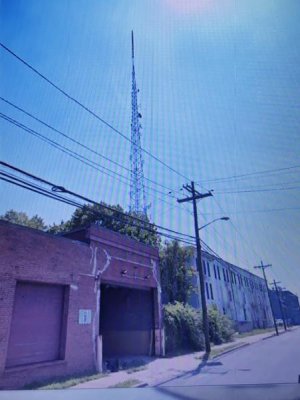
As a kid they were my favorite top 40 station, after they changed from Passport Radio. WIFI the only other choice on FM was flat, very compressed stereo separation and lousy signal, could never get through WMMRs flamethrower, never heard a FM stereo top 40 with that bad a sound. WPSTs presentation was laid back no high energy but great music plus great stereo also a great Philly signal. I never knew of a FM transmitter in the heart of a city, very run down area, the 10 bay is still up, could it be the fanatics back up, recent photo enclosed.

I felt a disturbance in the force... 
Anyway....I went to the FCC history cards, armed with a pretty good idea of what they would say.
And I was right: 97.5 signed on in 1947 as WTOA, and it never ran more than 14 kW until 1967, when it went for a maximum power increase.
Had it done so before 1964 when the rules changed, it might have been able to get more than 50 kW. But once the class structure for FM was codified, class B stations were limited to 50 kW, and that's how much 97.5 got.
(So why did it say 100 kW in BY? Some FM stations played the game, in that early era of using both h+v polarization, of adding up their power in each plane... and 50 h plus 50 v indeed "adds up" to 100.)
Anyway....I went to the FCC history cards, armed with a pretty good idea of what they would say.
And I was right: 97.5 signed on in 1947 as WTOA, and it never ran more than 14 kW until 1967, when it went for a maximum power increase.
Had it done so before 1964 when the rules changed, it might have been able to get more than 50 kW. But once the class structure for FM was codified, class B stations were limited to 50 kW, and that's how much 97.5 got.
(So why did it say 100 kW in BY? Some FM stations played the game, in that early era of using both h+v polarization, of adding up their power in each plane... and 50 h plus 50 v indeed "adds up" to 100.)
WTOA
I was an engineer at WTOA when they increased power to 50KW. They were at 14,500 watts because they were short spaced to WALK in Pachogue, LI. also on 97.5. In order to get WALK to agree to accept some interference a deal was negotiated. I don't know all of the details but it did involve sending WALK the old 3KW GE backup transmitter. A new AEL 5KW transmitter and directional antenna were installed for the 50KW upgrade. On the first day of operation at 50KW the New AEL transmitter failed and WTOA was back to 14,500KW for 3 days because AEL had not finished work on the second 5KW backup transmitter and had to use parts from it to fix the new main transmitter and it failed again after only a few hours. AEL had no other replacement part on hand. Art silver was so upset he cancelled the AEL deal and purchased I believe a Gates instead.
I felt a disturbance in the force...
Anyway....I went to the FCC history cards, armed with a pretty good idea of what they would say.
And I was right: 97.5 signed on in 1947 as WTOA, and it never ran more than 14 kW until 1967, when it went for a maximum power increase.
Had it done so before 1964 when the rules changed, it might have been able to get more than 50 kW. But once the class structure for FM was codified, class B stations were limited to 50 kW, and that's how much 97.5 got.
(So why did it say 100 kW in BY? Some FM stations played the game, in that early era of using both h+v polarization, of adding up their power in each plane... and 50 h plus 50 v indeed "adds up" to 100.)
I was an engineer at WTOA when they increased power to 50KW. They were at 14,500 watts because they were short spaced to WALK in Pachogue, LI. also on 97.5. In order to get WALK to agree to accept some interference a deal was negotiated. I don't know all of the details but it did involve sending WALK the old 3KW GE backup transmitter. A new AEL 5KW transmitter and directional antenna were installed for the 50KW upgrade. On the first day of operation at 50KW the New AEL transmitter failed and WTOA was back to 14,500KW for 3 days because AEL had not finished work on the second 5KW backup transmitter and had to use parts from it to fix the new main transmitter and it failed again after only a few hours. AEL had no other replacement part on hand. Art silver was so upset he cancelled the AEL deal and purchased I believe a Gates instead.
- Status
- This thread has been closed due to inactivity. You can create a new thread to discuss this topic.