
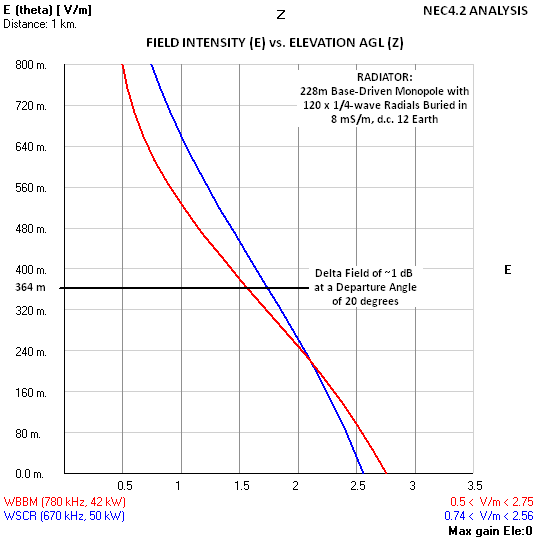
The study shown below responded to a question on another website, but might be of interest here, too. To answer that question, it compares the theoretical field intensities of WSCR and WBBM at elevation angles of zero to about 39 degrees AGL that exist 1 km from the WSCR tower.
The study shows that even with the 42 kW transmitter power licensed to WBBM at night, they have higher groundwave fields than WSCR does with 50 kW.
But nighttime skywave coverage over a great-circle path of about 300 miles depends on radiation centered at about 20 degrees elevation AGL. In that case and for equal propagation conditions -- the nighttime skywave field received from WBBM at that range is about 1 dB less than from WSCR.
The reason for the differences is the difference in the gain/shape of the vertical plane radiation patterns of the WSCR tower on those two frequencies.
The study shows that even with the 42 kW transmitter power licensed to WBBM at night, they have higher groundwave fields than WSCR does with 50 kW.
But nighttime skywave coverage over a great-circle path of about 300 miles depends on radiation centered at about 20 degrees elevation AGL. In that case and for equal propagation conditions -- the nighttime skywave field received from WBBM at that range is about 1 dB less than from WSCR.
The reason for the differences is the difference in the gain/shape of the vertical plane radiation patterns of the WSCR tower on those two frequencies.