Back to WCBS vs. WNBC, it always seemed like WCBS had a better Night signal in Michigan, partly due to the tower being electrically longer at 880 kHz than at 660 kHz.

-
Get involved.
We want your input!
Apply for Membership and join the conversations about everything related to broadcasting.
After we receive your registration, a moderator will review it. After your registration is approved, you will be permitted to post.
If you use a disposable or false email address, your registration will be rejected.
After your membership is approved, please take a minute to tell us a little bit about yourself.
https://www.radiodiscussions.com/forums/introduce-yourself.1088/
Thanks in advance and have fun!
RadioDiscussions Administrators
You are using an out of date browser. It may not display this or other websites correctly.
You should upgrade or use an alternative browser.
You should upgrade or use an alternative browser.
WCBS long-distance reception
- Thread starter Yabadabado1
- Start date
WCBS daytime DX from the Bahamas:
The Caribbean World Series has been going on for the past 2 weeks, so you could be getting p-b-p from Puerto Rico, Cuba, Mexico, Venezuela, Panama or Colombia!It looks like WADO would be more likely to get to Puerto Rico, etc. with the 50 kW Day Pattern.
In 1971, I heard WADO in Michigan playing "Maggie May" in English followed by a Spanish speaking announcer. The old Night Pattern was the equivalent of the old 1000 watt nondirectional facility in the nulls after the 1940s. It was late at Night, and many stations signed off then.
Then fairly recently, I heard PBP Baseball in Spanish in Northeast Michigan in the late afternoon, and the very quick English TOH ID.


Bottom is the old 5 kW DA-1 Pattern.
In this case, it was WADO, they said “WADO New York”.The Caribbean World Series has been going on for the past 2 weeks, so you could be getting p-b-p from Puerto Rico, Cuba, Mexico, Venezuela, Panama or Colombia!

back when i lived in NW PA, after WCBS Skywave burned off, i had like a 2-3-4 minute window for CKLW Brandon, MB. Im the only person to have reported long distance DX or 100kw 91.5 and 10kw 880, CLW.. and from the same location

Adding my opinion to Schrodingers Cat comment-
1. The High Island main antenna has slightly greater efficiency at 880 kHz, compared to 660 kHz.
2. The antenna is top loaded. This and the difference in antenna electrical length changes the current distribution, thus changing the vertical radiation pattern of the antenna at different frequencies. This means the ionosphere is illuminated slightly differently at a given angle above the horizon, with respect to 660 kHz and 880 kHz.
3. I think it is reasonable to assume skywave propagation is not necessarily the same at different frequencies at a given moment, even over the same ground level path between transmitter and receiver.
Having said that, I would not obsess too much about this. There is no social media story here, it is just a nuance.
It's common for skywave propagation to ebb and flow differently from similar transmitting facilities in one area. On any day 660 and 880 are fine signals from the number one market in the US.
Also note that even though WCBS likely has a slight edge for skywave propagation, WFAN operates at a frequency where path attenuation of the groundwave signal is less, compared to the higher frequency of WCBS. Thus, WFAN has greater groundwave coverage, and WCBS has slightly greater radiated signal at lower vertical elevation angle because of points 1 and 2 above.
Note the ground itself does not have greater conductivity at lower frequencies, rather it is the behavior of radio wave propagation over a given ground conductivity. Provided the antenna system successfully launches an electromagnetic wave, ground conductivity should not significantly affect single hop skywave propagation. Antenna system includes ground plane out to approximately 3/8 wavelength.
As always, if I got the technical part wrong, jump in here and correct me.
1. The High Island main antenna has slightly greater efficiency at 880 kHz, compared to 660 kHz.
2. The antenna is top loaded. This and the difference in antenna electrical length changes the current distribution, thus changing the vertical radiation pattern of the antenna at different frequencies. This means the ionosphere is illuminated slightly differently at a given angle above the horizon, with respect to 660 kHz and 880 kHz.
3. I think it is reasonable to assume skywave propagation is not necessarily the same at different frequencies at a given moment, even over the same ground level path between transmitter and receiver.
Having said that, I would not obsess too much about this. There is no social media story here, it is just a nuance.
It's common for skywave propagation to ebb and flow differently from similar transmitting facilities in one area. On any day 660 and 880 are fine signals from the number one market in the US.
Also note that even though WCBS likely has a slight edge for skywave propagation, WFAN operates at a frequency where path attenuation of the groundwave signal is less, compared to the higher frequency of WCBS. Thus, WFAN has greater groundwave coverage, and WCBS has slightly greater radiated signal at lower vertical elevation angle because of points 1 and 2 above.
Note the ground itself does not have greater conductivity at lower frequencies, rather it is the behavior of radio wave propagation over a given ground conductivity. Provided the antenna system successfully launches an electromagnetic wave, ground conductivity should not significantly affect single hop skywave propagation. Antenna system includes ground plane out to approximately 3/8 wavelength.
As always, if I got the technical part wrong, jump in here and correct me.
Last edited:
When I was in St. Pete's Beach FL a few years ago, I also noticed WCBS was the only NYC signal I picked up at night. Using a car radio, 660 and 770 were not audible. And while it wasn't strong, I could understand news stories I was hearing on 880.
I asked myself, if 660 is lower on the dial, why wasn't I getting WFAN from the same Bronx tower? After all, in the daytime in places like Vermont and Maine, WFAN is sometimes audible when WCBS and WABC are not. Then I learned that being lower on the dial helps a lot in propagation but only in the daytime, using ground wave. Skywave doesn't favor lower-on-the-dial stations. And as Greg explains above, night time skywave has its own rules!
I asked myself, if 660 is lower on the dial, why wasn't I getting WFAN from the same Bronx tower? After all, in the daytime in places like Vermont and Maine, WFAN is sometimes audible when WCBS and WABC are not. Then I learned that being lower on the dial helps a lot in propagation but only in the daytime, using ground wave. Skywave doesn't favor lower-on-the-dial stations. And as Greg explains above, night time skywave has its own rules!
Last edited:
It looks like the WNEW...WBBR 1130 Directional Night pattern favors the East Southeast more than the Northeast. It might be that the three shorter DA towers have more high angle skywave, and like others have mentioned, higher frequencies may have better skywave, at least during certain times of the year.I always found WBBR to have a far superior signal in New England at night
You guessed it, right along the northeastern coast.Along the north coast beaches, yes. But get inland or on the southern coast and it is all Venzuela and Colombia.

Moved to DX and Reception.
I find it interesting that 880 WCBS puts a good signal into central Florida but 660 WFAN does not. The signals are radiating from the same tower.
That was my observation too most of the time I lived in Tampa but when I first moved down there in 1984, '66 WNBC' had a much better signal and I could even hear it stereo on my AM Stereo Walkman.
I think it was because of less Cuban interference.
Also, I've noticed WFAN, WABC, and WCBS come in a lot stronger at night in Daytona Beach than over in Tampa, probably because there's a lot less land between there and New York.
Last edited:
... Also, I've noticed WFAN, WABC, and WCBS come in a lot stronger at night in Daytona Beach than over in Tampa, probably because there's a lot less land between there and New York.
That makes sense because in a multiple hop sky wave path the ocean surface is probably an optimum reflector.
Ground conductivity should not significantly affect single hop skywave propagation, but it will affect multiple hop skywave propagation at the reflection points on the earth's surface. I think the ionosphere characteristics are ever changing and this causes the intermittent nature of sky wave radio listening.

File:Antenna Vertical Angle vs 1 Hop Distance.png - Wikipedia
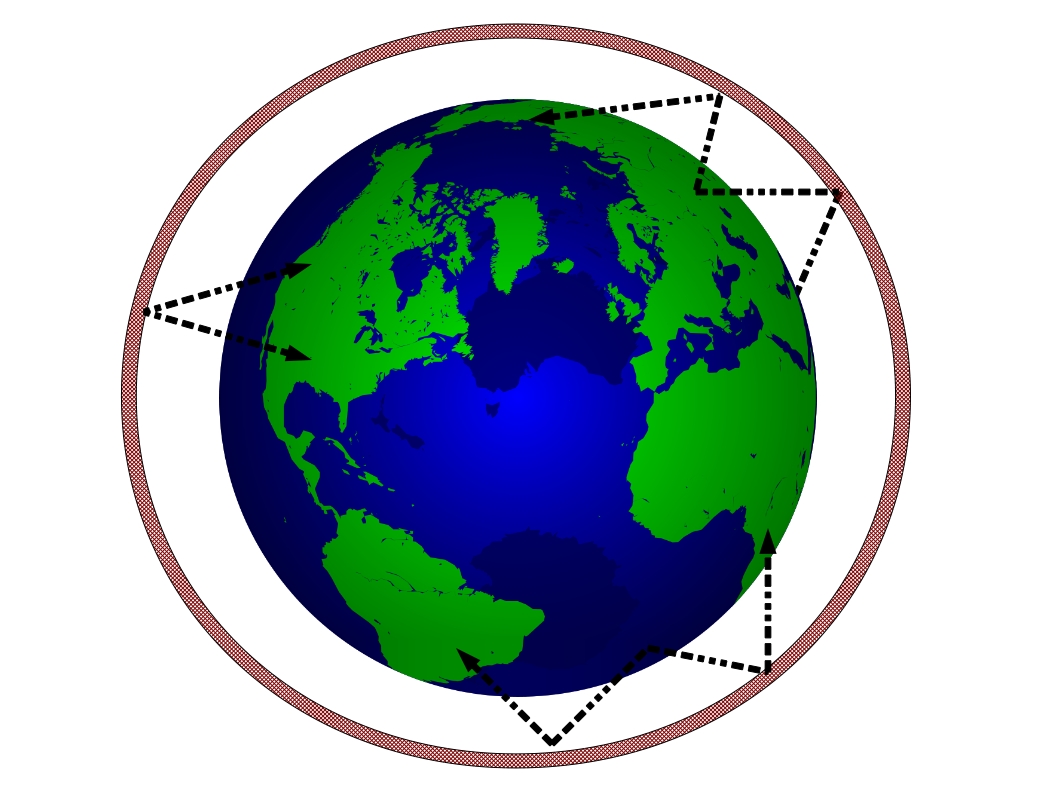
Skywave - Wikipedia
Different tower electrical heights have different vertical elevation patterns, which in turn excite different levels of the ionosphere at different distances. Result = Goulash

File:Monopole antenna radiation patterns.svg - Wikipedia
The image below is a public government document. If this is not OK to post, please delete.
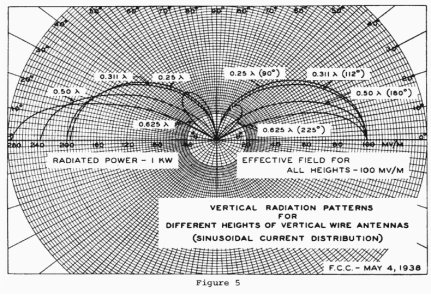
Radio broadcasting certainly made good use of the sky wave phenomenon, at a time when other forms of immediate mass communication to the public did not exist. Younger people might not realize what a big deal AM sky wave was in rural areas back then, when many people did not have TV reception. For those who remember, AM radio at night still brings a thrill.
Last edited:
In Chicago, WCBS is the NYC station that comes in strongest for me. You can get WFAN but it's weak and inconsistent. Also, somewhat randomly when I was in Philadelphia last week I tried for the NYC AM stations during the middle of the day. Several came in quite well, including WCBS, but WFAN was rather hard to hear. So this might be a general phenomenon.

Heh, I would think WFAN would be the easiest in Philly being on the lower end of the dial. I do remember back in 2014 when some buddies and I were driving from New York to DC, WFAN noticeably weakened right about Philly and was pretty much inaudible by the time we crossed into Maryland. This was in the middle of a July afternoon. We were on the New Jersey Turnpike so not in Philly itself.
That said, a few years later driving from Columbus to suburban D.C. to visit one of those same buddies, also on a July afternoon with similarly fantastic weather, I picked up a very weak WFAN in northwest Maryland and took it almost all the way to Gaithersburg.
That said, a few years later driving from Columbus to suburban D.C. to visit one of those same buddies, also on a July afternoon with similarly fantastic weather, I picked up a very weak WFAN in northwest Maryland and took it almost all the way to Gaithersburg.
Both WABC...WCBS 880 and WEAF...WFAN 660 use Top Loading. The tower height is about 520 feet. WJZ...WABC 760/770 had considered triplexing, but has a monopole antenna tower, slightly more than a half wave, in New Jersey. Those are what would be called legacy call letters, not necessarily original call letters. As I recall, the tower built on Columbia Island for WABC...WCBS 860/880 was something like 410 feet high and was also top loaded.
Last edited:
Here's an article about the History of the WABC...WCBS 860/880 tower on what was named Columbia Island.

 www.radioworld.com
CBS-WABC-TX-1-726x910.jpg
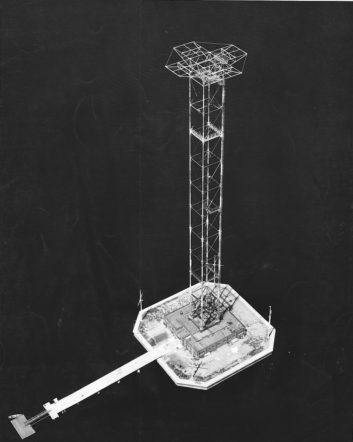
WCBS: A Radio Island in the Stream - Radio World
Popular radio history author Buc Fitch relates the story of a station whose transmitter sat on an island, WCBS 880.
www.radioworld.com
CBS-WABC-TX-1-726x910.jpg
Any ground wave signal that has to cross parts of Long Island is severely attenuated. The M-3 Map shows it as 0.5 mS/m. A recent application for the station in Patchogue has at least one measured radial that has measurement points well below 0.1 mS/m, the lowest curve on the more recent ground wave graphs.
Same for Manhattan as I understand. I've enjoyed @fybush's examples over the years of how signals suffer crossing Manhattan in either direction, whether it's WABC coming from New Jersey, WFAN and WCBS from High Island or any other station.
What I've never understood is how WFAN and WCBS can be heard so well to the southwest, above examples included, when its signal is so degraded crossing Manhattan.
What I've never understood is how WFAN and WCBS can be heard so well to the southwest, above examples included, when its signal is so degraded crossing Manhattan.
I remember WFAN (and WNBC) used to show up regularly in the monthly radio ratings in Philadelphia. I don’t remember WCBS similarly showing up in the Philly ratings but with local all news KYW even if WCBS came in clearly people probably didn’t feel a need/reason to listen to it in Philly.
From what I heard, the salt water flats West of The Hudson, The Meadowlands, where almost all of the New York City towers are located, was or is far in excess of M-3. I have heard that they have tried to reverse some of the irrigation for the grass lands, I think somebody said it was the Amish, who sold the hay for income, and used reversed diverted Ocean water to irrigate it. If anyone has a link to the story, please post it. Anyway, it seems like I've heard quoted 40 mS/m in that area, at least at one time. The M-3 Map shows 4 mS/m. Maybe the relocated WOR tower application shows some radials. So maybe if it crosses the Meadowlands in those areas, it might explain it. Dave Doherty told me that a station he worked at near the ocean, possibly in Rhode Island, had large diurnal conductivity changes with the tides up the river near the station.
- Status
- This thread has been closed due to inactivity. You can create a new thread to discuss this topic.