• Get involved.
    We want your input!
    Apply for Membership and join the conversations about everything related to broadcasting.

    After we receive your registration, a moderator will review it. After your registration is approved, you will be permitted to post.
    If you use a disposable or false email address, your registration will be rejected.

    After your membership is approved, please take a minute to tell us a little bit about yourself.
    https://www.radiodiscussions.com/forums/introduce-yourself.1088/

    Thanks in advance and have fun!
    RadioDiscussions Administrators

WCSB Flips to Jazz

It's also amazing to me that WCSB does in fact have the level of support it does. Some of these stations don't. People are noticing, and not in a good way.

We've seen this around the country when alternative stations flip formats to something else. The alternative music fans come out complaining that their music is being treated badly.

My first question is was there enough "support" for the station to operate independently of the university? How much money did they raise and how was that money spent? Could they have raised enough to hire a professional administrator and take the station off university property? Those are key questions the supporters should be asking.

I also don't think the decline in student radio is good for culture, and in fact, we're seeing stations with high levels of student interest once again. There's a valid role for student radio to play, and reasonable arguments in favor of its continued existence.

I agree with all of that, and I have a long history of supporting student radio.

Do you really want to accelerate the message that FM is only for large donors and more elite non profits and declining corporations?

Welcome to the real world. Once again, look at the alternative: K-Love. What message does that send?

It would be nice if there were alternatives. Some schools such as Harvard have turned their college stations to alumni groups. I think Columbia is run the same way.

 
I don't have access to the WCSB budget.

From what I'm reading, from people who seem to have some sense of the operations of the stations, possibly because they worked or had volunteered there in some capacity, WCSB cost about $40K a year.

It's claimed that it breaks down between $28K or so for some sort of scholarship/work study program, and an engineer on call and doing maintenance. It's also said that they had an annual fundraiser that covered station expenses. I'm not familiar enough with that to say.

The post I link to below shares some thoughts on how this was handled. I don't think it was actually wise of the administration to say "it wasn't about the budget" - it actually opened that up to questioning. If they hadn't brought it up, maybe more would assume it was. They could have closed out college radio day, had disclosure with the station's staff and volunteers, and transitioned to an online station.


Now, I get that some will say Ideastream is more "professional" and will give opportunities to the students. Is that happening to any significant degree at GPB? I would argue that probably fewer students ever get involved with those programs than the previous college radio formats. If you could prove a clear program that benefitted students in a significant number more than the communications, social and multimedia skills provided by a strong college radio station, I might be more sympathetic.

Either way, we wouldn't be debating this half as much if it had been handled professionally.
 
We've seen this around the country when alternative stations flip formats to something else. The alternative music fans come out complaining that their music is being treated badly.

My first question is was there enough "support" for the station to operate independently of the university? How much money did they raise and how was that money spent? Could they have raised enough to hire a professional administrator and take the station off university property? Those are key questions the supporters should be asking.


I agree with all of that, and I have a long history of supporting student radio.


Welcome to the real world. Once again, look at the alternative: K-Love. What message does that send?

It would be nice if there were alternatives. Some schools such as Harvard have turned their college stations to alumni groups. I think Columbia is run the same way.

You know, I think some lessons can be taken from what happened to KTXT in Lubbock in 2008 and its return in 2011. Here's the story from Wikipedia:

 
They are obviously familiar with the JazzNeo on HD. They didn't do this for themselves. That's not what foundations do. They do this to benefit others. As Char said, "This project is a great opportunity to ensure that the sound and spirit of jazz continue for future generations.”
And what if the future generations says "Nah. We pass. Play it to the tombstones in the graveyard were most of your listeners are today."
 
Once again, I have no dog in this fight. I just have knowledge of other similar situations at other universities. Let me address some points from that reddit post:

CSU prez tries to spin this as creating new opportunities for students, while failing to recognize the even greater opportunities that they had in being able to run a station completely.

Running a station is not the same as having responsibility. Some of these students are still minors in the eyes of the law. Regardless of their age, the university is legally responsible for what happens on the signal and on the premises. Plus we have the issue of non-students on university property. The liability matters, and the students really have no answer to that.

Despite the fact that WCSB has been broadcasting online for 30 years, students were not given the option to continue their organization as a streaming station and were in fact locked out of the studio, effectively saying that it isn't the FCC license that was driving this but that the student organization itself was an issue.

That brings me back to the responsibility issue. Who is responsible to the FCC? The university. Who is responsible for accidents in the studio? The university. The students have no answer to offset those liability concerns.

These are just my observations. I have no inside knowledge of anything.

Given what I'm reading, perhaps some people might understand why some colleges simply turn the license in to the FCC. Once that's done, it's done.
 
You know, I think some lessons can be taken from what happened to KTXT in Lubbock in 2008 and its return in 2011. Here's the story from Wikipedia:

Interesting story. The main factor it seems to me is how involved an academic department wanted to be in operating the station. I saw some similar things in Kentucky, where WKU's media department was very dedicated to operating a PBS TV station, even though there already was a PBS station in the area owned by the state. The department somehow had the funding, the staffing, and the intertest to take the responsibility. From what I can see, that's what's missing at CSU.
 
They've handled that responsibility for thirty years. They trusted the students that long, and had community volunteers doing ethnic shows. Sure, if you're going to treat people that way and have no trust in them, well... that says more about the administration or the forces behind this than the people who gave their time to the station.

Additionally, what's the current issue at public radio? Funding. And younger audiences (some of whom I see saying they liked Ideastream programming and WCSB) are less likely to donate.

You can write these kids off as playing their weird music now, but what if the next Jobs or Bezos was involved with or loved WCSB and saw the administration doing this? Do you think they're going to be putting Ideastream in their trusts? This is not even good "business." Souring a bunch of people on your product at a time when you need all the supporters you can get. Not smart.
 
They've handled that responsibility for thirty years.

Not legally. That's the problem.
You can write these kids off as playing their weird music now, but what if the next Jobs or Bezos was involved with or loved WCSB and saw the administration doing this? Do you think they're going to be putting Ideastream in their trusts? This is not even good "business." Souring a bunch of people on your product at a time when you need all the supporters you can get. Not smart.

If they're as responsible as you say, they should turn this into a learning moment and gain strength from the experience. That would be my advice. Take what you've learned and apply it in a positive productive way. I imagine Ideastream needs passionate people who are dedicated to the art of radio. They should take the opportunities given, and continue to grow and contribute.
 
If they're as responsible as you say, they should turn this into a learning moment and gain strength from the experience. That would be my advice. Take what you've learned and apply it in a positive productive way. I imagine Ideastream needs passionate people who are dedicated to the art of radio. They should take the opportunities given, and continue to grow and contribute.
I think the track record of the station speaks for itself. Having said that, is there a place for them at Ideastream? Did those promised opportunities at GPB or the classical network that replaced KUSF materialize? I've been promised a lot of things in my career and the next GM or PD or owner completely forgot about them when the mood changed, nothing was in writing.

Maybe they did create those opportunities. But I'm a cynic about promises made from media consolidators, commercial or non. Maybe the programmers at WCSB will take it to a web stream or LPFM. Because part of what they did, if you dig into the history and social media, is they created specialty music programming that was a depth of cultural knowledge. A lot of these people are doing for free the sort of thing that DJs at KEXP get paid to do. Just because they aren't getting paid for it doesn't mean they don't have an audience, or following, or create professional programming within the context of their niche.

Reddit posts from people associated with the station said WCSB covered its bills with an annual fundraiser. That means listeners supported them. And that's something I think shows value. That's not what Ideastream does. And Ideastream can't fund a lot of outreach right now. Most public broadcasters can't keep the employees they've got, so I don't anticipate a lot of new paid internships or job opportunities opening up for these college students when the people who'd train them are barely holding onto theirs thanks to the CPB defunding.

Anyways. It's happened. And it's becoming circular for me to keep saying this - but it could have gone down differently. And maybe this will be an example to others on how not to do it. What's getting people more upset is the appearance of backroom dealing and lack of consideration and respect. People who invest their time for free to a cause or passion don't like being treated like they're useless or outcasts. That's human nature - and you can see it playing out on a lot of stages much bigger than one college radio station.
 
Having said that, is there a place for them at Ideastream? Did those promised opportunities at GPB or the classical network that replaced KUSF materialize? I've been promised a lot of things in my career and the next GM or PD or owner completely forgot about them when the mood changed, nothing was in writing.

The main thing the university wanted in this deal was paid internships in several departments at Ideastream. They're written in the deal. They exist and are real. But they're only available to actual students.

Maybe the programmers at WCSB will take it to a web stream or LPFM. Because part of what they did, if you dig into the history and social media, is they created specialty music programming that was a depth of cultural knowledge.

I don't know about that. The main question I had to ask myself when I was in college radio was what was more important to me: The music or radio. Because once I left college, there were no jobs playing the music I was playing in college radio. That was just the practical reality of it. If doing that kind of specialty music is their main interest, then they will likely never have much use for it in the real world. There aren't a lot of jobs at AAA radio stations like KEXP.
Reddit posts from people associated with the station said WCSB covered its bills with an annual fundraiser. That means listeners supported them. And that's something I think shows value. That's not what Ideastream does.

Sure it is, but Ideastream raises listener money from what IT does, not alternative rock. If the students want to take this online, they need to do a budget and see if they can raise enough from listeners to pay their expenses. Because the university is done with radio.

What's getting people more upset is the appearance of backroom dealing and lack of consideration and respect. People who invest their time for free to a cause or passion don't like being treated like they're useless or outcasts. That's human nature - and you can see it playing out on a lot of stages much bigger than one college radio station.

The radio station was a club. That's how the university viewed it. Like any other club students joined on campus. It was a very expensive club that required an FCC license. But it was a club. Not a job. There were no obligations made by the university to the club. My advice to other students around the country who do student radio like this is to expect a very similar thing to happen. Because this isn't an area where colleges want to be anymore. Once these students get into the job market, they will experience backroom deals all the time. This is nothing new. They need to be thankful for what they had, celebrate what they did, and move on.
 
Anyways. It's happened. And it's becoming circular for me to keep saying this - but it could have gone down differently. And maybe this will be an example to others on how not to do it.

I was at a college where this kind of thing happened. It was at a big private university, and the student station was located inside the building where the broadcasting department was based. The station had a very long history, going back to the 50s. The university decided it wanted to have the station run by professionals. They flipped it to NPR News. It became the second station in that market doing NPR News. The students had a closed carrier AM station. Ultimately that became a 100 watt FM station, and it's now in the student center. So the students had a place to go. The students actually own that second station, not the university. But this was a university that had a very active broadcasting department, and they were directly involved in overseeing the station. That's what appeared to be missing at WCSB. I don't know what kind of academic commitment the university has to broadcasting.

Let me repeat: The students, not the university, own the second radio station. The students and alumni (some of whom own radio companies) formed a non-profit company that applied for an FM license. They also involved the university, so the station could be on university property, and the tower is on a university building. It was all done legally and with contracts. There will be no backroom meetings. It's owned by the students. Could this happen in Cleveland? I don't know.
 
Last edited:
The really crappy: Some of the higher ups knew about this for months but signed NDAs ( source: Former CSB DJ Keith's show on ihatefreespeech.net) and the switch was DURING a meeting with the WCSB staff and were totally blindsided by the whole thing. They went back to get their stuff but their keycards were disabled

The good: WRUW and WJCU are opening their doors to displaced WCSB DJs to possible do their shows there.


IdeaStream might actually lose a considerable amount of donations over this, There were folks that believed in both Ideastream and WCSB so they donated to both. Now they will likely donate to neither. Combine that with the Trump administration cutting funding to NPR (Which is what Ideastream is)... all I gotta say is. Good luck!
 
The really crappy: Some of the higher ups knew about this for months but signed NDAs ( source: Former CSB DJ Keith's show on ihatefreespeech.net) and the switch was DURING a meeting with the WCSB staff and were totally blindsided by the whole thing.

As we've been discussing, the university was looking for a way out of radio. This was perhaps the best option. Perhaps an academic department could have stepped in. Perhaps the students could have set up their own radio company and made a proposal similar to what Ideastream did. But that's what it would have taken. Blaming Ideastream doesn't help anyone.
 
As we've been discussing, the university was looking for a way out of radio. This was perhaps the best option. Perhaps an academic department could have stepped in. Perhaps the students could have set up their own radio company and made a proposal similar to what Ideastream did. But that's what it would have taken. Blaming Ideastream doesn't help anyone.

How? They had literally zero time to react. They were blindsided and were left with zero time to propose anything.
 
How? They had literally zero time to react. They were blindsided and were left with zero time to propose anything.

Was any academic department at the university involved in the station? I haven't seen any mention of any academic department in any of the stories. And was that department involved in the deal with Ideastream? Or was this all at the presidential level?

Because that's where the problem is. Students are just students. Not employees in any contractual way. They're not part of the process unless they have a legal role. The university makes the decisions about undergrad students. "In Loco Parentis." In the place of parents. That's how things are at any university.

This kind of thing has happened at dozens of college stations around the country. Sometimes, the station is just shut down and the license is turned in. Sometimes the license is sold to K-Love or a religious broadcaster. In any case, the students are never involved. It could easily happen at the two other student stations in town.
 
Last edited:
WCSB staffers who went on to professional careers include Kid Leo, Ed Ference, Matt the Cat and Mike Olszewski. Many of John Gorman's legendary WMMS staff came from WCSB. And those are only some of the people who launched their careers from WCSB.
But those kind of opportunities are rare today and students are aware of that. Hopefully those who are dedicated to a career in the new worlds of "broadcasting" will not be discouraged and will find or create those kinds of opportunities again.
 
WCSB staffers who went on to professional careers include Kid Leo, Ed Ference, Matt the Cat and Mike Olszewski. Many of John Gorman's legendary WMMS staff came from WCSB. And those are only some of the people who launched their careers from WCSB.
But those kind of opportunities are rare today and students are aware of that. Hopefully those who are dedicated to a career in the new worlds of "broadcasting" will not be discouraged and will find or create those kinds of opportunities again.

Kid Leo got out of broadcast radio in 1988. He went to Columbia Records, where he could follow his love of music. That's my advice to these student. If they love music, they need to get in the music business. Radio isn't in the music business. Some colleges offer a combined degree in music & media. They should look for those degree programs.
 
WCSB staffers who went on to professional careers include Kid Leo, Ed Ference, Matt the Cat and Mike Olszewski. Many of John Gorman's legendary WMMS staff came from WCSB. And those are only some of the people who launched their careers from WCSB.
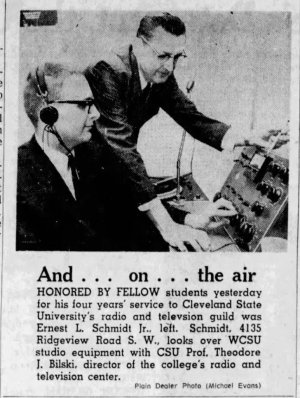
One correction: they did not come from WCSB but from carrier-current station "WCSU" (which moreso amounted to a public-address system at the college cafeteria). I cannot find an exact start date, and the Caldron and Cleveland Stater archives are apparently not digitized, but the Plain Dealer shows it existed as early as 1967.
1759774576804.jpeg

It was at "WCSU" where Kid Leo effectively trained on how to a be a radio host, and not only did he go to WMMS, but so did Betty Korvan, Charlie Kendall, Matt the Cat and Ed "Flash" Ferenc... mostly because Malrite was incredibly frugal on spending for air talent on the FM in the 1970s. You could argue that "WCSU" being an unintentional pipeline for WMMS air talent resulted in CSU applying for, and getting, a 10-watt FM license.


Back
Top Bottom