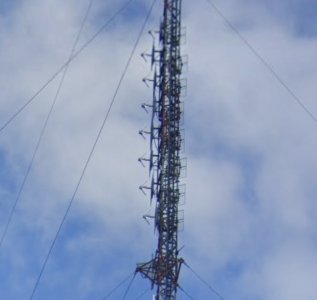
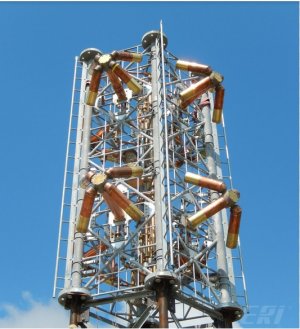
I thought of this question that relates to power output versus height, so I thought I would pass it along to the experts. In my current market (Vancouver BC), all of the local FM and TV broadcasters use the same mountain for transmitting. However, there are multiple towers spaced at various heights of the mountain.
Some stations transmit from the tower site located at the very top of the mountain access road, which provides an approximate HAAT of 2250 feet. Stations that use this tower may have some variance in their precise HAAT, but all transmit with approximately 75kw. At the same time, some broadcasters using this site are also running a lower power output (10kw).
Make your way slightly down the mountain access road, and you'll run into another tower site. This site is slightly lower (at 2,026 feet HAAT), but broadcasters using this tower operate at 100kw.
Continue down the mountain, and there's one remaining tower site. This site is located somewhere around 1,200 feet HAAT, and stations using the tower operate at 100kw.
With all of this information in mind, I was curious about which scenario is most "ideal" to someone who is attempting to engineer the best possible configuration for their station. Granted, all of these sites seem to work just fine in the core listening area, and I'm really not considering the fact that the "best site" is always the one that is most affordable to the owners and most accessible to the engineer. For simplicity, I'll list my questions:
1. Is the best scenario being at the top of the mountain with a slightly lower ERP? Or would you rather be at the next site down with max ERP for superior building penetration? Would being slightly lower (while running 100kw) actually create some multipath interference, which could be avoided at the higher site?
2. Is the lowest site (located at 1,000 feet below the tallest site) somewhere that most engineers would want to avoid to prevent multipath interference?
3. If your equipment is located on a tower on the side of a mountain, will the engineer mount the antenna on the side of the tower (facing the metropolitan area) without vertical polarization? What is the effect for those who happen to live near the mountain transmission site (if the beam has a horizontal polarization to better serve communities further away from the tower)?
Thanks in advance for any information!
Some stations transmit from the tower site located at the very top of the mountain access road, which provides an approximate HAAT of 2250 feet. Stations that use this tower may have some variance in their precise HAAT, but all transmit with approximately 75kw. At the same time, some broadcasters using this site are also running a lower power output (10kw).
Make your way slightly down the mountain access road, and you'll run into another tower site. This site is slightly lower (at 2,026 feet HAAT), but broadcasters using this tower operate at 100kw.
Continue down the mountain, and there's one remaining tower site. This site is located somewhere around 1,200 feet HAAT, and stations using the tower operate at 100kw.
With all of this information in mind, I was curious about which scenario is most "ideal" to someone who is attempting to engineer the best possible configuration for their station. Granted, all of these sites seem to work just fine in the core listening area, and I'm really not considering the fact that the "best site" is always the one that is most affordable to the owners and most accessible to the engineer. For simplicity, I'll list my questions:
1. Is the best scenario being at the top of the mountain with a slightly lower ERP? Or would you rather be at the next site down with max ERP for superior building penetration? Would being slightly lower (while running 100kw) actually create some multipath interference, which could be avoided at the higher site?
2. Is the lowest site (located at 1,000 feet below the tallest site) somewhere that most engineers would want to avoid to prevent multipath interference?
3. If your equipment is located on a tower on the side of a mountain, will the engineer mount the antenna on the side of the tower (facing the metropolitan area) without vertical polarization? What is the effect for those who happen to live near the mountain transmission site (if the beam has a horizontal polarization to better serve communities further away from the tower)?
Thanks in advance for any information!