Johnny Magnus, "The Host Who Loves You the Most"...MOR used to mean American Songbook or Standards, along with Broadway show tunes. As Gregg said, it was pop artists like Sinatra, Nat King Cole, Andy Williams, Dionne Warwick, Patti Page, Steve and Eydie, etc. MOR tends to include ballads, but not rock n' roll or country. So if a typically rock act recorded a ballad, it might be played, but not the rock act's rock songs. An example might be "Let It Be", a ballad from the Beatles. But Beatles' rock music would not be played.
The most popular MOR station I can think of was KMPC 710 in L.A. Another station was KGIL, who covered the San Fernando Valley, but their transmission range wasn't very far. I don't think they reached Pasadena or Orange County.
I used to think that MOR stations were "lame", because my parents listened to them. But they could have cool DJ's. Wink at KMPC used to talk about his friendship w/ Elvis in Memphis; and even though Elvis was really not part of their format, sometimes he played Elvis ballads.
Wink used to talk about record producers, like how Jimmy Bowen produced songs for Sinatra ( on Capitol Records, I think), and that was very interesting.
Johnny Magnus was on KMPC at night, and he talked about standards tunes as if they were very jazzy and hip. Johnny used to do a feature called "Weather With a Beat", where he gave temps and weather conditions around the nation to a Count Basie song, I think.
He had a very ethereal, mellow kind of a voice. I used to lie in the dark with my radio under my pillow, think of all the far away towns with their buildings lighted up in the still of the night, and what fun it would be to travel there.
MOR stations can succeed with age 18-34 demographic, but it depends on the DJ. It needs a "with it" DJ who really can interpret those records, artists, songwriters, and producers.
I'm sure that someone will show up at any minute and grumpily, angrily, debunk everything I just wrote.
That's okay. I still liked KMPC and KGIL.

-
Get involved.
We want your input!
Apply for Membership and join the conversations about everything related to broadcasting.
After we receive your registration, a moderator will review it. After your registration is approved, you will be permitted to post.
If you use a disposable or false email address, your registration will be rejected.
After your membership is approved, please take a minute to tell us a little bit about yourself.
https://www.radiodiscussions.com/forums/introduce-yourself.1088/
Thanks in advance and have fun!
RadioDiscussions Administrators
You are using an out of date browser. It may not display this or other websites correctly.
You should upgrade or use an alternative browser.
You should upgrade or use an alternative browser.
What was middle of the road?
- Thread starter vchimpanzee
- Start date

Well, somewhere I read that these were two different formats.Nope. "Adult Standards" was coined while these stations were still in a pre-rock universe---in the 80s.
As for demographics, the stated target of MOR stations was 18-49. Center of that target is 33 1/2---and that's probably too low. It really was radio for 40-somethings. Sure, they'd get some younger and some older, but the 40s were kinda the sweet spot for that format in the 60s and early 70s before it morphed to Adult Contemporary.
Given what happened on WBT, I don't think you can necessarily say MOR turned into adult contemporary. But WBT was described as Top 40 at first. But WSOC sounded like adult contemporary to me.

Things happened differently in different markets. I've never been to Charlotte. I grew up in California. That's why I used the references I used.Given what happened on WBT, I don't think you can necessarily say MOR turned into adult contemporary. But WBT was described as Top 40 at first. But WSOC sounded like adult contemporary to me.
Magnus was special. I started listening to him at age 7 and there was never a point in my life where I wouldn't listen if Johnny was on.Johnny Magnus was on KMPC at night, and he talked about standards tunes as if they were very jazzy and hip. Johnny used to do a feature called "Weather With a Beat", where he gave temps and weather conditions around the nation to a Count Basie song, I think.
He had a very ethereal, mellow kind of a voice. I used to lie in the dark with my radio under my pillow, think of all the far away towns with their buildings lighted up in the still of the night, and what fun it would be to travel there.
MOR stations can succeed with age 18-34 demographic, but it depends on the DJ. It needs a "with it" DJ who really can interpret those records, artists, songwriters, and producers.
I'm sure that someone will show up at any minute and grumpily, angrily, debunk everything I just wrote.
That's okay. I still liked KMPC and KGIL.
Don't forget KBIG 740...my Aunt constantly switched between KPOL and KBIG...she loved the music and personalities on KPOL, but was totally enamored with the fact that KBIG's signal came from Catalina, one of her favorite places!As VChimp notes, the term "Adult Standards" wasn't around then (1960s-70s). I think the first time I saw it used was in the 1980s, referring to what had been called "Big Band/Nostalgia".
And "MOR" or "Middle-of-the-Road" didn't really exist as a format description until the 60s.
If you go back before Bill Haley and Elvis, to 1952-53, radio stations that played popular music were playing Perry Como, Rosemary Clooney, Nat "King" Cole and Patti Page. Essentially---those stations---KMPC, KSFO and KFI included---played the hits.
When rock and roll took over the charts, those stations started playing only some of the hits. The type of hits they'd been playing all along.
What those stations weren't were nostalgia machines. At most, they played two old songs an hour---and those were rarely more than five years old (exceptions---Dick Whittinghill would slip in a big band thing once a morning, Chuck Cecil had an entire show (The Swingin' Years) devoted to it).
As time went by, rock and roll's dominance of the charts became undeniable and even the pop stuff began to drift in that direction, in search of sales. Steve Lawrence may have wanted to be Frank Sinatra, but by 1962, he was singing a Carole King song ("Go Away Little Girl") and hitting #1. And as the 60s progressed, other artists (especially those signed to Columbia Records, like Andy Williams, Johnny Mathis, Tony Bennett and others) simply covered the pop hits of the day with (slightly) more adult orchestration and production.
At the same time, the earliest Beautiful Music stations (KPOL, KGBS, KABL) were showing up. So the KMPCs, KFIs and KSFOs of the world, looking for a way to describe where they fell (not KPOL, not KHJ), wound up with Middle of the Road---MOR.
Until not too long ago, Johnny had a couple of hours Sunday mornings on KKJZ 88.1Magnus was special. I started listening to him at age 7 and there was never a point in my life where I wouldn't listen if Johnny was on.
Since Broadcasting Yearbook used "MOR" for WEZC, perhaps some MOR stations evolved into that type of format.Things happened differently in different markets. I've never been to Charlotte. I grew up in California. That's why I used the references I used.
I wasn't in Charlotte for WBT's change. I read a newspaper column that described the WBT morning host as walking into his boss' office and cursing like a sailor when the change was made, and when I had access to newspaper coverage and letters to the editor, it was clear it was drastic and upsetting. But the music on WBT from before seems to be what has been described here.
Adult Contemporary in the 1970s was very different from what the format came to be in the 80s and 90s. For the most part, it was whatever the Top 40 station in the market was playing, minus the five or six hardest records and rock-based gold that went back ten to fifteen years instead of five to seven. KFMB-AM in San Diego was a classic example of an AC that drew most of its inspiration from Top 40.Since Broadcasting Yearbook used "MOR" for WEZC, perhaps some MOR stations evolved into that type of format.
I wasn't in Charlotte for WBT's change. I read a newspaper column that described the WBT morning host as walking into his boss' office and cursing like a sailor when the change was made, and when I had access to newspaper coverage and letters to the editor, it was clear it was drastic and upsetting. But the music on WBT from before seems to be what has been described here.

The Yearbook did not judge or assign format names. They sent a form to every station and the manager filled it out. Art Kellar’s WEZC was Beautiful Music.Since Broadcasting Yearbook used "MOR" for WEZC, perhaps some MOR stations evolved into that type of format.
Most old line MOR stations were talk heavy due to their network glory days heritages.I wasn't in Charlotte for WBT's change. I read a newspaper column that described the WBT morning host as walking into his boss' office and cursing like a sailor when the change was made, and when I had access to newspaper coverage and letters to the editor, it was clear it was drastic and upsetting. But the music on WBT from before seems to be what has been described here.
During COVID, K-Jazz was running repeats of Johnny's show, which aired Saturday and Sunday mornings from 7-10 a.m. In August of 2021, Johnny retired and Chuck Southcott took the timeslot. I'm told Johnny made the decision, and that it was not health-related.Until not too long ago, Johnny had a couple of hours Sunday mornings on KKJZ 88.1
Until it changed to what the Yearbook listed as MOR in 1983. Probably not changed in the Yearbook until 1984.The Yearbook did not judge or assign format names. They sent a form to every station and the manager filled it out. Art Kellar’s WEZC was Beautiful Music.
WBT was.Most old line MOR stations were talk heavy due to their network glory days heritages.
The thing to understand is that none of these format descriptors can be taken as Gospel. Any two stations sharing a label can be very different from one another. They describe a type of radio. There is no "MOR music", though there is "music MOR stations would have played".
Maybe. Some stations did not update the Yearbook and threw out the forms. At one time, I was manager of three different stations in two different markets in the Yearbook.Until it changed to what the Yearbook listed as MOR in 1983. Probably not changed in the Yearbook until 1984.
I was listed at one place for five straight years after I left.Maybe. Some stations did not update the Yearbook and threw out the forms. At one time, I was manager of three different stations in two different markets in the Yearbook.
Good to know...During COVID, K-Jazz was running repeats of Johnny's show, which aired Saturday and Sunday mornings from 7-10 a.m. In August of 2021, Johnny retired and Chuck Southcott took the timeslot. I'm told Johnny made the decision, and that it was not health-related.
If memory serves I think KMPC actually morphed into the format you just described, tried it for a while and then pretty much morphed back into what they were doing before...Adult Contemporary in the 1970s was very different from what the format came to be in the 80s and 90s. For the most part, it was whatever the Top 40 station in the market was playing, minus the five or six hardest records and rock-based gold that went back ten to fifteen years instead of five to seven. KFMB-AM in San Diego was a classic example of an AC that drew most of its inspiration from Top 40.
WLVV and WZXI were, I believe, listed as MOR before WEZC when they were really soft adult contemporary. If WBT had changed to what those stations were doing, whatever that would have sounded like ten years earlier, it might have been categorized as adult contemporary or it might not have. Seems like that's what WSOC sounded like. Perhaps fewer people would have been upset.The thing to understand is that none of these format descriptors can be taken as Gospel. Any two stations sharing a label can be very different from one another. They describe a type of radio. There is no "MOR music", though there is "music MOR stations would have played".
No worries, those were great stations!MOR used to mean American Songbook or Standards, along with Broadway show tunes. As Gregg said, it was pop artists like Sinatra, Nat King Cole, Andy Williams, Dionne Warwick, Patti Page, Steve and Eydie, etc. MOR tends to include ballads, but not rock n' roll or country. So if a typically rock act recorded a ballad, it might be played, but not the rock act's rock songs. An example might be "Let It Be", a ballad from the Beatles. But Beatles' rock music would not be played.
The most popular MOR station I can think of was KMPC 710 in L.A. Another station was KGIL, who covered the San Fernando Valley, but their transmission range wasn't very far. I don't think they reached Pasadena or Orange County.
I used to think that MOR stations were "lame", because my parents listened to them. But they could have cool DJ's. Wink at KMPC used to talk about his friendship w/ Elvis in Memphis; and even though Elvis was really not part of their format, sometimes he played Elvis ballads.
Wink used to talk about record producers, like how Jimmy Bowen produced songs for Sinatra ( on Capitol Records, I think), and that was very interesting.
Johnny Magnus was on KMPC at night, and he talked about standards tunes as if they were very jazzy and hip. Johnny used to do a feature called "Weather With a Beat", where he gave temps and weather conditions around the nation to a Count Basie song, I think.
He had a very ethereal, mellow kind of a voice. I used to lie in the dark with my radio under my pillow, think of all the far away towns with their buildings lighted up in the still of the night, and what fun it would be to travel there.
MOR stations can succeed with age 18-34 demographic, but it depends on the DJ. It needs a "with it" DJ who really can interpret those records, artists, songwriters, and producers.
I'm sure that someone will show up at any minute and grumpily, angrily, debunk everything I just wrote.
That's okay. I still liked KMPC and KGIL.
If memory serves I think KMPC actually morphed into the format you just described, tried it for a while and then pretty much morphed back into what they were doing before...
KMPC made a pretty abrupt move to AC in 1973. The gold library suddenly included The Big Bopper's "Chantilly Lace" and Geoff Edwards was needling Charlie Tuna on the air about how he (Geoff) was playing Marvin Gaye's "Trouble Man" before KROQ (AM).
Here's a comparison of two KMPC playlists---the one on the left is from 1973, the one on the right from 1970:
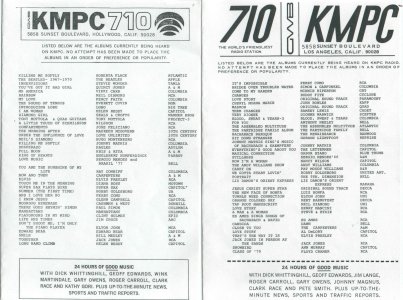
They dialed it back quite a bit in 1974, but never returned to what they were doing before 1973, largely because the mainline MOR artists were releasing less and less material.
They stayed AC until 1980, when they went talk. That was a disaster, and when they returned to music in 1982, it was as a nostalgia station---playing hits of the 30s, 40s and 50s. And that was very successful.
Last edited:
These charts bring back memories..."Hi I'm Roger Carroll, and I play records!", and of course Gentleman Jim Lange, who we also remember from the great KSFO...(and the Dating Game !)KMPC made a pretty abrupt move to AC in 1973. The gold library suddenly included The Big Bopper's "Chantilly Lace" and Geoff Edwards was needling Charlie Tuna on the air about how he (Geoff) was playing Marvin Gaye's "Trouble Man" before KROQ (AM).
Here's a comparison of two KMPC playlists---the one on the left is from 1973, the one on the right from 1970:
View attachment 4908
They dialed it back quite a bit in 1974, but never returned to what they were doing before 1973, largely because the mainline MOR artists were releasing less and less material.
They stayed AC until 1980, when they went talk. That was a disaster, and when they returned to music in 1982, it was as a nostalgia station---playing hits of the 30s, 40s and 50s. And that was very successful.
This is a good description of Adult Contemporary programming. They generally played Top 40, but a softened Top 40, with a lot of gold added.Adult Contemporary in the 1970s was very different from what the format came to be in the 80s and 90s. For the most part, it was whatever the Top 40 station in the market was playing, minus the five or six hardest records and rock-based gold that went back ten to fifteen years instead of five to seven. KFMB-AM in San Diego was a classic example of an AC that drew most of its inspiration from Top 40.
Back in the 70's, I used to "DX" around at night, just on a regular transistor radio, and KOIL 1290 Omaha came in pretty clearly, especially when my family was traveling in the Palm Springs area, or traveling to Phoenix. They called themselves Top 40 in those days, but it wasn't Top 40 like an L.A. station. They eliminated some of the hardest records, and played more gold than L.A. rockers. This is just my opinion. -- Daryl
- Status
- This thread has been closed due to inactivity. You can create a new thread to discuss this topic.