106.7, WJZZ, Detroit comes to mindJazz was actually one of the heritage 60's FM formats, dating to the era when owners thought FM was for "quality music" like jazz and classical. My first radio job in 1959 was at an all jazz FM that operated Monday to Saturday, 5 PM till 11 PM... and that was in what was, at the time, a top 10 market.
As soon as FM became immensely profitable, many of the jazz stations switched format.

-
Get involved.
We want your input!
Apply for Membership and join the conversations about everything related to broadcasting.
After we receive your registration, a moderator will review it. After your registration is approved, you will be permitted to post.
If you use a disposable or false email address, your registration will be rejected.
After your membership is approved, please take a minute to tell us a little bit about yourself.
https://www.radiodiscussions.com/forums/introduce-yourself.1088/
Thanks in advance and have fun!
RadioDiscussions Administrators
You are using an out of date browser. It may not display this or other websites correctly.
You should upgrade or use an alternative browser.
You should upgrade or use an alternative browser.
When did people start moving to FM?
- Thread starter vchimpanzee
- Start date
I understand Dallas/Fort Worth was the first market to reach a greater number of FM listeners than AM listeners. As I recall that was 1975. That may have been just rated stations and the margins were not by much (ie: 52% vs. 48%).
Dallas/Ft. Worth was definitely one of the first, if not the first. As Mediafrog mentioned, Arbitron combined the markets in 1974 (though it continued to release breakout reports for Tarrant and Dallas Counties through either '76 or '77), and there were only three AM's that covered both counties 24/7. Plus, KNUS 98.7 went on an aggressive campaign to install FM converters in cars. KLIF 1190 almost immediately fell out of the top-10 after that.
I believe I saw David say that the majority of music listening nationally was FM by the end of '75, and half of all national listening was FM by the end of '77. AM, however, was still healthy in most markets and was still the majority of listening in some of them. In the southwest Missouri Ozarks, KTTS-FM 94.7 overtook sister KTTS 1400 at the #1 spot in 1979, and AM never finished #1 again. KTTS 1400 and KWTO 560, however, continued to perform well into the 80's.
Personally, I got my first car in high school in 1991, and it only had an AM radio. Well, it had an FM converter that didn't work well. It was one I inherited from my dad when he upgraded his vehicle a few months earlier. He didn't make me buy it from him, and I didn't complain when I got it. However, I mostly listened to AM. We had a top-40 station that simulcast on an AM daytimer and still had an alternative station on AM until that summer, when it flipped to gospel. After dark and when those two stations played something I didn't like, we had two oldies AM's, one of which simulcasted the FM oldies while another aired satellite programming with breaks for college sports. There was also an urban station on AM that literally flipped days after I got my drivers license to a religious and gospel format. The AM alternative station hired its entire staff away to program an urban format on its sister FM on my 16th birthday. At home, I listened almost exclusively to FM, but, unless I really wanted to fool with the converter which was really fickle and responded to every speed bump and pothole, I had AM in the car. In the summer between my junior and senior years in high school, my dad and I pulled the old AM and converter out and put an AM/FM/cassette radio in the car for a father and son bonding project. My dad thought I should finally have a good radio if I was going to be going off to college in a year. It was also a distraction from breaking up with my high school girlfriend a few months earlier, and he knew I had gotten interested in radio in junior high after I came back from a summer camp where I didn't know anyone and mostly listened to the radio when we had any free time.
H
Harvey_Dogg
Guest
The best AOR stations were out of Detroit. I could listen to CJOM, WRIF, and WWWW from Indianapolis in the 1980's.

In Puerto Rico, the language issue meant that going to REI was not possible for most people. But we all found that there were lots of Viet Nam and military vets from the late 60's into the 70's that both knew English and had tech training and could take the test and pass with ease. So, for owners needing lots of First Ticket holders for a directional, it became a "hire a veteran".Yes, directional AMs in the late 60s/early 70s required a First Phone to be on duty, then to have one full timer with a First Phone working full time, then part time. First Phone Wonder Schools met that need......you essentially memorized the test, Some of them were REI and, Brown Institure.
Little story about FM in a smaller market.
In 1972, I was moved to Birmingham as PD of WERC AM and FM. I took the oldies format off the FM and went to a rock-leaning Top 40 on a monster signal. When the first book came out, the morning guy at WSGN, the AM top 40 station, started looking for another market. He went to Memphis, and then to LA. His name was Rick Dees.
I met Dees later in LA when both of us did projects for Tom Rounds. He said that my FM in Birmingham got him moving out of his comfort zone and that I had done him a big favor!
Of course, we had sent a funeral wreath up in the private elevator to WSGN's "penthouse" when the book came out. That was fun, of course.
In 1972, I was moved to Birmingham as PD of WERC AM and FM. I took the oldies format off the FM and went to a rock-leaning Top 40 on a monster signal. When the first book came out, the morning guy at WSGN, the AM top 40 station, started looking for another market. He went to Memphis, and then to LA. His name was Rick Dees.
I met Dees later in LA when both of us did projects for Tom Rounds. He said that my FM in Birmingham got him moving out of his comfort zone and that I had done him a big favor!
Of course, we had sent a funeral wreath up in the private elevator to WSGN's "penthouse" when the book came out. That was fun, of course.
Broadcasting Yearbook called WQDR "album-oriented adult contemporary". That doesn't sound like anything you described. I have to wonder where that term came from.Yep, Abrams determined through his PD stint at WQDR in Raleigh that a tight, researched and star-based format would beat the progressive rock freeform stations. There, Superstars was born and he quickly worked to make his formula into a consultancy.
Because the Superstars stations played hits, and not a bunch of album cuts, they got lots of teen males, and they did extremely well in 18-34 and even 25-44 men. Before that, a lot of album rock stations played many cuts that only sounded good in listener's jointland moments.
The term "AOR" for Album Oriented Rock was one of the Radio & Records creations, IIRC, that were intended to make the magazine different from Billboard. They renamed a number of formats, with album rock being one of them.
My father had a '76 Ford Granada which only had AM. When my grandparents traded their '78 Malibu for an '83 Malibu in 1983, that's the first car we had with an FM radio. However, I drove the '68 Chevy with just AM for a while after that. I know I was driving the Malibu by '87 because I was watching for WKIT Hendersonville NC (now WMYI Greenville SC), which Broadcasting Magazine had said was granted a power increase, to turn on the new transmitter. All I got at first was WXLY Charleston SC. Now that I think of it, I was hearing two beautiful music stations on 94.5, one in Greenville SC and the other in the Greensboro NC market. The Greensboro area station changed in 1986.It looks like GM and Chrysler made AM/FM radio an option starting in 1963 or 1964 on certain models.
The high-end Chrysler Imperial had FM for 1963, and for 1964 many GM vehicles from Cadillac, Buick and Olds picked up AM/FM options.
It took a long time for AM/FM to become standard on all models, though. IIRC, the 1976 Chevy Malibu my parents had when I was a tot was AM only.

We had a 1950's-era Capehart cabinet-style AM/FM radio and phonograph combo. Pretty much exactly like this:
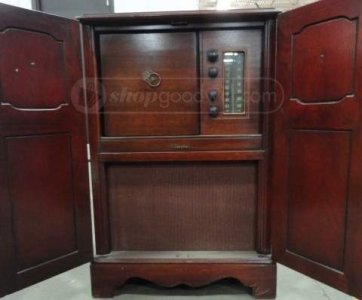
My parents bought it before I was born in 1956.
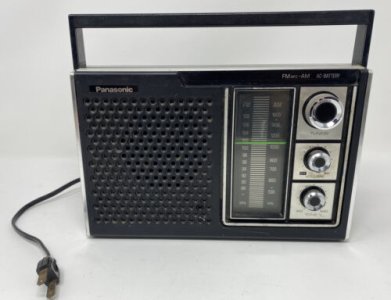
My Jr. High graduation gift in June of 1969 was a Panasonic AM/FM portable:
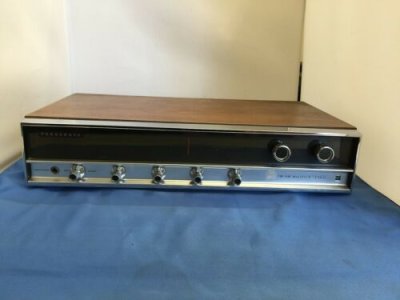
And in 1971, with money from my first few paychecks as a baby DJ, I bought a Panasonic AM/FM receiver and a Garrard turntable:
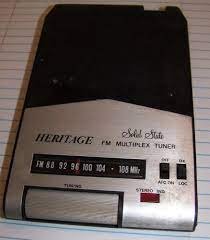
And then, in 1973, I bought one of these handy FM adaptors that slid into the 8-track player in my car:
And that was useful until I got my first car with a factory AM/FM radio in 1978, a Toyota Corolla SR5 liftback.
So, I guess I just grew up with FM always available.
My parents bought it before I was born in 1956.
My Jr. High graduation gift in June of 1969 was a Panasonic AM/FM portable:
And in 1971, with money from my first few paychecks as a baby DJ, I bought a Panasonic AM/FM receiver and a Garrard turntable:
And then, in 1973, I bought one of these handy FM adaptors that slid into the 8-track player in my car:
And that was useful until I got my first car with a factory AM/FM radio in 1978, a Toyota Corolla SR5 liftback.
So, I guess I just grew up with FM always available.
My grandmother's car, which was a 1965 Mercury, had an FM (mono). I got an AM/FM portable, probably Christmas 1967 or 68. My first car (a 1966 Chrysler Newport was AM only), eventually something possessed me to but a 1970 Buick Wildcat which got gallons per mile, and had FM. Next one, I had an FM converter, then an underdash FM radio. The 1983 Ford Escort I bought in 1983 had AM only, and I replaced it with an aftermarket AM/FM/Cassette. The FM in it was sweet, not a bad DX machine and a little bit of squelch to mute the "swoosh".
Someone in the station management who filled in the Broadcasting station form did not want to be associated with hippies and marijuana.Broadcasting Yearbook called WQDR "album-oriented adult contemporary". That doesn't sound like anything you described. I have to wonder where that term came from.
When Abrams was developing the format in around 1972-73, the format had no name. It was adult targeted, it was contemporary and it was from albums.
Also, remember that the Broadcasting Yearbook depended on stations filling out an annual form log before publication. Not everyone filled theirs out, and the YB kept the prior data. At one point, I was listed as GM of two separately owned competitors because my former station never updated their listing.
In the 1970s, KNX-FM in Los Angeles ended up describing itself (off-air, at least) essentially the same way. And really, it was accurate---it was album-oriented rock, but soft. "The Mellow Sound" worked as an on-air positioner.Someone in the station management who filled in the Broadcasting station form did not want to be associated with hippies and marijuana.
When Abrams was developing the format in around 1972-73, the format had no name. It was adult targeted, it was contemporary and it was from albums.
Also, remember that the Broadcasting Yearbook depended on stations filling out an annual form log before publication. Not everyone filled theirs out, and the YB kept the prior data. At one point, I was listed as GM of two separately owned competitors because my former station never updated their listing.
And, again, it avoided the "hippie syndrome" that limited sales to waterbeds, paraphernalia stores, pawn shops and bail bondsmen.In the 1970s, KNX-FM in Los Angeles ended up describing itself (off-air, at least) essentially the same way. And really, it was accurate---it was album-oriented rock, but soft. "The Mellow Sound" worked as an on-air positioner.

I looked around a bit. My parents' 1976 Chevy Malibu had no radio as standard. AM was $75, and AM/FM was $226, in 1976 dollars. That's over 5% of the base price of the car!
No wonder many of you didn't have FM radios in the car in the 70s.
No wonder many of you didn't have FM radios in the car in the 70s.
It also avoided CBS New York brass, according to an interview I've lost in the internet ether over the years, which quotes PD Steve Marshall as saying that they thought it was a lot more MOR than AOR, and he wasn't about to tell them otherwise until he had some ratings to show them.And, again, it avoided the "hippie syndrome" that limited sales to waterbeds, paraphernalia stores, pawn shops and bail bondsmen.
I got a '73 Mustang in Phoenix and got them to give me the AM/FM to close the deal. I was pleased, as about 18 months later my new job was for an AM and FM combo... and the station paid the shipping to Puerto Rico of the radio with the whole car attached.I looked around a bit. My parents' 1976 Chevy Malibu had no radio as standard. AM was $75, and AM/FM was $226, in 1976 dollars. That's over 5% of the base price of the car!
No wonder many of you didn't have FM radios in the car in the 70s.
True. Radios----even heaters---were optional until a lot later than most people realize.I looked around a bit. My parents' 1976 Chevy Malibu had no radio as standard. AM was $75, and AM/FM was $226, in 1976 dollars. That's over 5% of the base price of the car!
No wonder many of you didn't have FM radios in the car in the 70s.
Last edited:
No one knew about aftermarket AM/FM/Cassettes or 8 tracks?I looked around a bit. My parents' 1976 Chevy Malibu had no radio as standard. AM was $75, and AM/FM was $226, in 1976 dollars. That's over 5% of the base price of the car!
No wonder many of you didn't have FM radios in the car in the 70s.
A lot of us did. Only one car I owned (the first, for nine months) had just an AM radio. But I knew I was replacing it as soon as I had the money saved, and I budgeted for an 8-track deck (it was 1973) and a cartridge-style FM converter.No one knew about aftermarket AM/FM/Cassettes or 8 tracks?
Remember, though---if you've already paid $75 for a factory AM radio, adding to that is a big swallow. That $75 PTBoardOp cites from 1976 for an AM radio is $373.97 today. The $226 for AM/FM? That's $1,126.89 in today's money. Top-of-the-line iPhone money. Aftermarket was only a little less expensive (unless you went for cheap/bad), speakers were sold separately and installation cost money.
And in the 70s, the adults/parents were products of the Great Depression. My mom thought I was insane to drop $175 (installed) for a stereo in a car I'd just bought with a "perfectly good" AM radio that...yes, I had paid for. I could have ordered either an AM/FM mono or an AM/FM stereo radio in the car, but the prices, as we see above, were nuts. And this model didn't have a factory tape deck option and I wanted to be able to pick my own music sometimes. So I knew I could do better, if only slightly less expensively, with an under-dash Clarion 8-track, four speakers and a cartridge-style FM adaptor.
An interesting thing though: A lot more of us in my hometown of 3,000 people with only one radio station (AM) and no outside over-the-air signals until sundown (there was Los Angeles FM on cable and a 10-watt translator of dubious legality rebroadcasting KKDJ) had tape decks and FM in our cars than did friends of mine in L.A. We were reacting to a lack of choice. But there was still a lot on the AM band in Los Angeles. So people made do with what was the least expensive. Which, if you look at an AM radio as $373 and an AM/FM as $1,100, is pretty understandable. In fact, now, I realize I should have felt ripped off by the AM price.
Last edited:

Sort of related, I bought a Panasonic clock radio in 1988 for I believe less than 25 bucks at the time. Amazingly this unit still works like a charm some 34 years later. Plus it has an illuminated radio dial which is wonderful.
A lot of us did. Only one car I owned (the first, for nine months) had just an AM radio. But I knew I was replacing it as soon as I had the money saved, and I budgeted for an 8-track deck (it was 1973) and a cartridge-style FM converter.
Remember, though---if you've already paid $75 for a factory AM radio, adding to that is a big swallow. That $75 PTBoardOp cites from 1976 for an AM radio is $373.97 today. The $226 for AM/FM? That's $1,126.89 in today's money. Top-of-the-line iPhone money. Aftermarket was only a little less expensive (unless you went for cheap/bad), speakers were sold separately and installation cost money.
And in the 70s, the adults/parents were products of the Great Depression. My mom thought I was insane to drop $175 (installed) for a stereo in a car I'd just bought with a "perfectly good" AM radio that...yes, I had paid for. I could have ordered either an AM/FM mono or an AM/FM stereo radio in the car, but the prices, as we see above, were nuts. And this model didn't have a factory tape deck option and I wanted to be able to pick my own music sometimes. So I knew I could do better, if only slightly less expensively, with an under-dash Clarion 8-track, four speakers and a cartridge-style FM adaptor.
An interesting thing though: A lot more of us in my hometown of 3,000 people with only one radio station (AM) and no outside over-the-air signals until sundown (there was Los Angeles FM on cable and a 10-watt translator of dubious legality rebroadcasting KKDJ) had tape decks and FM in our cars than did friends of mine in L.A. We were reacting to a lack of choice. But there was still a lot on the AM band in Los Angeles. So people made do with what was the least expensive. Which, if you look at an AM radio as $373 and an AM/FM as $1,100, is pretty understandable. In fact, now, I realize I should have felt ripped off by the AM price.
I guess I don't remember a line-item charge for an AM-only radio. I didn't think any came with no radio at all.Sort of related, I bought a Panasonic clock radio in 1988 for I believe less than 25 bucks at the time. Amazingly this unit still works like a charm some 34 years later. Plus it has an illuminated radio dial which is wonderful.
- Status
- This thread has been closed due to inactivity. You can create a new thread to discuss this topic.