
Here is an ad from 1939:
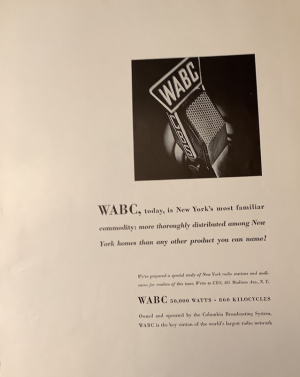

I see it says they've prepared a "special study." I take it they didn't have a Neilsen back then. So did each radio station do their own survey? I suspect it was biased in some way.Here is an ad from 1939:
View attachment 2328
There were other ratings companies in that era. Arbitron (which is Nielsen today) began in 1975, and was preceded by Hooper, Pulse and others. For some history of ratings, check...I see it says they've prepared a "special study." I take it they didn't have a Neilsen back then. So did each radio station do their own survey? I suspect it was biased in some way.
When WABC was owned by CBS.
Here is the listing from the 1939 Broadcasting Yearbook:Never. The original WABC was the station that is now known as WCBS. In 1946, the station changed its call sign to WCBS to avoid confusion with the newly-formed ABC network. In 1939, the station that is now known as WABC had the call sign WJZ.
WCBS (AM) on Wikipedia

I see it says they've prepared a "special study." I take it they didn't have a Neilsen back then. So did each radio station do their own survey? I suspect it was biased in some way.
That was a different "WABC".ABC had a different meaning when CBS owned WABC it was Atlantic Broadcasting Company.
Turns out WCBS had its origins in Providence Rhode Island as a Portable Radio Station until the original owners made the final decision to Springfield, Ill. Note the Springfield Station is now known as WFMB-AM.And WCBS was a station in Springfield, Ill. I presume emissaries of Mr. Paley reached out to the Springfield owners to acquire the call.
And, in fact, this week in 1946 WEAF changes calls to WNBC while WABC changes calls to WCBS.And WCBS was a station in Springfield, Ill. I presume emissaries of Mr. Paley reached out to the Springfield owners to acquire the call.
Yes named after Atlantic Broadcasting Company the then owners of what is now known as WCBS-AM.That was a different "WABC".
With WNBC-TV the call letters was in New Britain, Connecticut which is now known as WVIT-TV the NBC affiliate in the New Haven area.It was a two-step process that took seven years to happen . In 1946, WABC 880 changes to WCBS, the same year 660 WEAF changes to WNBC.
Then in 1953, 770 WJZ changes to WABC.
So maybe a better way to say it is "When CBS had the WABC call letters." CBS of course never owned what is today WABC.
It's interesting how some of NYC's iconic AM stations have seen several call letter changes over the years. 660 went from WEAF to WNBC to WRCA then back to WNBC and currently WFAN. 1050 went from WHN to WMGM back to WHN to WFAN to WUKQ to WEVD to the current WEPN. 1130 went from WOV to WNEW to WBBR.
Yet a few have never changed their call signs: WMCA 570, WOR 710 and WINS 1010.
NBC engineer Carl Deitsch supervised the design and construction of the million dollar project. Deitsch was NBC’s shortwave broadcast expert, having done the same job previously for its shortwave stations in Bound Brook, New Jersey. He was assisted by others from the crack NBC engineering team, including key men from the NBC broadcast stations KPO and KGO in San Francisco. Construction began in 1943 with the installation of two 50 kW Federal Telegraph Co. transmitters. Rhombic antennas targeted Japan, Australia and the Philippines. Broadcasting commenced on December 27, 1944, with the call signs KNBA and KNBC. The next year, two more RCA transmitters were added, using the call signs KNBI and KNBX.
The original Federal transmitters were radio telegraph (CW) systems, and were fed by separate Federal modulators. One modulator fed two transmitters, which was possible because they shared common programs. Federal later built a 200 kW transmitter for Dixon.
This is also how Imus ended up on WFAN.It was a two-step process that took seven years to happen . In 1946, WABC 880 changes to WCBS, the same year 660 WEAF changes to WNBC.
Then in 1953, 770 WJZ changes to WABC.
So maybe a better way to say it is "When CBS had the WABC call letters." CBS of course never owned what is today WABC.
It's interesting how some of NYC's iconic AM stations have seen several call letter changes over the years. 660 went from WEAF to WNBC to WRCA then back to WNBC and currently WFAN. 1050 went from WHN to WMGM back to WHN to WFAN to WUKQ to WEVD to the current WEPN. 1130 went from WOV to WNEW to WBBR.
Yet a few have never changed their call signs: WMCA 570, WOR 710 and WINS 1010.
Imus was one of the last WNBC-AM Personalities who stayed for the transition as WFAN-AM and stayed there for 2 decades before he left for a rant that got him in hot water with CBS Radio management.This is also how Imus ended up on WFAN.
ViacomCBS is a direct corporate successor to Westinghouse (along with the original CBS, Inc., not to be confused with the 2005–2019 CBS Corporation) and Westinghouse of course founded WJZ.It was a two-step process that took seven years to happen . In 1946, WABC 880 changes to WCBS, the same year 660 WEAF changes to WNBC.
Then in 1953, 770 WJZ changes to WABC.
So maybe a better way to say it is "When CBS had the WABC call letters." CBS of course never owned what is today WABC.
"One of the last"? What other WNBC personalities were retained at WFAN, other than Charles McCord, who wasn't a personality on his own but part of the Imus show?Imus was one of the last WNBC-AM Personalities who stayed for the transition as WFAN-AM and stayed there for 2 decades before he left for a rant that got him in hot water with CBS Radio management.
Emmis only hired Imus and McCord, maybe a producer or two, but that was it. They didn’t need to hire him but realized that his show would be a better draw than Greg Gumbel."One of the last"? What other WNBC personalities were retained at WFAN, other than Charles McCord, who wasn't a personality on his own but part of the Imus show?


