• Get involved.
    We want your input!
    Apply for Membership and join the conversations about everything related to broadcasting.

    After we receive your registration, a moderator will review it. After your registration is approved, you will be permitted to post.
    If you use a disposable or false email address, your registration will be rejected.

    After your membership is approved, please take a minute to tell us a little bit about yourself.
    https://www.radiodiscussions.com/forums/introduce-yourself.1088/

    Thanks in advance and have fun!
    RadioDiscussions Administrators

Which Beautiful/Easy Listening Orchestras Were Better or Worse Than Others and Why

Apparently Gleason's albums made money for Gleason as he was still recording them up to 1971. (We had several in the KOVA library before I got the format updated a couple of years after that.)
His later albums had a few cuts that I actually used in my Beautiful Music syndicated format in the 80's. They had less of that "50's sound" and were quite acceptable for my more contemporary approach.
 
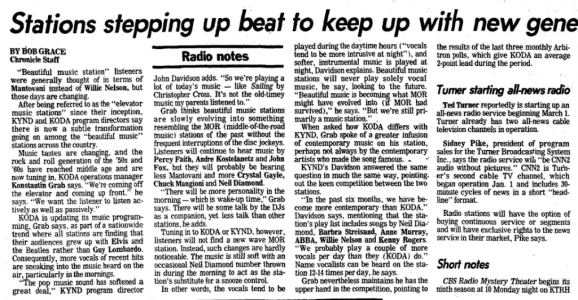
KYND's John Davidson said Beautiful Music stations would never play solely vocal music.

Given that most stations still in the format in 1982 evolved into some version of AC by decade's end, his crystal ball must have had some cracks in it.
 
KYND's John Davidson said Beautiful Music stations would never play solely vocal music.

Given that most stations still in the format in 1982 evolved into some version of AC by decade's end, his crystal ball must have had some cracks in it.

Two things:

1) They weren't Beautiful Music stations, then, were they? When the last instrumental died (or before) they were AC.

2) A lesson I learned from every GM I ever worked for: "Never" and "Always" only apply until next quarter.
 
While "Love's Theme" by Barry White's Love Unlimited Orchestra was a big Top 40 hit in 1973-1974, did Beautiful Music and/or Easy Listening stations play the original hit on 20th Century Records or did they play other orchestral versions recorded for and supplied by the music services, or from BM/EZ albums by Percy Faith, etc. ?
 
While "Love's Theme" by Barry White's Love Unlimited Orchestra was a big Top 40 hit in 1973-1974, did Beautiful Music and/or Easy Listening stations play the original hit on 20th Century Records or did they play other orchestral versions recorded for and supplied by the music services, or from BM/EZ albums by Percy Faith, etc. ?

I'm pretty sure I heard the original on at least one L.A. Beautiful Music station at the time. Probably KBIG, given what Marlin Taylor had to say about his philosophy for Bonneville's stations.
 
While "Love's Theme" by Barry White's Love Unlimited Orchestra was a big Top 40 hit in 1973-1974, did Beautiful Music and/or Easy Listening stations play the original hit on 20th Century Records or did they play other orchestral versions recorded for and supplied by the music services, or from BM/EZ albums by Percy Faith, etc. ?

I think I answered that somewhere previously, but I can state from personal knowledge that TM's Beautiful Music played both the Love Unlimited Orchestra version and the in-house cover by the "TM Orchestra". I don't remember seeing any other versions from commercial albums on the cue sheets back then, and I would have remembered because the first time the "hit" version played during my shift I went looking for that on all the CHange reels.
 
Top 40 didn't fully penetrate until the early 80s, but CHR on FM was also different in terms of presentation and energy from late 70s AM Top 40.
But there were a number of markets where FM top 40 became dominant early in the 1970's. WPGC in DC became the bigger station after it upgraded its FM and promoted it on its 50 kw AM daytimer. WDRQ, KSLQ and WMYQ became leading Top 40's in the 1972-73 period, as did WERC(FM) in Birmingham and a number of other earlier Top 40's on FM. Buzz Bennett knocked of WMYQ before 1975 in Miami, making it probably the first FM to FM fight for the top rank in its format. After Tanner left Pittsburgh, Pittman's FM rose to the top... also around 1975 or 1976, IIRC.
 
When I started college WSEZ was listed in Broadcasting Yearbook as easy listening. and yet it was one of two stations most of the students listened to. I never once heard about AM Top 40. Where I lived before college the kids were listening to 61 Big WAYS but some had switched to or also listened to WBCY, also a former beautiful music station.

WGLD was the beautiful music station where I went to college and the guy across the hall listened when he studied. No, he wasn't like me. He and his friends could be wild. Also, they were from Puerto Rico.
 
I bought a random lot of reel to reel tapes someone, somewhere had gone to great pains to make (the selections are, for the most part, carefully documented on typewritten indexes, save for one, with absolutely beautiful handwriting).

Anyway, on one of those is most of the first volume of The Hollyridge Strings' "The Beatles Songbook". I never thought that Beatles songs could sound so schmaltzy!

And the worst part? I actually kind of like it!

c
 
I bought a random lot of reel to reel tapes someone, somewhere had gone to great pains to make (the selections are, for the most part, carefully documented on typewritten indexes, save for one, with absolutely beautiful handwriting).

Anyway, on one of those is most of the first volume of The Hollyridge Strings' "The Beatles Songbook". I never thought that Beatles songs could sound so schmaltzy!

And the worst part? I actually kind of like it!

c

Despite your attempts at clean living, your soul has somehow been possessed by a woman named Edna, who lived from 1893 to 1981.
 
George Martin produced an album of Beatles instrumentals. I suspect that was his way of showing how some of the Beatles songs wold have sounded if he had his way.
If you've heard the incidental music in "A Hard Day's Night" and "Help!" (the films) you already know what to expect. It's just that big-orchestra approach to the hits themselves, as they existed in 1964:


This is the UK Pressing. It was released, but with the tracks re-ordered, by United Artists records, which owned the "A Hard Day's Night" film and its soundtrack. I'm guessing this was part of that deal.
 
I bought a random lot of reel to reel tapes someone, somewhere had gone to great pains to make (the selections are, for the most part, carefully documented on typewritten indexes, save for one, with absolutely beautiful handwriting).

Anyway, on one of those is most of the first volume of The Hollyridge Strings' "The Beatles Songbook". I never thought that Beatles songs could sound so schmaltzy!

And the worst part? I actually kind of like it!

c
For those who don't know, The Hollyridge Strings was a studio orchestra at Capitol Records. The bio at AllMusic is pretty solid:


Here are the albums:


And, finally---someone has put all SIX of the Hollyridge Strings Beatles' albums into a YouTube playlist:


If, while listening, you begin to think that lace doilies would be a nice addition to your interior decor, that's Edna trying to possess your soul, too.
 
For those who don't know, The Hollyridge Strings was a studio orchestra at Capitol Records. The bio at AllMusic is pretty solid:

If, while listening, you begin to think that lace doilies would be a nice addition to your interior decor, that's Edna trying to possess your soul, too.
One of my criticisms of the American Beautiful Music syndicators was "too much full string based orchestra versions" of the known songs. I tried to use more orchestra-with-a-soloist such as Clayderman. Or orchestras that emphasized the brass section a bit more in the mix. I even coded songs as to the type of orchestration as well as by "tempo" and "mood".

We mentioned Jackie Gleason's orchestra a while back, and it did have a less "101 Strings" sound. The ones I used by Gleason did not have the older-feel muted horns, and were very contemporary.
 
Last edited:
I've been listening to tapes of K-Mart music tapes from the early 90s (because I have weird taste in music, I guess), and they actually aren't bad.

Most are a decent selection of standard AC fare with various "lite" BM instrumentals sprinkled in (many of them are recorded by Paul Mauriat).

I can picture these almost working as is on a present-day station (without the K-Mart voiceovers, of course).

I wonder how Edna would like it?

someone has put all SIX of the Hollyridge Strings Beatles' albums into a YouTube playlist:


If, while listening, you begin to think that lace doilies would be a nice addition to your interior decor, that's Edna trying to possess your soul, too.
I have to admit, the orchestration on many of these is very over the top and syrupy. It makes even most BM stations seem mild by comparison.

There's no names written, printed or typed anywhere on any of the tapes or their boxes that I could find, but for all we know, the person who recorded them was Edna herself :)

She was really into oldies, folk and syrupy orchestras, it seems.

Here's an example of the folk I found on these tapes:

Being that I was born and raised on folk, I have a strong affinity for songs like this (this one was among several that were on the same reel as the Syrupy Beatles album, which, oddly, makes sense).

There was also lots of The Lettermen. Any surprise there?

Didn't think so.

c

 
One of the side topics of the 1900 Yesterday thread involved Percy Faith, Lawrence Welk and Ray Conniff and discussed the good, the bad and the ugly of each, and it gave me an idea for a thread that discusses which orchestras were better or worse than others and why that is so.

I'll begin:

I don't really care much for Ray Conniff, as I find most of his material has a rather hokey sound which sticks out even relative to his almost as hokey contemporaries (some exceptions exist, of course).

Percy Faith is decent, especially when he sticks to standards and musicals (he didn't really do contemporary very well). "Theme to A Summer Place" is actually one of my favorites, an another is "Delicado" (an ancient copy of which I have from my grandparents or great grandparents on a 78 ROM record, with "Festival" as the B-side). I also like his treatment of the My Fair Lady soundtrack.

The various custom orchestras of the later era (mid 70s-early 90s) actually cover most of the then new stuff relatively well, especially the softer stuff.

Paul Mauriat is perhaps one of the more prolific orchestras of the period, and he really has a nice overall sound (like almost everyone, there's clunkers).

Bert Kaempfert is another one I like, although some of it gets a but hokey too (though nowhere near Ray Conniff; he's in a category of his own!).

So, feel free to agree or disagree, and tell what your likes and dislikes are.

c
Folks who bought Ray Conniff's recordings in the 50s and 60s did not consider him as being "hokey" at all, but rather hip and modern. He paid more attention to the rhythm section on his recordings and he may have been one of the earliest arrangers to multiple guitar rhythm sections each musician contributing a different pattern to the overall rhythm. S'Wonderful which had the chorus singing with the band instruments, was a re-working of a chart he had done for I think Artie Shaw ten years earlier. The was the first recording under his own name as leader to get extensive airplay - in 1956 and became a hit LP as well as, in some areas, a hit single I think. Those who loved the big bands regarded it as an extension or development of what he was doing in the 40s with Shaw and Bunny Berigan etc. Which it was. Although Percy Faith could and did write some blistering Goodman-style big band charts for his albums he mostly worked in an orchestral context with strings. Oh Conniff and Faith used many of the same musicians on their recordings - in NYC and later in L.A. My mother grew up with Ray and they used to play and rehearse in her parents cellar and then eat onion sandwiches with butter after. Back in Attleboro MA in the 1930s. Conniff made a lot of good records but many of them to me have a sameness to them I don't so much care for. Faith uses more colors and tells stories in his arrangements I can get lost in. For me much more interesting as well as satisfying musically. And that is what I felt when they were living as well. One of Ray's I always liked was his Beyond the Sea with chorus c. 1960 with the piano fills or countermelody. Also When Its Dark On Observatory Hill. Interesting discussion, thank you.
 
Folks who bought Ray Conniff's recordings in the 50s and 60s did not consider him as being "hokey" at all, but rather hip and modern. He paid more attention to the rhythm section on his recordings and he may have been one of the earliest arrangers to multiple guitar rhythm sections each musician contributing a different pattern to the overall rhythm.

To this day, I still consider his recording of "The 12 Days of Christmas" to be the absolute best version of the song. Conniff orchestrated not only the instrumental backing but also the singers ... it really was more of an orchestration than a choreography.

And that was back in 1962.
 
One of my criticisms of the American Beautiful Music syndicators was "too much full string based orchestra versions" of the known songs. I tried to use more orchestra-with-a-soloist such as Clayderman. Or orchestras that emphasized the brass section a bit more in the mix. I even coded songs as to the type of orchestration as well as by "tempo" and "mood".

We mentioned Jackie Gleason's orchestra a while back, and it did have a less "101 Strings" sound. The ones I used by Gleason did not have the older-feel muted horns, and were very contemporary.
Many of us loved the full string orchestras. Percy Faith's Bouquet series of LPs not all of which were so labeled. Phil Stout's SRP format was 80% orchestral by design and I recall hearing on the radio sometimes 100% orchestral except for the choral vocals from them for an hour or two at a time. What I have heard of Gleason, and I have not listened to everything he had made, is very lush with most of the musical interest in the soloists. 101 Strings was , at least the German recordings, a classical orchestra and much larger forces used than Faith or Kostelanetz say in the studio. They took elements from the artists selling on the major labels and did them up with a large orchestra so became quite music of excess. More Faith-style countermelodies, more Mantovani-style Whitmanesque cello yawps and string glissandos. More is better, right? Though I will admit to quite loving some of the German recordings and a few of the later English. Kind of slap-dash in places like they were trying to save money so did fewer takes and spliced the usable portions together. But very striking and new when we first heard them in 1957 and 58.


Back
Top Bottom