• Get involved.
    We want your input!
    Apply for Membership and join the conversations about everything related to broadcasting.

    After we receive your registration, a moderator will review it. After your registration is approved, you will be permitted to post.
    If you use a disposable or false email address, your registration will be rejected.

    After your membership is approved, please take a minute to tell us a little bit about yourself.
    https://www.radiodiscussions.com/forums/introduce-yourself.1088/

    Thanks in advance and have fun!
    RadioDiscussions Administrators

Which Beautiful/Easy Listening Orchestras Were Better or Worse Than Others and Why

"Easy listening was a term used in radio as far back as the 1920s. Initially it simply meant music that was easy to listen and enjoy. In other words nothing too highbrow or too lowbrow such as torrid dance music. Historically both easy listening and beautiful music, as well as a lot of other terms, were used to describe what in the 1960s became generally termed Beautiful Music. But many who worked at such stations in the 60s and 70s and beyond were told by their bosses at a station to refer to it as one or the other according to their taste and perception of what it meant to them at the time. In the 1960s "easy listening" referred to MOR stations as well and indeed Beautiful Music was an approach to MOR. Then about 1960 certain generally younger GMs started getting together and decided they didn't care for the "Beautiful: designation as to them it connoted to passive rather than an active involving approach so revived the term "Easy Listening" which some stations had been using all along and which pretty much caught on over the next few years. And you had some stations and syndicators using "BM/EZ" too - that was pretty common.
The web site I use for ratings has continued to list WAVV Fort Myers as Easy Listening when it has played such songs as "Lucky Star" by Madonna, which is on the high end of soft AC. That site is not known for updating formats.

Serenade Radio, an online station in Britain, uses the term. But there is a wide range of music, from the softest string-based instrumentals to very high energy big band or even rock and roll. Most of the shows I listen to are a mix of beautiful music what we would call adult standards.
 
Remember, "Easy Listening" was more of an on-air positioner: "All day, all night, all nice. E-Z 101" In fact, Art Keller made his company name out of his "E Z" station positioners / slogans. "Beautiful Music" was more of the trade name, just as "Adult Contemporary" is a trade title but seldom used on the air.
Art Kellar's EZ Communications stations. He had one in New Orleans as well for a while and he bought historically significant WKJF FM Pittsburgh which had become WJOI. He was the prime mover in the formation of the Independent Beautiful Music Association in 1978. Then he dropped the format on his stations in 1982-83.

Not sure when I first became familiar with those terms. Probably not until the 70s. Most of what I have learned has been from reading and studying documents and newspapers and talking to people who were there such as yourself. And of course your history site. As a young man I was a listener but knew nothing about the business. Can't recall ever hearing either term on broadcasts in the 50s or 60s.
 
Art Kellar's EZ Communications stations. He had one in New Orleans as well for a while and he bought historically significant WKJF FM Pittsburgh which had become WJOI. He was the prime mover in the formation of the Independent Beautiful Music Association in 1978. Then he dropped the format on his stations in 1982-83.
I was the first GM of Art's Richmond station, and then bought his music library in 1982 for my syndication service in Latin America.
Not sure when I first became familiar with those terms. Probably not until the 70s. Most of what I have learned has been from reading and studying documents and newspapers and talking to people who were there such as yourself. And of course your history site. As a young man I was a listener but knew nothing about the business. Can't recall ever hearing either term on broadcasts in the 50s or 60s.
I often used WDBN outside of Cleveland around 1960 as background music during homework. It was an early "good music" station and was likable to me as it avoided the the tainting of the format with Big Band songs that many early FMs in similar formats did. Other instrumental music stations had a lot more of that traditional sound.
 
I was the first GM of Art's Richmond station, and then bought his music library in 1982 for my syndication service in Latin America.

I often used WDBN outside of Cleveland around 1960 as background music during homework. It was an early "good music" station and was likable to me as it avoided the the tainting of the format with Big Band songs that many early FMs in similar formats did. Other instrumental music stations had a lot more of that traditional sound.
Think you had previously mentioned you got his library but I had no idea you had worked at - what was it - WEZR? Sometime I would like to ask about what you and he were doing in the early and mid 70s. WDBN I have studied but of course never heard as I did not live in that area. I grew up with all the instrumental music - both bands and orchestras - on the radio which is perhaps why I gravitated to beautiful Music stations. Not that I did not listen to and enjoy Peter Tripp on WMGM and Alan Freed on WABC when I was 11 and 12. My father bought one of those Hallicrafters sets to listen to the amateur band and the ship-to-shore communications in 1958. It had an FM received so I was able to find WMMW FM Meriden CT which then was simplexing Muzak to clients which I was absolutely fascinated by. Then about 1960 they put their Muzak on a sideband and ran Muzak's Programatic on their main FM channel for a year or so which I heard.

Niarhos and WDBN later became just as legendary to me as Taylor at WDVR though WDBN preceded WDVR by two and a half years. Different approach but some similarities. Niarhos broke things down on category reels after a couple of years while WDVR was playing records into the 70s. Both early and notable Beautiful FMs which did more than run background music. WDBN mostly instrumental, WDVR 93% instrumental.

Yes I have learned how many of the early Beautiful stations included sweet dance music with orchestral. Some Light Classical as well and a good amount from ETs.
 
This would have been near the end of the "Big and Bright" combination that ran from 1974 until around 1980 or so.

https://www.worldradiohistory.com/h...BC-IDX/74-OCR/1974-08-26-BC-OCR-Page-0019.pdf (bottom left corner of the page)

As noted in the above, AM 740 went more contemporary and FM 104.3 remained with essentially the same format as it had been running as KXTZ ("Ecstasy in Music", which I always found oddly suggestive for a company like Bonneville to use as a slogan).

740 has kept the KBRT calls for the rest of its existence to date.
The FM never achieved its full popularity until they dropped the XTZ calls. Hired Bill Moyes before he went out on his own and he did focus groups where they learned that for many people the calls connoted a rock station. So they relaunched as KBIG August '74 with Mancini ads and were something like #3 in 9 months. The dual newsmen during AM drive - was that in place when they were XTZ?
 
Even now, Merriam-Webster omits the sexual connection:


And the Cambridge Dictionary's main definition is "a state of extreme happiness"


I think your typical 1971 LDS folks probably weren't thinking of the word in that context.

I would bet lunch, however, that by 1974, the culture had changed to the point that they absolutely knew the sexual context and that's why they went back to KBIG.
Even knowing there is or was a sexual meaning still that would not mean we are always thinking in that context. Beautiful Music stations in the 60s and 70s excluded anything to suggestive or controversial right from go. Even so you had WXTC FM Charleston and another XTZ I think in Cincinnati or Indianapolis - all Beautiful.
 
This is true. There were gaps between songs on B/EZ one could drive a Kenworth through, on some stations as long as five seconds, but typically 2-3 seconds.

It probably made B/EZ one of the easiest formats to automate because one didn't have any of that high energy kid stuff to deal with. However towards the end of the format, it wasn't uncommon to hear standard, AC type segues with announcers talking over the opening notes on an instrumental (but still in most cases, rarely, if ever referring to the artists playing the instrumental music.)

It's a key factor in the difficulty in locating music for format research. Many versions were/are proprietary versions held in eternal copyright limbo. But some were from tragically unmentioned international recording artists. Like a German conductor named James Last.

For example, I only a few years ago found what Gen-Xer's across Puget Sound only remember as "The K-Bird Song" It was the snippet of an unknown instrumental heard in the TV commercial of what was KBRD (103.7, now KHTP.) With the Norman Rose voice-over "As Beautiful....As A Bird In Flight.......K-Bird, FM 104....Brings You The World's Most Beautiful Music....". The commercial ran on Puget Sound TV periodically from 1979 to 1991, just weeks before it's change to KMTT (The Mountain) in April 1991. I saw a similiar commercial for KQYT Phoenix "Quiet FM 95" with the same Norman Rose/James Last voice-over/music. So I'm guessing this was a market customized national TV ad theme campaign package.

And that song is?

"The Last Guest Is Gone" James Last (1970)


(Cue to :47 for the instantly familiar TV commercial snippet part.)

James Last also has a nice version of "Hey Jude"

Another criminally overlooked B/EZ conductor is Jackie Gleason (yes, that Jackie Gleason.) While best known as an actor, from the 1950s to the early 1970s, he made a series of albums for Capitol that made instrumental fans take notice. It's been said he couldn't read a note of sheet music. But this guy could conduct an orchestra better than John Williams.

Example: "A Pretty Girl Is Like A Melody" Just listen to that soaring string section! To me, this is the quintessential B/EZ song. Strings, perky trumpets, lush arrangements. Natural ending.............(long dead air pause).............."Your dial is set to Krisp........K-R-S-P.......Stereo 106......"

When vocals get brought up in these conversations, bear in mind in the old days, there really weren't as many mainstream solo Top 40/AC pop vocalists of any sort in B/EZ as you'd think.

And what you did hear was more the Jerry Vale, Roger Whittaker and Engelbert Humperdinck lot. Lots of "crooner covers". But generally, a mish mash of other super soft hits too wimpy for AC anymore (like "You Light Up My Life", Barbra Streisand, Neil Diamond, Christopher Cross, that sort. Nothing more uptempo.) But instrumentals strictly dominated each hour by 80%.

I know. I sat in many doctor's offices for many, many hours as a kid, playing Name That Tune with the office radio. How many of us did that?)

You'd be lucky to hear two vocals an hour on B/EZ. You'd find a unicorn if one of them were an original version of a familiar pop song. That's generally how they were spread out in this format. So, pretty much, once every 3 hours on KSEA Seattle, circa 1981.)


But overall, mainstream pop vocals was more MOR/"Full Service" AC's turf. There were distinct lines between these formats and B/EZ. And they were kept that way. Almost religiously.

It wasn't even really until the 1980s when MOR began dying off that AC vocals started really popping up on B/EZ radio playlists. And ultimately taking over most of them.

Both KQYT Phoeniz and KBRD Tacoma, which by the mid 80s was the leading Seattle Beautiful station, used Churchill Productions format. Tom Churchill and his family had owned KQYT in the 60s and put it on the air in 1963 when it was KRFM FM. The AM they soon sold to Dick Van Dyke. Very early Fm which scored high in ratings by mid 60s. BTW Tom died four years ago.
 
There's a difference between beautiful music made for beautiful music radio and instrumentals that became hits.

Bert Kaempfert to me is one of the best in the second group.

Percy Faith is one of the greats in the first group. His version of "Where Is Your Heart" is superior to Mantovani's. But Mantovani's "Charmaine" to me is the best version of that song.

Serenade Radio is an online only British station that takes listener donations. They have a great mix of what we would call adult standards and beautiful music instrumentals. Stanley Black and John Fox are just two of the beautiful music orchestras that I think do great versions of songs.
Perhaps, but Percy between 1944 and 1976 had more hit singles than Bert.
 
Think you had previously mentioned you got his library but I had no idea you had worked at - what was it - WEZR? Sometime I would like to ask about what you and he were doing in the early and mid 70s.
I only stayed with EX for about 6 months, first as OM of the two DC stations and then GM of the Richmond one. I had to go back to Ecuador as I could not sell my stations. I had planned to invest in the expansion of Kellar's EZ brand.

I stayed in Ecuador only about a year, and went to manage WUNO in San Juan after that. Here is the timetable: David Gleason's illustrated biography covering 64 years in radio
WDBN I have studied but of course never heard as I did not live in that area. I grew up with all the instrumental music - both bands and orchestras - on the radio which is perhaps why I gravitated to beautiful Music stations. Not that I did not listen to and enjoy Peter Tripp on WMGM and Alan Freed on WABC when I was 11 and 12.
I was devastated when Freed left Cleveland, but then I found Pete "Mad Daddy" Myers to replace him.
My father bought one of those Hallicrafters sets to listen to the amateur band and the ship-to-shore communications in 1958.
Around then I got a Hallicrafters SX 99 which did not have FM, and I never listened to SW except to get time checks. On MW I had verified about 2400 stations in all continents except Antarctica and about 80 countries.
It had an FM received so I was able to find WMMW FM Meriden CT which then was simplexing Muzak to clients which I was absolutely fascinated by. Then about 1960 they put their Muzak on a sideband and ran Muzak's Programatic on their main FM channel for a year or so which I heard.

Niarhos and WDBN later became just as legendary to me as Taylor at WDVR though WDBN preceded WDVR by two and a half years. Different approach but some similarities. Niarhos broke things down on category reels after a couple of years while WDVR was playing records into the 70s.
When I was with WEZR, we still played albums going into early 1970.
Both early and notable Beautiful FMs which did more than run background music. WDBN mostly instrumental, WDVR 93% instrumental.

Yes I have learned how many of the early Beautiful stations included sweet dance music with orchestral. Some Light Classical as well and a good amount from ETs.
 
I only stayed with EX for about 6 months, first as OM of the two DC stations and then GM of the Richmond one. I had to go back to Ecuador as I could not sell my stations. I had planned to invest in the expansion of Kellar's EZ brand.

I stayed in Ecuador only about a year, and went to manage WUNO in San Juan after that. Here is the timetable: David Gleason's illustrated biography covering 64 years in radio

I was devastated when Freed left Cleveland, but then I found Pete "Mad Daddy" Myers to replace him.

Around then I got a Hallicrafters SX 99 which did not have FM, and I never listened to SW except to get time checks. On MW I had verified about 2400 stations in all continents except Antarctica and about 80 countries.

When I was with WEZR, we still played albums going into early 1970.
I'm sorry, WEZS was Richmond, my mistake. Very interesting. When he bought WEZS it had been a Classical station and he kept the Met broadcasts from NYC at least for 1970-71. Who programmed his stations at that time?

Do you recall what WTVR FM also in Richmond was doing in 1970? They had run The Young Sound later Fall 1966 through Spring '68. Park had it on three of his stations at the time. Not sure what they did right after that but 1970 - 1973 they had something called The Good Sound. Was that ABC's FM format? Then mid '73 they went to Music For Two which baffles me unless that was Music... For the Two of Us. Into Aug '75 when they ran The Great Ones for a few weeks before going to Bonneville Beautiful Music which they stayed with until 1982 when they went Country.

When Freed left WJW I was seven years old and had never heard of him. In my research I found that Wm O'Neil who ran that station had a Muzak franchise and was an investor and officer in Transit Radio. After they sold WJW he and Lemmon iperated WSKP AM Miami which had been Paul Brake's WWPB AM. Early automated Beautiful Music station programmed by David Gordon at first who was responsible for the WPAT sound from 1954. I found on your history site ratings books which have it among Miami's top 5 by the early 60s. Had changed it to Beautiful Dec 1956. They sold to Ed Winton in 1966 which became WOCN AM. After about seven years Spanish language Beautiful Music. Then went to all Sp programming.

By the time I heard Alan Freed he was playing more Top 40 then R & B or as he used to call it "blues and rhythms" 1959 on WABC.The WJW and WINS formats I have only heard on recordings from the air. Fast-paced - he played about 15 singles an hour and did the commercials and dedications and PSAs etc. and sounded to me as he was working to get them all in. But I can admire what he did in laying on the R & B. Before him pop stations would play a little R & B on records which were selling to white people and even most negro stations played not much of it. Very much like Beautiful Music ten years earlier. So many programs in the live radio days had it but it was not until it was generally available on records and ETs from the late 30s and early 40s that some stations started making programs devoted mostly to mixed orchestral popular and light classical selections from those recordings by different artists and recorded Beautiful Music programming was born.

From what I have read about Freed he spent money and gave it away like crazy and obviously did not pay attention to his health. What I have heard from the 1950s of him was always very straightforward. I understand at WAKR 1945 to 1950 had was more zany and madcap and he had a big teenage following. Not familiar with Meyers but somehow in my mind I connect him with Top 40 programming. Was that the same person who was on WNEW in the 60s? Never much cared for what was called Top 40 radio but did hear some 1956 to 1960. Early years of that format. But with that you know it would like waiting to hear I recording I really enjoyed which there might be two per hour if even that. Which is why I preferred searching for Classical or Beautiful or Jazz on the radio instead. Those stations had more music and fewer announcers trying to entertain you or be your best friend. Though can understand why people liked personalities. As I did myself sometimes. Jean Shepherd I thought was very entertaining just talking and telling tales. The approach Jonathan Schwartz took I always enjoyed from the time he was at WNAC Boston 1964 down through the years. Though mostly I listened for the music.
 
Some of my personal favorite BM orchestras are:

John Fox
Mantovani
Caravelli
50 Guitars
101 Strings
A lot of good listening there. What are some of your fave cuts from them? Have you seen Mantovani's 1958 TV shows made for the U.S. market? Quite worthwhile and a few years ago were available by streaming.
 
The web site I use for ratings has continued to list WAVV Fort Myers as Easy Listening when it has played such songs as "Lucky Star" by Madonna, which is on the high end of soft AC. That site is not known for updating formats.

Serenade Radio, an online station in Britain, uses the term. But there is a wide range of music, from the softest string-based instrumentals to very high energy big band or even rock and roll. Most of the shows I listen to are a mix of beautiful music what we would call adult standards.
Yes a lot of that is - those services just list whatever format the stations tells them. That has always been true. I would guess some owners or GMs used the EL designation only because it gave them more leeway to introduce whatever they wanted whereas "Beautiful Music" they felt fairly confined them to certain genres. Too bad. But then many of us wanted to hear our Beautiful stations become more dashing and daring though we did not consider that to mean adding more and more vocals. The station programmers and syndicators did know what they were doing for the most part and knew how to go after the more substantial audiences so stayed careful. But many of us wanted to hear Barry White's Love's Theme and The Hustle and Disco and jazz instrumentals on Beautiful Music. I think it could have been done while remaining tasteful but yes they probably would have lost some of their dedicated listeners by so doing.
 
A lot of good listening there. What are some of your fave cuts from them? Have you seen Mantovani's 1958 TV shows made for the U.S. market? Quite worthwhile and a few years ago were available by streaming.
My parents had a lot of Mantovani in their record collection. The cover of 'Greensleeves' is one that stands out for me. Also the albums 'Songs to Remember', and 'Christmas Carols' I used to listen to a lot. Nowadays,, to listen to Beautiful Music, I usually just stream KNCT-FM, which is where I discovered John Fox, and others. For those not familiar with what is one of the last 'true' Beautiful Music radio stations, I provided a link.


I've never seen the Mantovani TV shows, I'll have to look those up on YouTube.
 
Both KQYT Phoeniz and KBRD Tacoma, which by the mid 80s was the leading Seattle Beautiful station, used Churchill Productions format. Tom Churchill and his family had owned KQYT in the 60s and put it on the air in 1963 when it was KRFM FM. The AM they soon sold to Dick Van Dyke. Very early Fm which scored high in ratings by mid 60s. BTW Tom died four years ago.
In Phoenix, in the 70's, it was a 3 way battle between KRFM (later KQYT), KMEO, and KBUZ. Four, if we include BM with brokered programs, KDOT. Was KRFM usually number one in the format, or was it KMEO? I know KMEO survived the longest till the early 90's. KBUZ which did a newscast every half hour, was the least popular of the three.

Interested in any knowledge or insight you might have on this.
 
In Phoenix, in the 70's, it was a 3 way battle between KRFM (later KQYT), KMEO, and KBUZ. Four, if we include BM with brokered programs, KDOT. Was KRFM usually number one in the format, or was it KMEO? I know KMEO survived the longest till the early 90's. KBUZ which did a newscast every half hour, was the least popular of the three.

Interested in any knowledge or insight you might have on this.
@Huff is the guy with access to the ratings.
 
@Huff is the guy with access to the ratings.
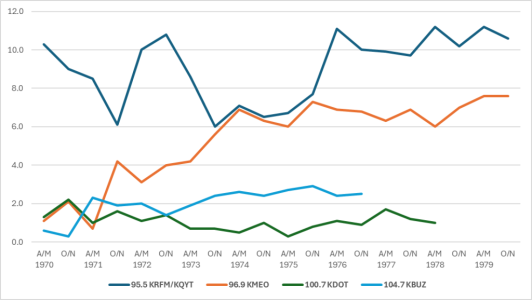
KRFM was an unusual monster: an FM pulling double-digit ratings as early as 1966!! It was also the first FM in Phoenix to reach #1 (Apr/May 1972).
KMEO caught up slowly but surely, making it neck-and-neck battle by 1973 before 95.5 pulled away again in 1975.
KBUZ and KDOT never really figured into the battle.
1754667932302.png
 
KRFM was an unusual monster: an FM pulling double-digit ratings as early as 1966!! It was also the first FM in Phoenix to reach #1 (Apr/May 1972).
KMEO caught up slowly but surely, making it neck-and-neck battle by 1973 before 95.5 pulled away again in 1975.
KBUZ and KDOT never really figured into the battle.
View attachment 9943
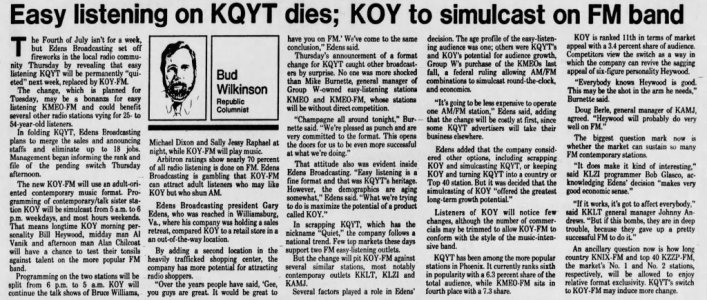
In 1978 was when KRFM became QUIET (KQYT). How did the battle with KMEO go from that point until KQYT flipped to a simulcast of KOY-AM in 1986? I'm wondering if the demise of KQYT had more to do with the aging of the audience, than low ratings.
 
In 1978 was when KRFM became QUIET (KQYT). How did the battle with KMEO go from that point until KQYT flipped to a simulcast of KOY-AM in 1986? I'm wondering if the demise of KQYT had more to do with the aging of the audience, than low ratings.

While @Huff unearths the numbers, here's the explanation from Gary Edens in the June 27, 1986 Arizona Republic:

Screenshot 2025-08-08 at 9.28.08 AM.jpeg


Back
Top Bottom