
Yes, I did. We called him "coach". Great guy.Tangent: so Michael, does this mean you worked for Joel Grey / Larry Hevner?

-
Get involved.
We want your input!
Apply for Membership and join the conversations about everything related to broadcasting.
After we receive your registration, a moderator will review it. After your registration is approved, you will be permitted to post.
If you use a disposable or false email address, your registration will be rejected.
After your membership is approved, please take a minute to tell us a little bit about yourself.
https://www.radiodiscussions.com/forums/introduce-yourself.1088/
Thanks in advance and have fun!
RadioDiscussions Administrators
You are using an out of date browser. It may not display this or other websites correctly.
You should upgrade or use an alternative browser.
You should upgrade or use an alternative browser.
Which Beautiful/Easy Listening Orchestras Were Better or Worse Than Others and Why
- Thread starter cc333
- Start date
Well now let's see - for instance in the Spring of 1976 156 Beautiful stations were rated in the top 5 of their markets. 22 of them were at #1. Of the 100 most listened to radio stations in the U.S, according to Arbitron, 22 had Beautiful Music formats.I’d be interested in seeing specifics on what those markets and radio stations were to back up that claim.
In the Spring of 1981 there were 143 Beautiful Music stations which placed in the top 5 or their markets including 29 which made #1.
Please see my second response to your previous message. Spr '76 Arb 156 in the top 5 of their markets, of which there were 22 at #1. They found that of the top 100 most-listened-to stations in the U.S. 22 were Beautiful Music-formatted. I cited Spring 1981 - 143 placed in the top 5 of their markets, 29 were #1 stations. Just two periods I happened to have in my notes. The strength of that format was between the early 1960s and 1990, peaking 1975 through 1981. With respect to ratings a service such as Arbitron only rated a portion of all existing stations, mostly the larger market stations. By the close of 1977 I have counted about 930 beautiful Music stations in the U.S. alone operating at that time. 60 or more of them had split formats combining Beautiful one part of the day with usually MOR or Country another part of the day.As you were replying, I was indeed looking at the first 1976 Duncan report that David has available. A perusal found very few markets with one or more in the top 5, or three in the top 10. Phoenix was the outlier with a top three in the format. Combined 12+ 1/4 hr, I didn’t see any market that could claim 30 to 40 percent listening to the format. At best I’d see around 20 total share points going to BM, basically as you said. Given, it’s just one book. But what stood out to me were the number of markets that by 1976 had already seen many stations drop the format. If I have any point to make, I’d consider the peak of the format (number of stations and total share) to be perhaps the five years or so prior to your consideration of the 75-81 era as such. Enjoying your insight and thoughts on the format, Dick.
Many FM owners went to Beautiful Music early on because they liked it and because everyone else was doing it - often with Classical two hours in the evenings. When more and more listeners gravitated to FM in the 70s and things became more competitive because they really could make some money with their FMs - then they realized there were other stations playing basically the same type of music so went to other formats. Especially if other stations were doing lots better than they were. Or sometimes just because they had different ideas or wanted to try something new.
In the early 1980s you had the greater popularity of Country Music and AC so many switched to one of the other to get younger listeners with what they regarded as more "mass-market" formats because those were just starting to really make it on FM by that time.
Thank you, I have been a life-long listener and have spent many years pursuing this study, digging around in libraries, examining trade journals, and conducting interviews with radio professionals who were there and listeners alike. Like many I was pretty oblivious to anything but the music and I just assumed it would always be there on the radio. When it was no longer I had to think OK well why not and what happened? So set out to find out.

The mid-70's through the earlier 80's were the peak listening years for Beautiful Music. While the shares in 12+ continued to be high, as the 80's moved on the listeners tended to be older and older.But what stood out to me were the number of markets that by 1976 had already seen many stations drop the format. If I have any point to make, I’d consider the peak of the format (number of stations and total share) to be perhaps the five years or so prior to your consideration of the 75-81 era as such. Enjoying your insight and thoughts on the format, Dick.

Dick and David, thank you. Fascinating statistics and input. And showing, as always it seems, that memory does become more and more clouded the older we grow. Making David’s resource even more valuable. My home market (in the top 50) was clearly the exception and down to just one FM (plus a daytimer AM) by spring of 1976.

K.M. Richards
Program Director, The Eighties Channel™
In the late 60's I did some amateur research on my Beautiiful Music station, Teleonda 95. We found that there were three types of listeners:
Pure background. A pleasant noise to make the home or work environment pleasant.
I'm taking an educated guess that this segment grew as Beautiful Music expanded.
"Company". Listened to louder, the songs were recognized and were part of passing time in similar environments, but much more foreground.
Again, an educated guess that a good chunk of that audience had been listening to "good music" MOR stations before those started fading from view.
Passionate listeners. They knew the lyrics to many songs would sing along with some, would even play with the volume when favorites came along.
There will always be those, regardless of format.
Interestingly, even though we were the first FM in the country and first stereo FM too, nobody mentioned sound quality or stereo as a reason to listen. All were very clear that it was about the music itself.
That leads me to a hypothesis on Dick's comment about AMs not doing as well in the format once FM started to catch on, and it goes along with the fact that a lot of markets had multiple FMs doing Beautiful Music.
It is a well-documented fact that the majority of the early FMs were operated by existing AM stations and that for quite a while those stations simulcast all or part of the day. That changed dramatically when the FCC mandated separate programming, and there were very few station owners at that point who were adventuresome and put a lot of money into their FMs. Hence the rise in automation, and the rise of Beautiful Music syndicators. The format appealed to the owners, was inexpensive to run, and was aesthetically pleasing to their years, having evolved from "good music" formats.
So it was no surprise to find multiple FMs in a market, because they weren't competing for ad dollars at that point in history. And as FM itself became increasingly adopted, the listeners to the format moved from AM to FM, if for no other reason than justifying the expense of the new radio.
I don't think it's as "interesting" as Dick does, looking at it through this lens.
I'm taking an educated guess that this segment grew as Beautiful Music expanded.
Again, an educated guess that a good chunk of that audience had been listening to "good music" MOR stations before those started fading from view.
There will always be those, regardless of format.
That leads me to a hypothesis on Dick's comment about AMs not doing as well in the format once FM started to catch on, and it goes along with the fact that a lot of markets had multiple FMs doing Beautiful Music.
It is a well-documented fact that the majority of the early FMs were operated by existing AM stations and that for quite a while those stations simulcast all or part of the day. That changed dramatically when the FCC mandated separate programming, and there were very few station owners at that point who were adventuresome and put a lot of money into their FMs. Hence the rise in automation, and the rise of Beautiful Music syndicators. The format appealed to the owners, was inexpensive to run, and was aesthetically pleasing to their years, having evolved from "good music" formats.
So it was no surprise to find multiple FMs in a market, because they weren't competing for ad dollars at that point in history. And as FM itself became increasingly adopted, the listeners to the format moved from AM to FM, if for no other reason than justifying the expense of the new radio.
I don't think it's as "interesting" as Dick does, looking at it through this lens.
Also, and you and I have talked about this before, K.M.----FM beautiful music stations started to get their big ratings at about the same time that AM MOR stations like KFI, KMPC and KGIL morphed into Adult Contemporary.
A visual example---on the right, a KMPC playlist from 1971. On the left, the same station in 1973.
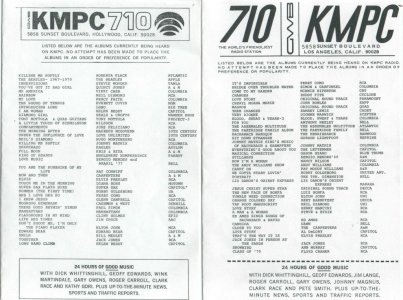
The effect was even greater on-air. When Geoff Edwards (middays on KMPC) is teasing KKDJ's Charlie Tuna because he's playing Marvin Gaye's "Trouble Man" first, it's a major shift.
There exists a 1975 aircheck of Sonny Melendrez saying the once-unthinkable phrase "Grand Funk on KMPC." The song was "Bad Time".
A lot of the 50+ audience was turned off by the change. This was also an era when people bought new cars much more frequently than they do today. The Buicks, Mercuries, Chryslers, Lincolns and Cadillacs that 50+ buyers favored in the mid-70s were beginning to show up with FM as standard equipment.
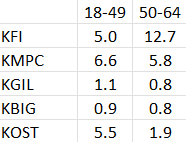
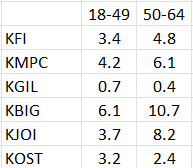
@Huff would be the guy to document the rise in shares for KBIG, KJOI and KOST from 1973 into the middle and late 70s, but you and I both know as AC programmers of the era that the change did cost the format 50+ audience---a trade we were willing to make to siphon off Top 40 audience in a period when it was very much a mass-appeal format.

Taking a look at my ratings archives from 1965 to 1975, it looks like 1970-73 is when Beautiful Music really started to take off on FM. New stations entered the format and stations that had been solely operating the format on a bare-bones basis started to put focused efforts into it.
Here are the April/May 1971 shares for Beautiful Music FMs in what were the top 5 markets at the time. With the exception of Detroit, where WABX edged out WLDM, the top Beautiful Music FM was also the top FM in the market.
1. NEW YORK CITY (11.1 total shares)
WRFM 4.5
WTFM 4.1
WPAT-F 2.5
2. LOS ANGELES (13.6)
KJOI 4.1
KOST 3.4
KWST 2.6
KUTE 1.5
KPOL-F 1.5
KBIG-F 0.5
3. CHICAGO (9.1)
WWEL 3.6
WFMF 2.4
WKFM 2.0
WCLR 1.1
4. DETROIT (10.6)
WLDM 2.9
WJR-F 2.7
WWJ-F 2.2
WOMC 2.8
5. WASHINGTON (13.9)
WJMD 5.7
WGAY-F 5.6
WEZR 1.4
WMAL-F 1.2
Here are the April/May 1971 shares for Beautiful Music FMs in what were the top 5 markets at the time. With the exception of Detroit, where WABX edged out WLDM, the top Beautiful Music FM was also the top FM in the market.
1. NEW YORK CITY (11.1 total shares)
WRFM 4.5
WTFM 4.1
WPAT-F 2.5
2. LOS ANGELES (13.6)
KJOI 4.1
KOST 3.4
KWST 2.6
KUTE 1.5
KPOL-F 1.5
KBIG-F 0.5
3. CHICAGO (9.1)
WWEL 3.6
WFMF 2.4
WKFM 2.0
WCLR 1.1
4. DETROIT (10.6)
WLDM 2.9
WJR-F 2.7
WWJ-F 2.2
WOMC 2.8
5. WASHINGTON (13.9)
WJMD 5.7
WGAY-F 5.6
WEZR 1.4
WMAL-F 1.2
K.M. Richards
Program Director, The Eighties Channel™
@Huff would be the guy to document the rise in shares for KBIG, KJOI and KOST from 1973 into the middle and late 70s, but you and I both know as AC programmers of the era that the change did cost the format 50+ audience---a trade we were willing to make to siphon off Top 40 audience in a period when it was very much a mass-appeal format.
That is a totally accurate description of what AC was trying to do, Mike. In fact, when Bill Wallace hired me at KAAP in 1978, he specifically said he wanted to do "top-40 for adults".
Of course, now I have to wonder how many of those Beautiful Music AMs that Dick has referenced were actually remnants of "good music"/MOR. As you and I know, KMPC was decidedly not MOR by the late 1970s.
April/May 1970 shares:@Huff would be the guy to document the rise in shares for KBIG, KJOI and KOST from 1973 into the middle and late 70s, but you and I both know as AC programmers of the era that the change did cost the format 50+ audience---a trade we were willing to make to siphon off Top 40 audience in a period when it was very much a mass-appeal format.
April/May 1975 shares:
I don't think so, as U did the format in spurts through about 1988.I'm taking an educated guess that this segment grew as Beautiful Music expanded.
When I did that first informal study in the later 60's, there had been no MOR station at all. In fact, until I did CHR 2 years before, there had not been any full-all-day formatted music station of any kind. And there was no TV.Again, an educated guess that a good chunk of that audience had been listening to "good music" MOR stations before those started fading from view.
And both Beautiful Music and album rock were perceived to be the least competitive with the "big" AM stations.It is a well-documented fact that the majority of the early FMs were operated by existing AM stations and that for quite a while those stations simulcast all or part of the day. That changed dramatically when the FCC mandated separate programming, and there were very few station owners at that point who were adventuresome and put a lot of money into their FMs. Hence the rise in automation, and the rise of Beautiful Music syndicators. The format appealed to the owners, was inexpensive to run, and was aesthetically pleasing to their years, having evolved from "good music" formats.
Even in the early 60's, those precursor "good music" stations were selling advertising... mostly local direct... but some were getting good results. By the later 60's, those stations were very profitable in most markets that had them.So it was no surprise to find multiple FMs in a market, because they weren't competing for ad dollars at that point in history.
And part of the adoption was the availability on FM of several formats that were not common on AM or not done well on AM. We even saw oldies or modified oldies on stations like WMOD in DC around 1968 and Drake Chennault's "Hit Parade" in that same year.And as FM itself became increasingly adopted, the listeners to the format moved from AM to FM, if for no other reason than justifying the expense of the new radio.
Along with that, a lot of FMs that had just been side mounted on their sister AM's shorter tower started to find tall buildings or big towers to mount on, adding huge coverage. For example, when daytime Top 40 WPGC in DC improved its FM considerably in 1969, it wiped out AM Top 40 WEAM almost instantly.
I'm taking an educated guess that this segment grew as Beautiful Music expanded.
Again, an educated guess that a good chunk of that audience had been listening to "good music" MOR stations before those started fading from view.
There will always be those, regardless of format.
That leads me to a hypothesis on Dick's comment about AMs not doing as well in the format once FM started to catch on, and it goes along with the fact that a lot of markets had multiple FMs doing Beautiful Music.
It is a well-documented fact that the majority of the early FMs were operated by existing AM stations and that for quite a while those stations simulcast all or part of the day. That changed dramatically when the FCC mandated separate programming, and there were very few station owners at that point who were adventuresome and put a lot of money into their FMs. Hence the rise in automation, and the rise of Beautiful Music syndicators. The format appealed to the owners, was inexpensive to run, and was aesthetically pleasing to their years, having evolved from "good music" formats.
So it was no surprise to find multiple FMs in a market, because they weren't competing for ad dollars at that point in history. And as FM itself became increasingly adopted, the listeners to the format moved from AM to FM, if for no other reason than justifying the expense of the new radio.
I don't think it's as "interesting" as Dick does, looking at it through this lens.
Dick and David, thank you. Fascinating statistics and input. And showing, as always it seems, that memory does become more and more clouded the older we grow. Making David’s resource even more valuable. My home market (in the top 50) was clearly the exception and down to just one FM (plus a daytimer AM) by spring of 1976.
The suggestion seems to be that Beautiful Music as a radio format did not do well on AM. That is not so although, as with FM there were markets where it did better than in others. Ratings reports I have been able to access show Beautiful AMs in top five positions in their markets, though in most I have been able to examine they were #4 to #6 in most time periods.I don't think so, as U did the format in spurts through about 1988.
When I did that first informal study in the later 60's, there had been no MOR station at all. In fact, until I did CHR 2 years before, there had not been any full-all-day formatted music station of any kind. And there was no TV.
And both Beautiful Music and album rock were perceived to be the least competitive with the "big" AM stations.
Even in the early 60's, those precursor "good music" stations were selling advertising... mostly local direct... but some were getting good results. By the later 60's, those stations were very profitable in most markets that had them.
And part of the adoption was the availability on FM of several formats that were not common on AM or not done well on AM. We even saw oldies or modified oldies on stations like WMOD in DC around 1968 and Drake Chennault's "Hit Parade" in that same year.
Along with that, a lot of FMs that had just been side mounted on their sister AM's shorter tower started to find tall buildings or big towers to mount on, adding huge coverage. For example, when daytime Top 40 WPGC in DC improved its FM considerably in 1969, it wiped out AM Top 40 WEAM almost instantly.
AM listeners heard Beautiful Music programs on generalist AMs before the advent of format radio. Some devoted as much as six hours daily to them one to two hours at a time. The Sunday afternoon Beautiful Music block, the romantic late eve hour, the dinner music show, the" housewive's matinee" had all become broadcasting cliches by the mid 1950s. And had big followings on block-programmed outlets.
But very few AMs had made a go of the format full-time before the coming of rock and R&B to generalist radio. Which were accepted and enjoyed by most of their audiences as fun and novelties until they began to crowd out more melodically-oriented genres from 1956. Which gave rise to the idea of the "adult station" which excluded most rock and aired "good music" instead. Originally good music was Classical and Light Classical - the more rhythmic genres of rock and R&B made everything that wasn't rock or R&B "good music". So MOR. MOR stations emphasizing more personalities and vocals became accepted as being designated as MOR though some used easy listening by the mid 60s. Those which downplayed personalities and offered more instrumental music became known as Beautiful Music. Between say 1956 and 1960.
Some gravitated to the new format because they just liked the music, others because they preferred the relative absence of personalities, shtick and patter and commercials, still others because they found it easier to use as background for whatever they were doing than anything else on radio. Although on AM the format usually had more of all than it later did on FM.
A lot of AMs did it for a few tears and then dropped it as no longer the hip thing when their ratings started to drop. After The Beatles many adults had started making their peace with youth music so were more accepting of it on generalist stations. Many moved it onto their FMs because the superior sound highlighted the strengths of instrumental music. As a sort of niche format for those who were willing to go to the trouble of buying and FM receiver. Or as a kind of community service. Some FMs had been getting pretty substantial audiences primarily playing background music to subscribing clients - this was by the later 50s. For FMs that was the only way to make any kind of profit from the medium and that remained true often well into the 60s.
But by say 1966 FMs started showing up among the top-rated AMs on ratings surveys for certain dayparts. Arbitron was breaking out the FMs in its reports. Which of course caused others to emulate these stations.
Some AMs did support and put money and effort into their FMs even going back through the 50s. Almost half of the successful background music FMs, before they began multiplexing, were co-owned with AMs. And I have found from 1959 there was a significant move to FM separation it seems almost for its prestige since the medium had few listeners even then. I was around and recall very well a few years later around 1965 when FMs became the thing and many people started getting them including myself. Part of the reason was that many schools were starting FM stations and offering deals on receivers so their students and their parents could listen to them. Others have mentioned the FCC's 50% non-duplication ruling of 1964 which only affected the larger centers of population. And as far as I can understand only positively led, and not directly, to the new what they then called "free-form" broadcasting aimed at college students. Which was a substantial group but not as numerous at that time as was drawn to more mainstream popular broadcasting which by then included Beautiful Music.
Percy Faith's songs were on Stardust, and two of them I think were on America's Best Music. And then there was a locally programmed station co-owned with a Stardust affiliate that had switched to oldies.I was thinking perhaps you were listening to stereo stations that did not play mono his which were pretty much all of them up to 1967. I have heard Summer Place which was a mono single, played on stereo stations. Delicado he remade in stereo in 1962 - not anywhere near as good as the '52 hit record or so think I.
I would say that the great explosion of Beautiful Music listening on FM from 1968 came mostly from people who had not picked up on it on AM. In other words most did not switch over from AM Beautiful stations. Those happy with it on AM would have had no reason to until their stations went off the air. And many very successful AM in the format did well through the 70s and even into the 80s.I don't think so, as U did the format in spurts through about 1988.
When I did that first informal study in the later 60's, there had been no MOR station at all. In fact, until I did CHR 2 years before, there had not been any full-all-day formatted music station of any kind. And there was no TV.
And both Beautiful Music and album rock were perceived to be the least competitive with the "big" AM stations.
Even in the early 60's, those precursor "good music" stations were selling advertising... mostly local direct... but some were getting good results. By the later 60's, those stations were very profitable in most markets that had them.
And part of the adoption was the availability on FM of several formats that were not common on AM or not done well on AM. We even saw oldies or modified oldies on stations like WMOD in DC around 1968 and Drake Chennault's "Hit Parade" in that same year.
Along with that, a lot of FMs that had just been side mounted on their sister AM's shorter tower started to find tall buildings or big towers to mount on, adding huge coverage. For example, when daytime Top 40 WPGC in DC improved its FM considerably in 1969, it wiped out AM Top 40 WEAM almost instantly.
Most of those I've never heard.Well let's see - Amor, Valencia, I Cross My Fingers, Brazilian Sleigh Bells, Christmas In Killarney, All My Love, Hot Canary, Syncopated Clock, Black Ball Ferry Line, On Top of Old Smokey, Loveliest Night of the Year, When the Saints Go Marching In, Always, Delicado, Jamaican Rhumba, Funny Fellow, Swedish Rhapsody, Theme From Moulin Rouge, Return To Paradise, Many Times, Suddenly, Dream, The Bandit, Non Dimenticar, Blue Mirage, Tropical Merengue, Valley Valparaiso, With A Little Bit of Love, Till, theme From A Summer Place, Theme For Young Love, Sons and Lovers, Dark At the Top of the Stairs, Light In the Piazza (not sure how much of a hit that was), Sound of Surf, Yellow Days, Can't Tale My Eyes Off of You, Zorba, Romeo and Juliet, Summer Place (vocal version), Everything's All Right, Joy, Crunchy Granola Suite, Hill Where the Lord Hides, Theme From Chinatown, Summer Place (disco version). May have missed a few. Not including the hits he arranged for vocalists he worked with. Only what was released with him as leader.
A good start would be the many long posts from the Facebook group.Thank you, I would like to do what I can. For me the music came first as far as an avenue for study and I was writing about it in the early 1980s. Then when it disappeared from the airwaves or I should say terrestrial airwaves I realized there was a whole story in its development on radio.
Quick question for Dick: where in your purview do you place WCKY Cincinnati in the 1970s - BM or MOR?
WCKY was the first station I listened to when DXing. I had listened to part of a high school football game and heard the broadcasters for the other team was also there so I decided to see if I could find them. That was the first "adult standards" station I remember hearing. That was in the late 70s and it would have definitely been MOR.
Except for a couple of stations like WPAT in the New York market and KPOL in LA, I can't see many true "Beautiful Music" stations that endured into the 70s. And those two I mention had FM simulcasts that were listed in combined form in Arbitron... generally as the AM station.The suggestion seems to be that Beautiful Music as a radio format did not do well on AM. That is not so although, as with FM there were markets where it did better than in others. Ratings reports I have been able to access show Beautiful AMs in top five positions in their markets, though in most I have been able to examine they were #4 to #6 in most time periods.
Some, like "Ocean" in Miami, left the format in the earlier 70's. And even ones like WVCG-1070 in Miami had their FM as well.
In the 1976 Duncan book, I can not find a single stand-alone AM Beautiful Music station with significan ratings.
But format radio pretty much started taking over in the early 50's when Top 40 was created. By the middle of the decade, there were few block programmed stations and those were, musically, MOR in that era.AM listeners heard Beautiful Music programs on generalist AMs before the advent of format radio.
Most of those, if they played instrumentals, used a big percentage of bands and not so much Jackie Gleason and the more modern "studio orchestra" sound.Some devoted as much as six hours daily to them one to two hours at a time. The Sunday afternoon Beautiful Music block, the romantic late eve hour, the dinner music show, the" housewive's matinee" had all become broadcasting cliches by the mid 1950s. And had big followings on block-programmed outlets.
You are missing the fact that Top 40 was created in 1951, and it played "the hits". When rock 'n' roll hits came along, the stations played both traditional sounds and the newer artists together... even as late as 1960 when many stations celebrated "Volare" as the prior year's #1 song... a definite MOR tune!But very few AMs had made a go of the format full-time before the coming of rock and R&B to generalist radio. Which were accepted and enjoyed by most of their audiences as fun and novelties until they began to crowd out more melodically-oriented genres from 1956.
The stations that were not Top 40 were generally among just a couple of big formats by the end of the 1950's: country, "race music" (sorry, but that is how it was called), and some form of MOR, often called "Full Service". Few were all instrumental. The MORs were the most varied, as they might play some instrumentals, be more traditional or even play some of the crossover artists that had Top 40 hits, like Nat "King" Cole and even Paul AnkaWhich gave rise to the idea of the "adult station" which excluded most rock and aired "good music" instead. Originally good music was Classical and Light Classical - the more rhythmic genres of rock and R&B made everything that wasn't rock or R&B "good music". So MOR. MOR stations emphasizing more personalities and vocals became accepted as being designated as MOR though some used easy listening by the mid 60s. Those which downplayed personalities and offered more instrumental music became known as Beautiful Music. Between say 1956 and 1960.
I was an AM band DXer starting in 1958 and in the next 5 or so years logged about 2,500 stations. I can recall very few that played instrumentals in rated dayparts, although there were several shows, such as the Holiday Inn overnight show that played instrumentals.Some gravitated to the new format because they just liked the music, others because they preferred the relative absence of personalities, shtick and patter and commercials, still others because they found it easier to use as background for whatever they were doing than anything else on radio. Although on AM the format usually had more of all than it later did on FM.
There were exceptions, such as McLendon's 1960 launch of KABL 960 in San Francisco... a station that took advantage of poor FM coverage in that market. KABL got a few imitators, but the format was not that common on AM
In 1950 there were about 1000 licensed FMs in construction or on the air. By 1960 they had fallen to just over 600. The independent FM for the most part had closed. The others simulcast their AM. Then, in the ealy 60's a new set of owners filed for FMs and got them and stuck with it.A lot of AMs did it for a few tears and then dropped it as no longer the hip thing when their ratings started to drop. After The Beatles many adults had started making their peace with youth music so were more accepting of it on generalist stations. Many moved it onto their FMs because the superior sound highlighted the strengths of instrumental music. As a sort of niche format for those who were willing to go to the trouble of buying and FM receiver. Or as a kind of community service. Some FMs had been getting pretty substantial audiences primarily playing background music to subscribing clients - this was by the later 50s. For FMs that was the only way to make any kind of profit from the medium and that remained true often well into the 60s.
But by say 1966 FMs started showing up among the top-rated AMs on ratings surveys for certain dayparts. Arbitron was breaking out the FMs in its reports. Which of course caused others to emulate these stations.
Some AMs did support and put money and effort into their FMs even going back through the 50s. Almost half of the successful background music FMs, before they began multiplexing, were co-owned with AMs. And I have found from 1959 there was a significant move to FM separation it seems almost for its prestige since the medium had few listeners even then.
And was not into effect until the start of 1967.I was around and recall very well a few years later around 1965 when FMs became the thing and many people started getting them including myself. Part of the reason was that many schools were starting FM stations and offering deals on receivers so their students and their parents could listen to them. Others have mentioned the FCC's 50% non-duplication ruling of 1964 which only affected the larger centers of population.
Major market AM station owners, faced with non-duplication rules, looked for the formats that would least affect their cash cows, and so Beautiful Music and Album Rock seemed to be the best way to protect their AMs.And as far as I can understand only positively led, and not directly, to the new what they then called "free-form" broadcasting aimed at college students. Which was a substantial group but not as numerous at that time as was drawn to more mainstream popular broadcasting which by then included Beautiful Music.
But if anything made Beautiful Music so successful, it was the duo of Shulke and Taylor who used syndication to mae doing the format cheap and easy: no cost of building a library, no PD, generally no talent, ability to automate, and even help in promotion and sales.
Last edited by a moderator:
I think most of those - they were popular at the time but not of a particularly lasting popularity. All worth hearing but perhaps about 15 of those are really worth keeping for all time. The stuff on his LPs would rate a much higher percentage than his single hits.Most of those I've never heard.