• Get involved.
    We want your input!
    Apply for Membership and join the conversations about everything related to broadcasting.

    After we receive your registration, a moderator will review it. After your registration is approved, you will be permitted to post.
    If you use a disposable or false email address, your registration will be rejected.

    After your membership is approved, please take a minute to tell us a little bit about yourself.
    https://www.radiodiscussions.com/forums/introduce-yourself.1088/

    Thanks in advance and have fun!
    RadioDiscussions Administrators

Which Beautiful/Easy Listening Orchestras Were Better or Worse Than Others and Why

Regarding the use of harp interludes - they were on KABL from the outset May 1959. WDBN did not go on the air until Fall 1960. Did they use harp? If so I am not sure I was aware of it.
From the Bay Area Radio Museum at KABL 960 AM San Francisco, CA | Bay Area Radio Museum & Hall of

"KABL came into being in May 1960, when legendary Dallas broadcaster Gordon McLendon added the Bay Area to his stable of major market radio holdings. He purchased venerable Oakland station KROW from Sheldon F. Sackett, publisher of the Oakland-based Olympic Press weekly newspaper for $800,000 and set out to shake things up."

I heard that stunting in Cleveland, and what is not mentioned are the goofy ads for things like war surplus destroyers and tanks.
 
Sorry do not seem to have got the hang of posting on here. Historically the term "Beautiful Music" comes into general use within the business in the early 1960s as a result of NcLendon's usage. I found it was used to characterize programs and even stations in that format going well back in the 50s at times . Though not generally. As you not it was often referred to as "Good Music" but only after rock m
"Music for the Two of Us" was not "matched flow". It was the usual 4-reel system that had tempo controlled reels and vocals mixed at random.

It was no different, other than the way the EOM cues were placed to cause an "overlap" rather than song-to-song separation.

They found a voiceover person in SoCal who did the liners in Spanish. We had to approve the translations, as the first ones we got were in Mexican Spanish. I also wrote hundreds of our own.

I was unaware of how the system worked internally, and that was quite interesting. For a while one of my competitors ran Bonneville, but their music was very "soft and traditional" compared to Peters and, later, FM 100. In those years, 1975-1978, we found that a service that had a lot more versions of Top 40 songs and less standards in newer orchestrations to fit our market. With FM 100, we added a reel that played two to three times an hour with Latin American "big songs" in instrumental versions.

And a really nice person. I have corresponded with him over the years.

As I recall, Shulke and Bonneville required live talent in studio doing the outros and intros and any local PSAs and the like in the top markets. The matched flow was more expensive, as there were more reels rotated and a bigger library size at each station.

When I syndicated "Música en Flor" we had a library of 120 "reels" and we sent out 6 replacement reels 22 times a year. That meant about 140 hours of music, and with random start times (I was the only one that required starts at different cut points on a "reel") there were millions of possible sets that could be generated.

Not familiar with that.. care to describe?
22 times a year? Much more than either Schulke or Bonneville put together! You did a lot of work! So within the random access you are saying they used each category reel in sequence but starting at a different point each day all the way through? Rather than switching to other reels within a category every quarter hour of half-hour?
 
From the Bay Area Radio Museum at KABL 960 AM San Francisco, CA | Bay Area Radio Museum & Hall of

"KABL came into being in May 1960, when legendary Dallas broadcaster Gordon McLendon added the Bay Area to his stable of major market radio holdings. He purchased venerable Oakland station KROW from Sheldon F. Sackett, publisher of the Oakland-based Olympic Press weekly newspaper for $800,000 and set out to shake things up."

I heard that stunting in Cleveland, and what is not mentioned are the goofy ads for things like war surplus destroyers and tanks.
Very famous. Ed Winton, who had worked for McLendon, used those exotics and mood intros on his Beautiful stations in Florida later on. Even sometimes recreating or creating a "live" broadcast of a sports event as McLendon had done in the early 60s on Liberty Network. Somehow all that stuff did not work as well in cities other than Oakland-San Francisco. Though many of those stations did well enough for a while.
 
As I said somewhere back there, I am reasonably certain that it was Gordon McLendon, who used the imaging phrase "beautiful music over San Francisco" for KABL and highlighted the phrase in his print advertising when he flipped both XTRA and KOST to that format.
That is what I have found. McLendon's success popularized that term. Within radio it was generally used from the early 1960s. Say 1962.
 
Very famous. Ed Winton, who had worked for McLendon, used those exotics and mood intros on his Beautiful stations in Florida later on. Even sometimes recreating or creating a "live" broadcast of a sports event as McLendon had done in the early 60s on Liberty Network. Somehow all that stuff did not work as well in cities other than Oakland-San Francisco. Though many of those stations did well enough for a while.
Winton's early Miami efforts did quite well until FM wiped him out. There were quite a few comparable early AM versions of KABL just like the Miami one.

The recreation of live sporting events was widespread. George Mooney, who later founded a station group, did the same using the teletype play by play narratives of each inning of baseball to create an actual simulated live broadcast. There were a number of such people who had the skill to integrate sound effects with an exciting announcing style to simulate a live broadcast.
 
Winton's early Miami efforts did quite well until FM wiped him out. There were quite a few comparable early AM versions of KABL just like the Miami one.

The recreation of live sporting events was widespread. George Mooney, who later founded a station group, did the same using the teletype play by play narratives of each inning of baseball to create an actual simulated live broadcast. There were a number of such people who had the skill to integrate sound effects with an exciting announcing style to simulate a live broadcast.
I was thinking more of Winton's WWBA stations at Tampa Bay which he continued to program long after he sold.

Thank you was unaware of Mooney.
 
It depends. For a while in the later 60's my Beautiful Music station was on in every upscale restaurant, store or boutique in the market and lots of people had it on in offices, at home as "mom" supervised the maids, and even when couples got together for dinner.

Our style of not allowing jingles, no "loud" hard sells, and only 20" spots made the ads unintrusive. We got very favorable responses from advertisers. For example, Lufthansa ran special copy for a "limited time only" round trip to one of its destinations in Germany which covered a once-weekly flight on four successive weeks. We were asked to revert to the "old copy" after just two days as they had sold out the four flights totally at a cost of about $2,500 each!

My feeling is that the format was for brand awareness and image. It was not for price/item and "big sale" announcements as much as creating top of mind awareness in an atmosphere that benefited the product.
This was in Ecuador?

Yes orchestral music was once considered top-of-the-line, luxurious, more cultured, more prestigious - depending on one's point of view. Which was why so many network advertisers from the later 1920s insisted on such a sound for their radio vehicles.
 
And that is what they were in the 70's and into the 80's. Almost all were 4 vocals an hour.

WPAT was an early FM simulcaster; KABL succeeded mostly because the FMs in SF in the 60's did not cover the hilly market at all well

The majority of those had FMs or added them. WAIT was a daytimer, and XTRA burnt through various formats in the 60's trying to be an LA station with a San Diego signal. Remember, even back then Nielsen would list simulcasts at the option of the station under just one station, and that was, back then, the AM.

It was 1961, and Storz rapidly expanded to multiple markets such as Minneapolis, Kansas City, New Orleans and others. McLendon went Top 40 on KLIF soon after Storz's big success in the earliest 50's, following with El Paso, Houston, San Antonio and then on to places like Louisville.

Most Top 40's played the hits. When Buddy Holly and Little Richard and Bill Haley hit the charts, those Top 40 station grew even bigger. In those markets (essentially every multi-station market) some other station continued to play Sinatra and Patti Page.

The big breakaway from any adult-only songs came with the dance crazes of the early 60's, such as the Twist and novelty rhythms like The Bristol Stomp. Then we got the trifecta of the Beach Boys, Motown and the British Invasion. That was earlier to mid 60's, all of it.

Even the ballads, by then, were more like "Blue Velvet" than a Sinatra song.
I would argue that the initial Storz success in 1951 came more from the personalities he hired rather than from any of his innovations. Yes he was eliminating non-music programs was until Fall of 1953. The DJs he hired were pulling their own music and he must have learned a lot from them. But in terms of the limited playlist for programs that did not come in until Bill Stewart as I understand it. And then only part of the broadcast day. The rest of the time they were playing the same stuff as hundreds of other AMs were. Possibly some of those men were lazy and only pulled a minimum of records. In those days it was mostly all singles. I have read that Storz himself never cared for 45 rpms so recorded them on to 78 rpms for station and his own use. Until 1957 or '58. Just my own conclusions and I know at variance with how history has received it.
 
22 times a year? Much more than either Schulke or Bonneville put together! You did a lot of work! So within the random access you are saying they used each category reel in sequence but starting at a different point each day all the way through? Rather than switching to other reels within a category every quarter hour of half-hour?
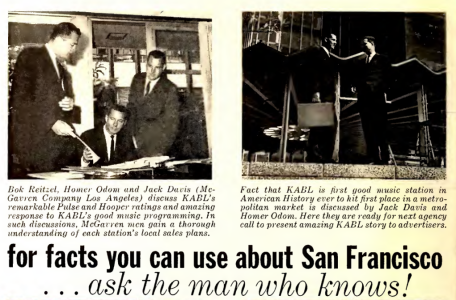
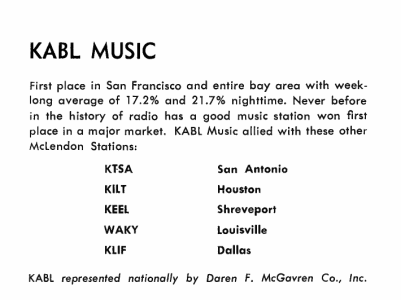
May of 1959. #1 in Fall '59 ratings sweeps.
 
KABL (Hooper)
Oct 1958: 2.0
June 1959: 10.5 (#3)
Nov 1959: 17.2 (#1)

Broadcasting Magazine, Oct. 1959:

1755875488949.png1755875803960.png
 
My congratulations sir on your locating those ratings reports! Anything before Duncan is difficult for most of us researching to come by.
Which is why I've spent decades and more money than I care to admit accumulating archival ARB data back to 1965. Unfortunately, there was never a Hooper "repository" or archive, so most of that data is lost to history, with the exception of a few trade ads here or there or the odd pamphlet report saved by a programmer.
 
Taking a look at my ratings archives from 1965 to 1975, it looks like 1970-73 is when Beautiful Music really started to take off on FM. New stations entered the format and stations that had been solely operating the format on a bare-bones basis started to put focused efforts into it.

Here are the April/May 1971 shares for Beautiful Music FMs in what were the top 5 markets at the time. With the exception of Detroit, where WABX edged out WLDM, the top Beautiful Music FM was also the top FM in the market.

1. NEW YORK CITY (11.1 total shares)
WRFM 4.5
WTFM 4.1
WPAT-F 2.5

2. LOS ANGELES (13.6)
KJOI 4.1
KOST 3.4
KWST 2.6
KUTE 1.5
KPOL-F 1.5
KBIG-F 0.5

3. CHICAGO (9.1)
WWEL 3.6
WFMF 2.4
WKFM 2.0
WCLR 1.1

4. DETROIT (10.6)
WLDM 2.9
WJR-F 2.7
WWJ-F 2.2
WOMC 2.8

5. WASHINGTON (13.9)
WJMD 5.7
WGAY-F 5.6
WEZR 1.4
WMAL-F 1.2
Very good! You must have spent years collecting these reports!
 
Which is why I've spent decades and more money than I care to admit accumulating archival ARB data back to 1965. Unfortunately, there was never a Hooper "repository" or archive, so most of that data is lost to history, with the exception of a few trade ads here or there or the odd pamphlet report saved by a programmer.
Yes. I have found some in newspaper as you say ads and articles but especially with Beautiful Music stations they are so often the adult numbers rather than the 12+ numbers which are published. Good work.
 
And that is what they were in the 70's and into the 80's. Almost all were 4 vocals an hour.

WPAT was an early FM simulcaster; KABL succeeded mostly because the FMs in SF in the 60's did not cover the hilly market at all well

The majority of those had FMs or added them. WAIT was a daytimer, and XTRA burnt through various formats in the 60's trying to be an LA station with a San Diego signal. Remember, even back then Nielsen would list simulcasts at the option of the station under just one station, and that was, back then, the AM.

It was 1961, and Storz rapidly expanded to multiple markets such as Minneapolis, Kansas City, New Orleans and others. McLendon went Top 40 on KLIF soon after Storz's big success in the earliest 50's, following with El Paso, Houston, San Antonio and then on to places like Louisville.

Most Top 40's played the hits. When Buddy Holly and Little Richard and Bill Haley hit the charts, those Top 40 station grew even bigger. In those markets (essentially every multi-station market) some other station continued to play Sinatra and Patti Page.

The big breakaway from any adult-only songs came with the dance crazes of the early 60's, such as the Twist and novelty rhythms like The Bristol Stomp. Then we got the trifecta of the Beach Boys, Motown and the British Invasion. That was earlier to mid 60's, all of it.

Even the ballads, by then, were more like "Blue Velvet" than a Sinatra song.
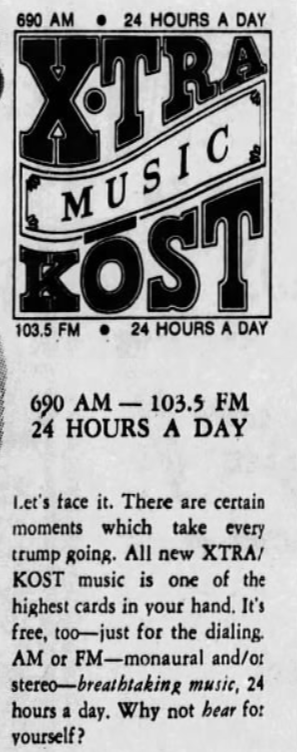
XTRA AM was Beautiful Music (initially with harp!) from 1967 or '68 ( sorry can't pull the exact date from my memory right now) until September 1980.
 
XTRA AM was Beautiful Music (initially with harp!) from 1967 or '68 ( sorry can't pull the exact date from my memory right now) until September 1980.
McLendon abandoned the all-classified format on 103.5 and flipped it from KADS to beautiful music KOST in October 1967. In March 1968, when KFWB went all-news, McLendon decided to give up the all-news format on XETRA (or, since he technically didn't own XETRA, he "convinced" its management to give it up) and made it a simulcast of KOST (which lasted until into the mid 70s)
1755877429495.png


Back
Top Bottom