• Get involved.
    We want your input!
    Apply for Membership and join the conversations about everything related to broadcasting.

    After we receive your registration, a moderator will review it. After your registration is approved, you will be permitted to post.
    If you use a disposable or false email address, your registration will be rejected.

    After your membership is approved, please take a minute to tell us a little bit about yourself.
    https://www.radiodiscussions.com/forums/introduce-yourself.1088/

    Thanks in advance and have fun!
    RadioDiscussions Administrators

Which Cities Got the Most AM Radio I-A Designations?

When the North American Regional Broadcast Agreement (NARBA) set up the highest designation for an AM radio station, I-A, only 38 stations were chosen. Only a few cities got more than one.

Chicago got four (670 WMAQ, 720 WGN, 780 WBBM, 890 WLS)
New York got three (660 WEAF-WNBC, 770 WJZ-WABC, 880 WCBS)
Mexico City got three (730 XEX, 900 XEW, 1220 XEB)
Toronto got two (740 CBL, 860 CJBC)

Los Angeles and Montreal came close to having two I-As. LA got 640 KFI as a I-A. Meanwhile 1070 KNX was equal to a Class I-A. It was 50,000 watts non-directional. But it was a I-B because it shared its frequency with CBA Moncton. New Brunswick was so far from California that CBA also was 50,000 watts non-directional. But you could only have one I-A on one frequency. So that knocked KNX and CBA down to I-B status.

Montreal had a similar story. 690 CBF was a I-A. CBM 940 came close. It only had a slight directional adjustment to its nighttime signal. But it was protecting XEQ 940 in Mexico City. They were far from each other and XEQ was non-directional at all times. But being on the same frequency, they were both I-Bs.

You'd think some other big cities would get more than a single I-A but that didn't happen.

Dallas-Fort Worth got a I-A (820 WBAP) and a I-B (1090 KRLD)
Nashville got a I-A (WSM 650) and I-B (WLAC 1510)
Philadelphia got a I-A (WCAU 1210) and a I-B ( KYW 1060)
Monterrey got a I-A (XEG 990) and a I-B (XEMR 1140)
Minneapolis-St. Paul got a I-A (WCCO 830) and a I-B (KSTP 1500)
 
Last edited:
I should add that 690 had once been assigned to Toronto as CFRB's frequency. I remember the story that when WLW 700 was given permission to go 500,000 watts, 690 CFRB complained that WLW was interfering with its signal, even though Cincinnati is 450 miles from Toronto. (That's how powerful half-a-million watts are!) But with the 1941 enactment of NARBA, 690 moved to Montreal. And CFRB was switched to 860 as a Class I-A.

I think the story goes that the CBC wanted 860 for its French language network, Radio-Canada. So in 1948, CFRB moved to Class I-B status on 1010 kHz, shared with CBR Calgary. And CJBC was bumped up to Class I-A status on 860 as the Toronto outlet for Radio-Canada.
 
Last edited:
I should add that 690 had once been assigned to Toronto as CFRB's frequency. I remember the story that when WLW 700 was given permission to go 500,000 watts, 690 CFRB complained that WLW was interfering with its signal, even though Cincinnati is 450 miles from Toronto. (That's how powerful half-a-million watts are!) But with the 1941 enactment of NARBA, 690 moved to Montreal. And CFRB was switched to 860 as a Class I-A.

I think the story goes that the CBC wanted 860 for its French language network, Radio-Canada. So in 1948, CFRB moved to Class I-B status on 1010 kHz, shared with CBR Calgary. And CJBC was bumped up to Class I-A status on 860 as the Toronto outlet for Radio-Canada.
 
I have always wondered about WOR and WWL which are listed as a Class A which IIRC other stations had to protect them but both are directional 24 hours. Shouldn't they be 1-B or did they sacrifice skywave for better coverage in the city?
 
Apparently 99% of Mexican AM stations were non-directional, only a few were assigned directionally.
 
When the North American Regional Broadcast Agreement (NARBA) set up the highest designation for an AM radio station, I-A, only 38 stations were chosen. Only a few cities got more than one.

Chicago got four (670 WMAQ, 720 WGN, 780 WBBM, 890 WLS)
New York got three (660 WEAF-WNBC, 770 WJZ-WABC, 880 WCBS)
Mexico City got three (730 XEX, 900 XEW, 1220 XEB)
Toronto got two (740 CBL, 860 CJBC)

Los Angeles and Montreal came close to having two I-As. LA got 640 KFI as a I-A. Meanwhile 1070 KNX was equal to a Class I-A. It was 50,000 watts non-directional. But it was a I-B because it shared its frequency with CBA Moncton. New Brunswick was so far from California that CBA also was 50,000 watts non-directional. But you could only have one I-A on one frequency. So that knocked KNX and CBA down to I-B status.

Montreal had a similar story. 690 CBF was a I-A. CBM 940 came close. It only had a slight directional adjustment to its nighttime signal. But it was protecting XEQ 940 in Mexico City. They were far from each other and XEQ was non-directional at all times. But being on the same frequency, they were both I-Bs.

You'd think some other big cities would get more than a single I-A but that didn't happen.

Dallas-Fort Worth got a I-A (820 WBAP) and a I-B (1090 KRLD)
Nashville got a I-A (WSM 650) and I-B (WLAC 1510)
Philadelphia got a I-A (WCAU 1210) and a I-B ( KYW 1060)
Monterrey got a I-A (XEG 990) and a I-B (XEMR 1140)
Minneapolis-St. Paul got a I-A (WCCO 830) and a I-B (KSTP 1500)
And Chicago originally had five until the FCC noted the zone had one more I-A station than it should have, and the eastern zone had one less. So Westinghouse was asked in 1934 to move KYW (1020) to Philadelphia, or it would be moved there as an eventual I-B, as you noted, under new ownership.
 
I have always wondered about WOR and WWL which are listed as a Class A which IIRC other stations had to protect them but both are directional 24 hours. Shouldn't they be 1-B or did they sacrifice skywave for better coverage in the city?
WWL and WBZ Boston are directional by choice to put more signal over land and less over water, but retained their I-A designations. WNBC, now WFAN, was directional for a time as well. All remain Class A today.
 
You'd think some other big cities would get more than a single I-A but that didn't happen.
Remember, they were not allocated the way FM is. It was more of a "first come / first served" situation which is why some of today's biggest cities have no 1-A or 1-B, such as Austin and Phoenix to give two examples.... along with basically all of Florida!
Dallas-Fort Worth got a I-A (820 WBAP) and a I-B (1090 KRLD)
Nashville got a I-A (WSM 650) and I-B (WLAC 1510)
Philadelphia got a I-A (WCAU 1210) and a I-B ( KYW 1060)
Monterrey got a I-A (XEG 990) and a I-B (XEMR 1140)
Minneapolis-St. Paul got a I-A (WCCO 830) and a I-B (KSTP 1500)
What about 150 kw Monterrey station on 1050?
 
I have always wondered about WOR and WWL which are listed as a Class A which IIRC other stations had to protect them but both are directional 24 hours. Shouldn't they be 1-B or did they sacrifice skywave for better coverage in the city?
Actually WOR had been a I-B. New York had three I-As and three I-Bs. The I-As are non-directional.

660 WEAF/WNBC I-A
710 WOR I-B (Directional at all times. But that helps it cover Philadelphia as well as NYC. It shares 710 with Seattle.)
770 WJZ/WABC I-A
880 WCBS I-A
1130 WNEW I-B (Non-directional by day, directional at night. It shares 1130 with Shreveport and Vancouver.)
1560 WQXR I-B (Directional at all times. Shares 1560 with Bakersfield.)
 
WQXR used to come in well in Chicago before Bakersfield sunset. This was back when the NY Times owned it and for some time after. What was their daytime pattern?
 
... along with basically all of Florida!
Before the widespread use of Air Conditioning post WW2, year round residency in Florida was "difficult" in a lot of parts of the state.
IMHO: the Sunshine State really didn't have the year round population to support attract big time radio operations when folks were "squatting" on channels. The 1920 census was 968K for the whole state. 1930 headcount was 1.4 million which was only the #31 ranking by states census. The operators that got directional night signals in Florida cities in the 40s and 1950's who lasted till the early 1980s should have been able to sell out for a really good "life time" rate of return.
 
Keep in mind what we consider "big cities" today were not big cities 90 years ago. Most big cities back then were in the northeast.

Another 1-A is WHAS Louisville. Not a big city, but at the time, the station was owned by the Bingham family. They owned the local newspaper as well. Those combined newspaper-radio groups, like Cox with WSB Atlanta, had a lot of power, and moved to the front of the line when it came to things like this. Other groups weren't as attentive. We've talked about KQV in Pittsburgh, that never sought to increase power when it could have.
 
WQXR used to come in well in Chicago before Bakersfield sunset. This was back when the NY Times owned it and for some time after. What was their daytime pattern?
Their old patterns are still on the books, since they've been operating under STAs since they sold the transmitter site:

 
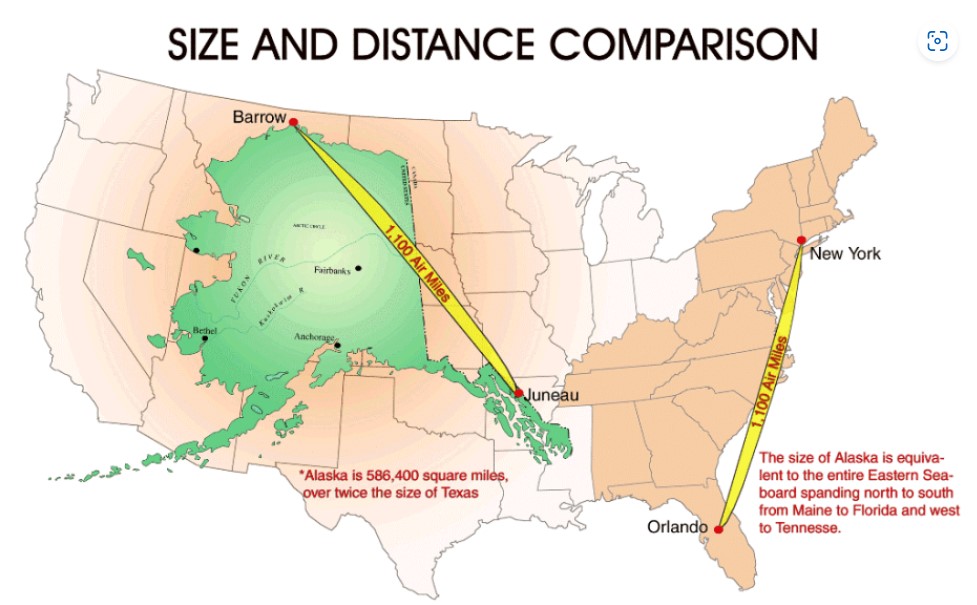
interesting note.... we have several Class A Clears in Alaska on the same frequencies as lower 48 class A Clears (the distance between them and any part of the lower 48 is about 1500 miles, but the distance between them and other clears is about 2000 miles or more.

And some of our Class A stations dont have 50kw
 
And some of our Class A stations dont have 50kw
I thought Alaska got a special exception to have a minimum power for Class A stations of 10 kW instead of 50 kW.

And just to emphasize how big Alaska is compared to the lower 48:
AlaskaUSMap.jpg
 
Status
This thread has been closed due to inactivity. You can create a new thread to discuss this topic.


Back
Top Bottom