• Get involved.
    We want your input!
    Apply for Membership and join the conversations about everything related to broadcasting.

    After we receive your registration, a moderator will review it. After your registration is approved, you will be permitted to post.
    If you use a disposable or false email address, your registration will be rejected.

    After your membership is approved, please take a minute to tell us a little bit about yourself.
    https://www.radiodiscussions.com/forums/introduce-yourself.1088/

    Thanks in advance and have fun!
    RadioDiscussions Administrators

Why are big hits "lost?"

Status
Not open for further replies.
Stations test songs against their core demographic. For example, a station targeting 25-44 women likely will not test against men, and will limit women to those who are 25-39 and who listen more than a certain number of hours a week. If the song scores negatively in any age subset, it likely will not be played.

Stations don't test for terms like "cliche" or the like. The question is some form of "How much would you like to hear this song today?".

And "Classic Hits" is not, in the industry, the same as "oldies". Oldies is 60's stuff and early/later fringe years. Classic Hits is late 70's to very early 90's. Different formats.
Thank you. I'm wondering how the stations select listeners to participate in the tests -- does the station pay a company who sets up focus groups to assemble a batch of listeners aged 25-44, or over the air do they announce they are looking for volunteers -- how would that be organized. Just curious, as many listeners, including me, find behind-the-scenes details to be fascinating.

I remember that in past discussions, you had told me that "oldies" format meant songs from the 60's with some fringe on either side of the decade; and "classic hits" meant 80's with fringe. But then you mentioned, that the terminology for the two formats was very fluid and up to each station to define the 2 terms for themselves. So, I was trying to give some leeway to those 2 format genres.
 
Thank you. I'm wondering how the stations select listeners to participate in the tests -- does the station pay a company who sets up focus groups to assemble a batch of listeners aged 25-44, or over the air do they announce they are looking for volunteers -- how would that be organized. Just curious, as many listeners, including me, find behind-the-scenes details to be fascinating.

I remember that in past discussions, you had told me that "oldies" format meant songs from the 60's with some fringe on either side of the decade; and "classic hits" meant 80's with fringe. But then you mentioned, that the terminology for the two formats was very fluid and up to each station to define the 2 terms for themselves. So, I was trying to give some leeway to those 2 format genres.
Search David Eduardo's threads. He's discussed music testing in great detail.
 
Thank you. I'm wondering how the stations select listeners to participate in the tests -- does the station pay a company who sets up focus groups to assemble a batch of listeners aged 25-44, or over the air do they announce they are looking for volunteers -- how would that be organized. Just curious, as many listeners, including me, find behind-the-scenes details to be fascinating.
Music tests are not focus groups. In a radio focus group, a moderator leads a discussion of topics related to a station, such as bits the morning show does or listener feelings about aspects of the station programming. "What would you say if I said, 'WRKZ plays a lot of songs I don't like? John, why don't we start with your answer?"

In a music test people who are pre-selected and then invited are asked to listen to hundreds of song snippets, called "hooks", and told to score them on how much they would like to hear that song today.

People are recruited based on the station's core target age, gender, ethnicity, etc., and who listen to the station enough hours a day/ week to know the music. They are paid amounts from $100 and up to do the study. Today, most tests are done online, but recruiting is done personally by phone and generally from established lists of residents such as the lists Nielsen might use for ratings.

The recruit technique is on purpose similar to ratings recruiting to get the same kind of people who might take a listener survey or accept a PPM. The participant goes through a screen about age, gender and the like and are asked what stations and how much they listen to. Those fitting the "recruit spec" are offered money and given a code to log in and take the test. They are never told what station is doing the study.
I remember that in past discussions, you had told me that "oldies" format meant songs from the 60's with some fringe on either side of the decade; and "classic hits" meant 80's with fringe. But then you mentioned, that the terminology for the two formats was very fluid and up to each station to define the 2 terms for themselves. So, I was trying to give some leeway to those 2 format genres.
The on air terminology is "whatever the station wants". But for the industry, it is highly specific and controlled by Nielsen insofar as what appears in a station's format name in the reports ad agencies get. The reason agencies want that data is that media buyers may be handling dozens of markets... a buy might be the whole Top 100 metros... and buyers don't know the stations and formats so they refer to Nielsen definitions to make sure they get the formats that fit an advertiser's customer profile.

Of course, it is very rare for an agency buy to include "oldies" formats. In fact, that name scares them away!

Music testing used to be done in person. I managed hundreds of them for HBC and Univision. Here is a little photo profile of a music test back when they were done in person: https://worldradiohistory.com/research_AMT.htm
 
Last edited:
I went back to Sean Ross's original article, and there really aren't any songs on his list that I would play. A lot of them are by major stars. But they're not songs that are in any way identified with those stars.

Take for example "Inside Your Heaven" by Carrie Underwood. She sang that song the night she won Idol in 2005. It was her first #1. You would think it would be meaningful to her career. But it's not. The song she considers her first #1 is Jesus Take The Wheel. It's a Top 10 gold for her, and it gets a special place in every concert she does. She doesn't perform "Inside Your Heaven" at all. If the artist doesn't play the song, why should radio play the song? It was a turntable hit. It got played because she won Idol. It's been eclipsed by dozens of much better songs that resonate with her and her fans. They have long since forgotten Inside Your Heaven.

I could probably write a story like this for every song on Sean's list. He doesn't seem to understand why radio has stopped playing R Kelly. He writes "The artist most represented on the Lost 100 is R. Kelly." Maybe he should read the news. R. Kelly's career is over. Someday people may be willing to listen to his music again. Not now.
 
Pac Man Fever isn't lost. We all know exactly where it is, and why. :LOL:

To me, a lost hit is the song that was, and still is, a great song. You hear it for the first time in years, remember how much you loved it and wouldn't mind hearing it more often. I usually hear a bunch of those songs on the PA system at the supermarket.
 
I went back to Sean Ross's original article, and there really aren't any songs on his list that I would play. A lot of them are by major stars. But they're not songs that are in any way identified with those stars.

Take for example "Inside Your Heaven" by Carrie Underwood. She sang that song the night she won Idol in 2005. It was her first #1. You would think it would be meaningful to her career. But it's not. The song she considers her first #1 is Jesus Take The Wheel. It's a Top 10 gold for her, and it gets a special place in every concert she does. She doesn't perform "Inside Your Heaven" at all. If the artist doesn't play the song, why should radio play the song? It was a turntable hit. It got played because she won Idol. It's been eclipsed by dozens of much better songs that resonate with her and her fans. They have long since forgotten Inside Your Heaven.
I’d like to piggyback on this. “Inside Your Heaven” may be the perfect reason why using Hot 100 chart performance is a terrible justification for playing a song. The song debuted at #1 based on high single sales, but fell off the chart pretty quickly. Like you said, she just won Idol, so there’s a lot of curiosity driving people to buy the single, download, whatever. But it wasn’t a radio hit. It peaked at #12 on AC, not bad, but entirely forgettable. “Jesus, Take The Wheel” and “Before He Cheats” are way more memorable, at least for Country or AC.

Another reason to not use Billboard for justifying airplay: “Harlem Shake by Bauuer (2013). It was Billboard’s #4 song of the entire year, but received negligible airplay. I can’t imagine ANYONE would want to hear that song on the radio today or in the future.
 
The problem with focusing on the chart run of a song is that it's not very long. Yes the song gets a lot of airplay while it's in the chart. But hits aren't made by how high they chart. Hits are made by how LONG they chart. In other words: recurrent airplay. There are songs by several artists that are getting so much recurrent airplay two years after they peaked that they have stunted the success of the follow-up singles. Recurrent airplay is what solidifies the stature and success of a song beyond its initial run for #1.
 
Music tests are not focus groups. In a radio focus group, a moderator leads a discussion of topics related to a station, such as bits the morning show does or listener feelings about aspects of the station programming. "What would you say if I said, 'WRKZ plays a lot of songs I don't like? John, why don't we start with your answer?"

In a music test people who are pre-selected and then invited are asked to listen to hundreds of song snippets, called "hooks", and told to score them on how much they would like to hear that song today.

People are recruited based on the station's core target age, gender, ethnicity, etc., and who listen to the station enough hours a day/ week to know the music. They are paid amounts from $100 and up to do the study. Today, most tests are done online, but recruiting is done personally by phone and generally from established lists of residents such as the lists Nielsen might use for ratings.

The recruit technique is on purpose similar to ratings recruiting to get the same kind of people who might take a listener survey or accept a PPM. The participant goes through a screen about age, gender and the like and are asked what stations and how much they listen to. Those fitting the "recruit spec" are offered money and given a code to log in and take the test. They are never told what station is doing the study.

The on air terminology is "whatever the station wants". But for the industry, it is highly specific and controlled by Nielsen insofar as what appears in a station's format name in the reports ad agencies get. The reason agencies want that data is that media buyers may be handling dozens of markets... a buy might be the whole Top 100 metros... and buyers don't know the stations and formats so they refer to Nielsen definitions to make sure they get the formats that fit an advertiser's customer profile.

Of course, it is very rare for an agency buy to include "oldies" formats. In fact, that name scares them away!

Music testing used to be done in person. I managed hundreds of them for HBC and Univision. Here is a little photo profile of a music test back when they were done in person: https://worldradiohistory.com/research_AMT.htm
Thank you, David ! I found this information to be very interesting, including the photos of the equipment used to do the testing. Thank you again for the link. - Daryl :)
 
I could probably write a story like this for every song on Sean's list. He doesn't seem to understand why radio has stopped playing R Kelly. He writes "The artist most represented on the Lost 100 is R. Kelly." Maybe he should read the news. R. Kelly's career is over. Someday people may be willing to listen to his music again. Not now.

Sean's not advocating for any of these records to be played. He did a piece a few years back on big hits from a certain year that don't get played anymore and it got hits and comments and he's turned it into a feature. Sean Ross absolutely understands what's keeping these records from being played.
 
"Achy Breaky Heart" was a #1 country hit in 1992, and a top 5 hit on the Hot 100.

Some songs don't get "lost", they get burial at sea.
when WBCN FM Boston was taking a shot at Barry Scott's "The Lost 45's" ( a trademarked name BTW) that was running on another station and doing very well on Sunday nights....they had a promo that included the line " those songs are not lost, someone put them away for a reason" and that IMHO is pretty much spot on in many cases.

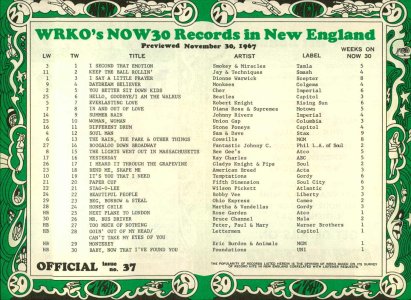
I am one of the 2 moderators of a "Big 68 WRKO" fan page on FB, and each week I normally post a picture of the WRKO record store chart position flyer ..the ones you used to get at your local record emporium back in the day ( I'll link the source below).

When you look back on those charts, you look at some of the songs and ask how the hell did some of these songs ever get played?

How did this song make it on the charts? I've never heard of it until today. Not even on SXM.


WRKO_1967-11-30_1.JPG

 
when WBCN FM Boston was taking a shot at Barry Scott's "The Lost 45's" ( a trademarked name BTW) that was running on another station and doing very well on Sunday nights....they had a promo that included the line " those songs are not lost, someone put them away for a reason" and that IMHO is pretty much spot on in many cases.

I am one of the 2 moderators of a "Big 68 WRKO" fan page on FB, and each week I normally post a picture of the WRKO record store chart position flyer ..the ones you used to get at your local record emporium back in the day ( I'll link the source below).

When you look back on those charts, you look at some of the songs and ask how the hell did some of these songs ever get played?

How did this song make it on the charts? I've never heard of it until today. Not even on SXM.


View attachment 4157


I guess it depends what station you were listening to in 1967. "Next Plane to London" went to #5 at KHJ in Los Angeles, so I absolutely heard it.

But--the week after it peaked at #5 on KHJ, it went to #8 and the week after that, it was nowhere to be found on the Boss 30.

I don't think I ever heard it on the radio again until some really loose oldies station played it in the 80s.

Its entire chart run at KHJ was six weeks---which is a perfect illustration of BigA's point that it's chart longevity more than chart peak that matters.
 
when WBCN FM Boston was taking a shot at Barry Scott's "The Lost 45's" ( a trademarked name BTW) that was running on another station and doing very well on Sunday nights....they had a promo that included the line " those songs are not lost, someone put them away for a reason" and that IMHO is pretty much spot on in many cases.

I am one of the 2 moderators of a "Big 68 WRKO" fan page on FB, and each week I normally post a picture of the WRKO record store chart position flyer ..the ones you used to get at your local record emporium back in the day ( I'll link the source below).

When you look back on those charts, you look at some of the songs and ask how the hell did some of these songs ever get played?

How did this song make it on the charts? I've never heard of it until today. Not even on SXM.


View attachment 4157

I remember it well, even though I was only 12 when it was current. Not sure how high it got on WRKO's survey, but it definitely wasn't a two-week wonder that never got far before being dropped. Some of these songs may have been pushed across the RKO Top 40 stations -- KHJ, WHBQ, WRKO, etc. -- and did better on those stations' playlists than they might have on competitors', or in markets with no RKO presence.
 
Its entire chart run at KHJ was six weeks---which is a perfect illustration of BigA's point that it's chart longevity more than chart peak that matters.

Of the 30 songs on the WRKO survey, none had been there for as much as 10 weeks, and only one had been on it for nine! I bet "Soul Man" was played very little that week and disappeared the next. It's amazing to look at this and compare it to today's playlists, on which change is glacial and even midchart peakers hang around for at least four months.
 
I guess it depends what station you were listening to in 1967. "Next Plane to London" went to #5 at KHJ in Los Angeles, so I absolutely heard it.

But--the week after it peaked at #5 on KHJ, it went to #8 and the week after that, it was nowhere to be found on the Boss 30.

I don't think I ever heard it on the radio again until some really loose oldies station played it in the 80s.
I’ve heard “Next Plane to London” pop up on WDJO recently.
 
I guess it depends what station you were listening to in 1967. "Next Plane to London" went to #5 at KHJ in Los Angeles, so I absolutely heard it.

But--the week after it peaked at #5 on KHJ, it went to #8 and the week after that, it was nowhere to be found on the Boss 30.

I don't think I ever heard it on the radio again until some really loose oldies station played it in the 80s.

Its entire chart run at KHJ was six weeks---which is a perfect illustration of BigA's point that it's chart longevity more than chart peak that matters.
Also #5 on CKLW. I do remember the song, even on oldies stations throughout the years.
 
I remember it well, even though I was only 12 when it was current. Not sure how high it got on WRKO's survey, but it definitely wasn't a two-week wonder that never got far before being dropped. Some of these songs may have been pushed across the RKO Top 40 stations -- KHJ, WHBQ, WRKO, etc. -- and did better on those stations' playlists than they might have on competitors', or in markets with no RKO presence.
Didn't realize we were that close in age, CT. I was 11.

Looks like it peaked at #11 on WRKO the week of December 14, which was the same week it peaked at KHJ.

At WRKO, it went 11-16-gone. Total chart run: Four weeks.

RKO group adds were absolutely a thing (cue @DavidEduardo and a Bernie Torres bag man joke here).
 
Status
Not open for further replies.


Back
Top Bottom