• Get involved.
    We want your input!
    Apply for Membership and join the conversations about everything related to broadcasting.

    After we receive your registration, a moderator will review it. After your registration is approved, you will be permitted to post.
    If you use a disposable or false email address, your registration will be rejected.

    After your membership is approved, please take a minute to tell us a little bit about yourself.
    https://www.radiodiscussions.com/forums/introduce-yourself.1088/

    Thanks in advance and have fun!
    RadioDiscussions Administrators

Why are big hits "lost?"

Status
Not open for further replies.
To me, ( and this is just me), Hall and Oates sound like "soft rock" music that is indeed vapid. Much of 70's music was vapid, vanilla, and nondescript. The artists murmured the lyrics to a background of high-pitched guitar, drumsticks, and cymbals.
Issac Hayes did this a lot, ( with disco accompaniment added in), and I can't stand him, either.

Pretty sure that Al Green can do better with this material than Hall and Oates. However, to me, this sounds like smooth jazz background music for the workplace or played in the background at the dentist's office. And, I don't like drippy, saccharine break-up lyrics, whether it's Taylor Swift, or Adele, or Hall and Oates, or anyone else.

In addition, there's not much beat, it's not danceable, nor necessarily tuneful nor melodic. But that's just me !
As they say on the internet, YMMV. :) And it's true that everyone has different tastes in music.

However, I do agree with you about a lot of country music that you think is good, and I think it's good also. :) -- Daryl
You're coming off as VChimp II "get off my lawn with that music I don't like".
If you want to learn about the legendary CKLW Music Director Rosalie Trombley and how she did her job, spend a half-hour watching this.
 
Youd think catering to the pop audience as a whole there would be some more variety.
Stop and think about what you just said.

You're talking about a format that literally plays the most popular songs of the current moment.

At any given time, there are truly hot records, records that haven't hit that stage yet (and may or may not) and records that have already hit that stage and are declining---they've peaked.

The truly hot records are probably the smallest of those three groups. But they're the records the audience wants to hear---EXPECTS to hear---when they tune in your radio station.

CHR is the last format where anyone should expect to hear variety that allows for all-day, every day listening.
 
I know of many cases and have many friends who were or are PDs of current based stations, and pretty much they try / tried to avoid wasting time with record promoters unless there was some special reason to talk to them, such as a promotion.

If you're a chart reporter at a station that plays currents, it is in your job description that you take label calls and handle relations with them. All of the major groups have corporate people who also handle label relations. So obviously its become an important aspect to the job, Whether you like it or not, it's your job,
You certainly are not going to get anything objective and of value from what a PD friend called "the record ducks".

Of course not. That's not the point. If you're a music station, you're making money using their content. You can learn things about the music you play, and present it to your listeners as first-person information. It gives you a direct connection to the music you play. This is why the legendary DJs from the 60s spent time with labels and artists, and this is why it's important to do it today. Otherwise there's no connection between the local talent and the music they play. You might as well eliminate all the people and just play a satellite feed.
 
Stop and think about what you just said.

You're talking about a format that literally plays the most popular songs of the current moment.

At any given time, there are truly hot records, records that haven't hit that stage yet (and may or may not) and records that have already hit that stage and are declining---they've peaked.

The truly hot records are probably the smallest of those three groups. But they're the records the audience wants to hear---EXPECTS to hear---when they tune in your radio station.

CHR is the last format where anyone should expect to hear variety that allows for all-day, every day listening.
Not quite sure if it is a hot ac or ac, but WINC fm in winchester, va plays a lot of variety from the 90s-10s (mainly pop and soft rock) alongside some current hits.
 
If you're a chart reporter at a station that plays currents, it is in your job description that you take label calls and handle relations with them. All of the major groups have corporate people who also handle label relations. So obviously its become an important aspect to the job, Whether you like it or not, it's your job,


Of course not. That's not the point. If you're a music station, you're making money using their content. You can learn things about the music you play, and present it to your listeners as first-person information. It gives you a direct connection to the music you play. This is why the legendary DJs from the 60s spent time with labels and artists, and this is why it's important to do it today. Otherwise there's no connection between the local talent and the music they play. You might as well eliminate all the people and just play a satellite feed.
Being in touch with the record companies and their people is a basic, if you're programming current music, the hits. Not just for the music information, but also for the industry connection. You can learn much about your market competition and about programming happening in other markets. You just have to listen. It takes more time that it should, but it's worth it. Record promoters got us Chris Cross to perform in Miami, we got Grand Master Melle Mel to perform on the beach, our station got the Pointer Sisters show in Miami... not because we took payola, but because both the record company and the artist and the station wanted to, promote. Hey, I got my first PD gig, because a record promoter sold the station on me! God bless one of the best record promoters, ever, Moe Preskell. He worked me like I was a record and got me added!
 
If you're a chart reporter at a station that plays currents, it is in your job description that you take label calls and handle relations with them. All of the major groups have corporate people who also handle label relations. So obviously its become an important aspect to the job, Whether you like it or not, it's your job,
But, at the station level, the task is to minimize the time wasted dealing with record promoters. That is why I used the example of a very successful PD in LA. If they had an MD, it was in name only... and that is the case at many stations.

Whether a station lists a PD and an MD for "the trades" the fact is that one of the internal objectives is to reduce the amount of time wasted dealing with promoters.

At the corporate level, there are relationships that involve company wide promotions and the like and those positions generally are installed to create some kind of revenue. While the regular company-wide conference calls about music in each format involve those who deal with the labels nationally, they are there more to see what artists they should be talking about with the labels to do profitable involvements.

While it was useful to have good relations back in the days of albums and CDs and artist T-shirts, that stuff is pretty much gone. At a number of stations I ran or programmed we'd "expect" a quantity of albums or CDs any time we made an add and every label knew that. Today, there is nothing as universally liked as albums that we can insist on getting.

Sidebar: a friend who is in programming had a "discrimination filing" threat a time back because the station was giving away T-shirts for an artist. But they only had S, M and L sizes. No XL, XXL or XXXL. The complainant was apparently "morbidly obese" and was not offered the chance to get "an appropriately sized f---ing t.shikrt".
Of course not. That's not the point. If you're a music station, you're making money using their content. You can learn things about the music you play, and present it to your listeners as first-person information.
Very few record promoters have deep, first hand knowledge of artists. They closest the come is being roped into the support staff if one of the label's artists in in the area they serve.

Can they help get you interviews or endorsements or some other kind of station/artist involvement? Sometimes. But few are at the level of having direct artist contact or even promotional decision making authority.
It gives you a direct connection to the music you play. This is why the legendary DJs from the 60s spent time with labels and artists, and this is why it's important to do it today.
Maybe in a couple of markets back when stations "from the 60s" had double digit shares. But today, if you are in Kansas City or New Orleans or Pittsburgh you are not going to get anything of value from a record promoter... and even less in Fargo or Macon or Pensacola.
Otherwise there's no connection between the local talent and the music they play. You might as well eliminate all the people and just play a satellite feed.
The closest I have seen record promoters come to having "music connections" is being enlisted to drive an artist and their manager to a station interview or event.

In a few cases, the head of a labels promotion department will also be involved with developing new artists and working on coordination with the company they are touring for. And if you are in a huge radio market, you may have some contact with that person. Otherwise, those top-of-the-ladder promo people just don't have time to deal with every station and every PD.

With consolidation, the labels all tried to pester the national PDs and national format / content managers but soon learned that each of them spent most of their time talking with local PDs, going over research and other tasks and had little time to deal with promoters.
 
I think the thing with Donna is disco is kinda where she started. She grew out of it.
I think you are forgetting her 1989 smash "This Time I Know It's For Real", while not technicaly disco, it's a great comeback to her earlier 80's hits. After the '89 smash, she unfortunately faded.
 
Being in touch with the record companies and their people is a basic, if you're programming current music, the hits. Not just for the music information, but also for the industry connection. You can learn much about your market competition and about programming happening in other markets. You just have to listen. It takes more time that it should, but it's worth it. Record promoters got us Chris Cross to perform in Miami, we got Grand Master Melle Mel to perform on the beach, our station got the Pointer Sisters show in Miami... not because we took payola, but because both the record company and the artist and the station wanted to, promote. Hey, I got my first PD gig, because a record promoter sold the station on me! God bless one of the best record promoters, ever, Moe Preskell. He worked me like I was a record and got me added!
You are talking about a major market and a big break-out market going back to WQAM and the WQAM/WFUN battle, WMYQ, Y-100, Power 96 and others in CHR. And Super Q, FM92, Amor and others in Spanish contemporary and a landmark Urban station as well.

A number of similarly sized markets that were not focus points for artists and labels did not get that kind of attention back in that long-gone era. Artists were not as thrilled by doing a park in Kansas City or Louisville as they were about the beach in Miami. There are more photo ops all over Miami than in a dozen Clevelands or Detroits.

Of course there were promoters who had greater depth of involvement and character. I have told before of the head of promotion of an international label in a Latin American nation who intervened when HQ wanted to drop a 3-album contract after two released bombed. He got them to give it "one more try" and flew the artist to Miami and booked Ocean View and a great arranger and producer. Released first in Colombia, Shakira's third album went multi-platinum internationally; her career was saved by one top level A&R/Promotion person who believed. But that is rare.
 
I think you are forgetting her 1989 smash "This Time I Know It's For Real", while not technicaly disco, it's a great comeback to her earlier 80's hits. After the '89 smash, she unfortunately faded.
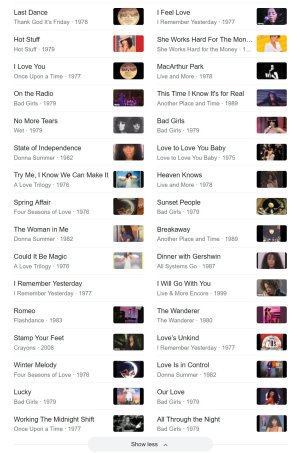
Nearly all of Donna Summer's hits were in the 70's, not the "earlier 80's". And all the big ones except the one you mention were smack dab in the middle of the 70's disco era.

Donna.jpg
Courtesy of Google Search.
 
Nearly all of Donna Summer's hits were in the 70's, not the "earlier 80's". And all the big ones except the one you mention were smack dab in the middle of the 70's disco era.

View attachment 4221
Courtesy of Google Search.
Yeah I know that...I was referring to her last hit in '83 before "Real", "She Works Hard For the Money". "Could It Be Magic" is one of my all-time favs from her, a great one, much preferred over Manilow's version.
 
You're coming off as VChimp II "get off my lawn with that music I don't like".
If you want to learn about the legendary CKLW Music Director Rosalie Trombley and how she did her job, spend a half-hour watching this.
Yes, Rosalie did a fantastic job ! I understand there will be a statue or some kind of tribute to her ! (y)
😊
 
There are chart freaks who still are ticked that Olivia Newton-John's "Physical" sat at #1 on the Hot 100 and Foreigner's "Waiting For A Girl Like You" stalled out behind it, peaking at #2.

Again---#1 is a statistic, not an award. There's nothing to be mad about.


But beyond that---while Olivia sold more singles than Foreigner each one of those weeks, the "Physical" album was double platinum.

"Foreigner 4" was SIX times platinum.

So WAY more people bought the Foreigner song than the Olivia song---but they bought the album, which didn't show up on the singles chart.
But you also have to remember there was a fitness craze going on around 1981-82 with Richard Simmons and John McEnroe and his tennis antics. That may have played a role into "Physical's" dominace in late 1981. It was all about staying fit back then. Personally I prefer the Foreigner ballad and yes 10 weeks at #2 was beyond aggravating.
 
But you also have to remember there was a fitness craze going on around 1981-82 with Richard Simmons and John McEnroe and his tennis antics. That may have played a role into "Physical's" dominace in late 1981. It was all about staying fit back then. Personally I prefer the Foreigner ballad and yes 10 weeks at #2 was beyond aggravating.

Why is it aggravating when you understand that Foreigner sold far more copies than Olivia did, just not in a dying (45 rpm) format?
 
Nearly all of Donna Summer's hits were in the 70's, not the "earlier 80's". And all the big ones except the one you mention were smack dab in the middle of the 70's disco era.

View attachment 4221
Courtesy of Google Search.
David, I'm afraid an image like that just muddies the waters as to what constitutes a hit.

The top six rows of that graphic show most of Donna Summer's hits, plus one stiff ("State of Independence").

It also in fact does show the song Oldies mentions---"This Time I Know It's For Real" (fourth column, right), which peaked at #7. And two others---"The Wanderer" and "Love Is In Control" are further down in that picture.

I had completely forgotten "This Time..." Punched it up on YouTube. Remembered it in four notes. Under normal circumstances, I'd debate "smash" and peaking at #7 being used in the same sentence, but it was a great record and her first top ten in six years.
 
Last edited:
So, if you know this is just you, then how do you manage to write this?

We're on page 21 of some pretty thorough descriptions from people who were there (not just me, not just David), including illustrations, of how records became hits.

And somehow, the idea persists that record companies could coerce every Top 40 station in America to play a lot of records that people actually hated, and yet the ratings didn't go down---inverting the basic equally off-kilter theory involving many of the same people on the KRTH Hip-Hop thread that broadcasters should broaden their playlist beyond proven hits that today's 25-49-year old adults want to hear.
😊 I thought we were just socializing about why some songs became hits, then they went away. I thought that was the topic of the thread : "Lost Hits." People have all sorts of ideas of why that happened. I think it's a long thread, because the topic is very interesting; and people like to chat with each other about music and tell anecdotes about the past. It is just people being nostalgic and chatting.

:) But I hear you. You and others don't want to listen to me complain about soft rock of the 70's. So I won't complain about that any more. :)
 
Why is it aggravating when you understand that Foreigner sold far more copies than Olivia did, just not in a dying (45 rpm) format?
Had Foreigner sold more 45's it likely would have cut into or delayed "Physical's" dominance. We had to wait for Hall & Oates to do that, but by then "Waiting......" was heading downward. "Waiting..." was played alot on SoCal radio back then. I like that Foreigner song (one of my all-time 80's ballads) and frankly both songs deserved that #1 statistical spot. So yeah, it's probably a personal thing, since I love the song which I grew up with.
 
😊 I thought we were just socializing about why some songs became hits, then they went away. I thought that was the topic of the thread : "Lost Hits." People have all sorts of ideas of why that happened. I think it's a long thread, because the topic is very interesting; and people like to chat with each other about music and tell anecdotes about the past. It is just people being nostalgic and chatting.

:) But I hear you. You and others don't want to listen to me complain about soft rock of the 70's. So I won't complain about that any more. :)
C'mon, Daryl.

I don't care if you complain about soft rock of the 70s.

The issue is when someone---anyone on this board---has the information presented to them, with evidence, as to how records of that type, at that time, became hits and then says "stations in the 70's must have played this due to heavy pressure from promoters".

If it's just you, say so (I know, you did). That's fine. We all have hit records we would have loved not to be hits. But pick a lane.
 
Status
Not open for further replies.


Back
Top Bottom