• Get involved.
    We want your input!
    Apply for Membership and join the conversations about everything related to broadcasting.

    After we receive your registration, a moderator will review it. After your registration is approved, you will be permitted to post.
    If you use a disposable or false email address, your registration will be rejected.

    After your membership is approved, please take a minute to tell us a little bit about yourself.
    https://www.radiodiscussions.com/forums/introduce-yourself.1088/

    Thanks in advance and have fun!
    RadioDiscussions Administrators

Why aren't Harrisonburg and Charlottesville a single TV market?

For a short time in the 1980s, they were, but then they split and became two separate markets. Actually Charlottesville seemed to have a hard time becoming a TV market at all, they had previously been part of the Richmond market, but as WVIR became more and more viable, it finally made sense for it to be a market separate from Richmond. Fast-forward to the present day. There is huge overlap between the two markets, indeed, some of WHSV's LPTVs, that now provide full network service to that market, are basically glorified WVIR translators, and carry "NBC29" news as well.

I realize that Gray owns both WVIR and WHSV, so I'm assuming that if they were collapsed into a single market, Gray would have to divest one or the other. Is that the reason they're not a single market?

Or would they? Could they do something similar to what Sinclair did with all of their markets where they had de facto control of two of the Big Four stations (WCHS/WVAH Charleston WV, WSYX/WTTE Columbus, WKEF/WRGT Dayton)? Or even getting away from the Sinclair shenanigans (which the FCC probably doesn't want to see repeated), WSAZ and WQCW (Huntington/Portsmouth/Charleston) are owned by Gray, and evidently that's allowed with no drama, but the deal there was that WQCW wasn't one of the top four stations in the market.

Thoughts from the forum?
 
At one time Charlottesville and Harrisonburg were sort of secondary markets of Washington, DC. And some of the DC stations were carried on cable/sat services there. Not sure of the current status. During the analog era there were numerous translators for the DC stations across the Shenandoah Valley and near the I-81 corridor.
 
The fact that they are both full markets (have all the big 4) make it that they wont collapse them into one market. I doubt they would ever collapse two markets together anymore with owners buying low powered stations to add missing networks to markets. If they haven't moved Glendive to the Bismarck/Minot/Dickinson/Williston market (they actually were one market for a few years in the 90s) or the Billings market yet (more logical as KXGN gets the news from KTVQ Billings and KXGN-DT2 is a slight simulcast of KULR NBC) I doubt it would ever happen.

I realize that Gray owns both WVIR and WHSV, so I'm assuming that if they were collapsed into a single market, Gray would have to divest one or the other. Is that the reason they're not a single market?
doubt it. But for sake of argument, they could sell off WVIR to someone or just shut it down. They have a translator (WVIR-CD) that already carries NBC programming and its on UHF. Problem solved as its a low powered station.


Or would they? Could they do something similar to what Sinclair did with all of their markets where they had de facto control of two of the Big Four stations (WCHS/WVAH Charleston WV, WSYX/WTTE Columbus, WKEF/WRGT Dayton)? Or even getting away from the Sinclair shenanigans (which the FCC probably doesn't want to see repeated),
Sinclair has shell companies from back in the day. When Gray ran into the whole "cant own two of the big 4 in a market" they just bought the programming from the other station and moved it to their own. Then they sell the station to someone else or shut it down.

WSAZ and WQCW (Huntington/Portsmouth/Charleston) are owned by Gray, and evidently that's allowed with no drama, but the deal there was that WQCW wasn't one of the top four stations in the market.
Your example is allowed as the other station is not in the top 4.
Gray fell into that in a couple markets when they bought Quincy Broadcasting. KDLH (Duluth, MN) and WISE (Ft Wayne, IN) Quincy had to divest when they bought Granite Broadcasting back in 2015. They moved the big 4 (CBS on KDLH and NBC on WISE) to subs on their own station (KBJR and WPTA) and sold the others to SagamoreHill. In 2018 they bought the stations back because both stations were no longer in the top 4. They were not allowed to move the Big 4 nets back to those stations.

The rules about owning multiple stations in a market is easy
-Subchannels don't count so you can be like in Alpena, MI and have all 4 networks on one station (WBKB)
-Low powered stations don't count. Here in Mankato we have CBS/FOX on KEYC and NBC on KMNF-LD. Both owned by Gray
-Can't own two of the top 4 stations in a market if both stations are full powered....there are two exceptions. In Sioux Falls, SD Gray owns the ABC and the NBC/FOX and they are on full powered stations. There was a small window where that was allowed (that window has been slammed shut). The other is to get a failing station waiver as what Gray did in Lincoln/Grand Island, Nebraska. They bought KSNB and carried diginet programming on it. When they bought Hoak Media they moved NBC from KHAS (which was sold) to KSNB.
 
Last edited:
At one time Charlottesville and Harrisonburg were sort of secondary markets of Washington, DC. And some of the DC stations were carried on cable/sat services there. Not sure of the current status. During the analog era there were numerous translators for the DC stations across the Shenandoah Valley and near the I-81 corridor.
I'm pretty sure Charlottesville was a secondary market of Richmond, not Washington.

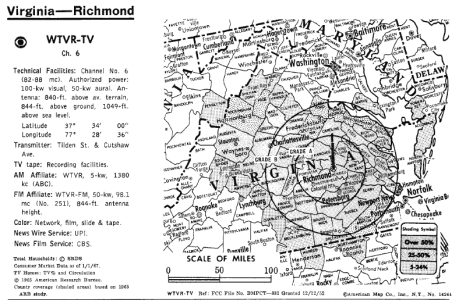
Until fairly recently, may still be, some Washington stations were carried as far south as Staunton. And Richmond stations were carried in places such as Front Royal, Harrisonburg, Staunton, and in 1967, WTVR showed up in Television Factbook with viewership in Pendleton County WV, which is in a deep valley totally cut off from the outside world aside from a thin corridor along which US 220 runs from Cumberland MD to Covington VA. It's not that far from Harrisonburg on US 33, but trust me, that is a route you do not want to take unless you absolutely have to, it goes basically up over top of a mountain and back down again, very steep. It's not especially dangerous, but it's no fun either. Just make sure you have good brakes.

This could always have been garbled information (it happened from time to time in TVFB) where the actual channel 6 was WJAC, but they just saw "channel 6" and thought it was WTVR. These kinds of goofs happened more often when stations on the same channel shared the same network affiliation, e.g. WLWD/WTWO, WAVE/WSAZ, and WSLS/WAVY.

1679273574232.png
 
Last edited:
But for sake of argument, they could sell off WVIR to someone or just shut it down. They have a translator (WVIR-CD) that already carries NBC programming and its on UHF. Problem solved as its a low powered station.
My thinking was that it would make far more sense, and get around all this (if you ask me) Rube Goldberg LPTV business, by having WHSV to be ABC for the whole market, and WVIR and WCAV to be NBC and CBS respectively, putting Fox and CW on subchannels of whichever station wanted to carry them. But that would mean Gray divesting either WHSV or WVIR. The terrain up that way isn't the friendliest environment to try and daisy-chain together a string of LPTVs to provide all-network service to the market. You need full-powered stations in that type of market. The restrictions placed by the National Radio Quiet Zone are also a factor.
 
I'm pretty sure Charlottesville was a secondary market of Richmond, not Washington.
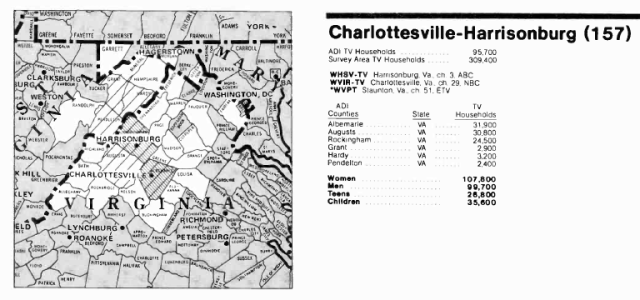
Charlottesville was part of the Richmond market until 1986 or 1987. The broadcasting book from 1985 shows Richmond market. There is no 1986 book but 1987 Albemarle county (where Charlottesville is located) broke off to its own market with WVIR. A few counties were added many years later. (into the mid 90s it was still just Albemarle county). It looks like it was 1986 as when I pull up the Richmond market WVIR is not listed.

Harrisonburg has always been its own market

With both markets being a 1 station market (WHSV ABC and WVIR NBC) for years obviously cable had to pipe in CBS and FOX later.

But point being to the original question No they wont combine markets.
 
Charlottesville was part of the Richmond market until 1986 or 1987. The broadcasting book from 1985 shows Richmond market. There is no 1986 book but 1987 Albemarle county (where Charlottesville is located) broke off to its own market with WVIR. A few counties were added many years later. (into the mid 90s it was still just Albemarle county). It looks like it was 1986 as when I pull up the Richmond market WVIR is not listed.

Harrisonburg has always been its own market

With both markets being a 1 station market (WHSV ABC and WVIR NBC) for years obviously cable had to pipe in CBS and FOX later.

But point being to the original question No they wont combine markets.
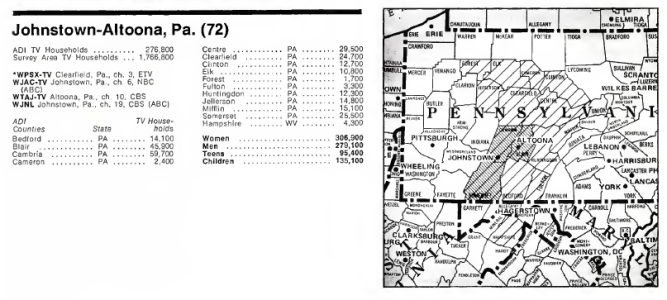
Actually, per the 1980 BCYB, there was a combined Charlottesville-Harrisonburg market for just that one year, then it took several years for Charlottesville to settle into its own market, some years being absorbed back into Richmond, some years being its own market comprised just of Albemarle County. Take that base, and add on the counties that have since become part of the Charlottesville market, and you have a fairly good-sized, geographically coherent (for the most part) market. I say "for the most part" because the extreme topography in the West Virginia counties (Pendleton, Grant, and Hardy) would possibly necessitate translators for WVIR and WCAV (yes, Rube Goldberg-ish, as I said, but there's no getting around the realities of the orography). In those counties, they've always had to cobble together an assortment of stations, depending upon location, from Harrisonburg, Clarksburg, Johnstown, DC via translators, and even Roanoke on Franklin cable at one time. In the meantime, Mineral County did it right, and brought in DC and Baltimore via cable from the very beginning, the FCC's SV list showed them with 90%+ cable penetration, no mean feat. There was one year (1975) when Hampshire County even fell into the Johnstown-Altoona market. When you're that far out in the cut, you just have to take whatever you can get.

1679291095012.png
1679292045426.png
 
Actually, per the 1980 BCYB, there was a combined Charlottesville-Harrisonburg market for just that one year, then it took several years for Charlottesville to settle into its own market, some years being absorbed back into Richmond, some years being its own market comprised just of Albemarle County.
my mistake. Yes in 1980 Charlottesville moved from the Richmond "supplementary market" to a combined market with Harrisonburg for one year. In 1981 it became its own market but in 1982 it was back to the Richmond market until 1986 when it "went at it alone"
 
my mistake. Yes in 1980 Charlottesville moved from the Richmond "supplementary market" to a combined market with Harrisonburg for one year. In 1981 it became its own market but in 1982 it was back to the Richmond market until 1986 when it "went at it alone"
When you're starting up a brand new network affiliate on the edge of an existing market --- something that the networks probably wouldn't put up with anymore, lest it cannibalize both that market and others around it (looking at you, WYMT Hazard KY and the neither-fish-nor-fowl situation it created in eastern Kentucky) --- it's going to take time, for viewers' habits to change such that the new station becomes top-of-mind, and becomes preferred over stations that everyone has become accustomed to watching, and on top of that, preferred to the extent that it gains a preponderance of the viewing. WMUR in New Hampshire comes immediately to mind, but Manchester probably will never become its own market --- Boston's just too huge. NBC dealt decisively with this kind of scenario with WHAG and WMGM in the Washington and Philadelphia markets respectively. ABC also still tolerates dual affiliations in the Tampa-Sarasota and Grand Rapids-Kalamazoo markets. WKYT/WYMT is a critter all unto itself, you could cobble together a "Hazard DMA" with infill of other Lexington stations for the remaining networks, but that would create a smaller rump Lexington market, and would chew out of Charleston-Huntington, Knoxville, and Tri-Cities as well, something none of those four markets want (and Gray also has stations in C-H and Knoxville). C-H has also lost enough counties that it's not keen to lose any more.
 
When you're starting up a brand new network affiliate on the edge of an existing market --- something that the networks probably wouldn't put up with anymore,
The networks wont let that happen anymore. Its pretty much one affiliate per network per market

WMUR in New Hampshire comes immediately to mind, but Manchester probably will never become its own market --- Boston's just too huge.
exactly. Plus with ABC and PBS only licensed to the "market" (meaning the NH side) won't happen. Plus Hearst owns both ABC's in the Boston Market (WMUR and WCVB)

NBC dealt decisively with this kind of scenario with WHAG and WMGM in the Washington and Philadelphia markets respectively.
owning the network in the market kinda put the kai-bosh on those.

ABC also still tolerates dual affiliations in the Tampa-Sarasota and Grand Rapids-Kalamazoo markets.
Also in the vast Lincoln/Grand Island/Hastings/Kearney etc market in Nebraska. Lincoln gets KLKN (Standard media) and Grand Island get KHGI (Sinclair). Satellite gets both as does streaming.

CBS has it in Spokane, WA market with KREM (Tegna) in Spokane and KLEW (Sinclair) in Lewiston, ID. Cant think of any other markets with more than one CBS licensed in the market that isnt a satellite/semi-satellite like WKYT/WYMT, the KX network in Western North Dakota (KXMA, KXMB, KXMC, KXMD) and the double CBS O&O here in Minneapolis (WCCO Minneapolis and satellite KCCW Walker/Bemidji)
 
The networks wont let that happen anymore. Its pretty much one affiliate per network per market


exactly. Plus with ABC and PBS only licensed to the "market" (meaning the NH side) won't happen. Plus Hearst owns both ABC's in the Boston Market (WMUR and WCVB)


owning the network in the market kinda put the kai-bosh on those.


Also in the vast Lincoln/Grand Island/Hastings/Kearney etc market in Nebraska. Lincoln gets KLKN (Standard media) and Grand Island get KHGI (Sinclair). Satellite gets both as does streaming.

CBS has it in Spokane, WA market with KREM (Tegna) in Spokane and KLEW (Sinclair) in Lewiston, ID. Cant think of any other markets with more than one CBS licensed in the market that isnt a satellite/semi-satellite like WKYT/WYMT, the KX network in Western North Dakota (KXMA, KXMB, KXMC, KXMD) and the double CBS O&O here in Minneapolis (WCCO Minneapolis and satellite KCCW Walker/Bemidji)

KLEW is part of that three-station mini-network whose flagship is KIMA Yakima with semi-satellite KEPR in the Tri-Cities, from back in the days before markets were as carefully delineated as they are today, and KLEW fell within what is now the Spokane market. You really have two-markets-but-not-two-markets, in that Yakima and the Tri-Cities comprise a single DMA. The other Big Four Yakima stations have similar set-ups in the Tri-Cities area. (Incidentally, satellite coverage in that market is problematical. Per TVTV, which I know is not always reliable, apparently the whole market just gets Yakima, and Tri-Cities viewers don't get local news cut-ins. Is that right?)

I'm also reminded here of KREX in Grand Junction, CO, which once had satellites in Durango, Montrose, and Glenwood Springs. That was an interesting arrangement. And even though it didn't have satellites, there was the bizarre situation of KNTV San Jose being a second ABC affiliate within the San Francisco market, but serving as the ABC affiliate for the Salinas-Monterey market, even though San Jose didn't fall physically within that market, and viewership of the other S-M stations was probably far lower in San Jose than SF stations, very likely almost non-existent (who in San Jose wants to watch the news from Salinas?). NBC's purchase of KNTV after KRON went independent took care of that, with ABC migrating to a subchannel of KSBW (obviously not an option in analog days).
 
Last edited:
You really have two-markets-but-not-two-markets, in that Yakima and the Tri-Cities comprise a single DMA. The other Big Four Yakima stations have similar set-ups in the Tri-Cities area. (Incidentally, satellite coverage in that market is problematical. Per TVTV, which I know is not always reliable, apparently the whole market just gets Yakima, and Tri-Cities viewers don't get local news cut-ins. Is that right?)
satellite gives you both KIMA and KEPR for CBS. As for the other nets (NBC, ABC, FOX) since news is the same on both stations of a net only one is carried, although Directv gives you one city (Yakima) and Dish is the other (Tri Cities) for some reason. There are 2 PBS stations in the vast market and both are carried
 
satellite gives you both KIMA and KEPR for CBS. As for the other nets (NBC, ABC, FOX) since news is the same on both stations of a net only one is carried, although Directv gives you one city (Yakima) and Dish is the other (Tri Cities) for some reason. There are 2 PBS stations in the vast market and both are carried

That makes sense. I just assumed that all of the Tri-Cities stations were semi-satellites with their own news, public affairs, and so on. Yes, I could have looked that up. Good that satellite provides the one newscast local to the Tri-Cities.
 
They are semi-satellites but only for local commercials and legal ID. The news is the same on both. Verifying this on zap2it on both NBC's it just says "local news at 5, local news at 6" but on ABC they both say "KAPP KVEW News at 6"
 
Status
This thread has been closed due to inactivity. You can create a new thread to discuss this topic.


Back
Top Bottom