• Get involved.
    We want your input!
    Apply for Membership and join the conversations about everything related to broadcasting.

    After we receive your registration, a moderator will review it. After your registration is approved, you will be permitted to post.
    If you use a disposable or false email address, your registration will be rejected.

    After your membership is approved, please take a minute to tell us a little bit about yourself.
    https://www.radiodiscussions.com/forums/introduce-yourself.1088/

    Thanks in advance and have fun!
    RadioDiscussions Administrators

Why do so many stations in the US use defaults, bad or invalid RDS PI codes?

So this question for me comes up every time during the Sporadic-E DX season.

Why do so many stations in the US use defaults, bad or invalid RDS PI codes? For example 0000, FFFF, or 3712 or something completely random. When comes time to ID the station it makes it more difficult. I know DX is not the primary purpose for this but it seems the NRSC has clear set standard on how to handle this. On receivers that do decode this to a call they'll display something wrong or nothing at all.

I can't think of a technical limitation why this is done. It seems all you have to do is go to FM PI Code Allocations | National Radio Systems Committee put in your call sign and you get a valid PI code. You then punch that into your RDS encoder. At least to me it seems like this would take 2 minutes.

Should you need to change it to for some reason iHeart does this you can report your change. Forgot exactly why iHeart changes their sometimes but it seems at least they report it.

This may have been asked before but I can't find it.
 
US doesn’t support auto frequency change. So It doesn’t do anything for the end listener.

Why go thru the effort?

RadioDNS uses it in the US. Other connected car services may also use it. You could end up with the wrong audio or related metadata and associated multimedia content.
 
At least for many iHeart stations, there's something with traffic data delivery that apparently requires modifying the PI code to replace the first digit with a "1".
 
Why do so many stations in the US abuse the PS name (the eight-character ID that shows the station name)? It's meant to be a static representation of the station branding, or call letters, or whatever they choose to identify with. Instead, a lot of stations use dynamic PS, squeezing in ever-changing scrolling text with track and program names, contact numbers, and so on. For the DXer it's almost impossible to determine which station was briefly identifying with, say, "TAYLOR" while playing a Swift song, and in poor reception conditions the data very quickly gets garbled and muddled.

There's a part of the RDS standard that's designed just to send out this type of longer, dynamic text, the 256-character RT field. Often, stations in the US populate the PS and RT with the same thing for no apparent reason. Why not put a static station name on PS and the song and artist info on RT?
 
Why do so many stations in the US abuse the PS name (the eight-character ID that shows the station name)? It's meant to be a static representation of the station branding, or call letters, or whatever they choose to identify with. Instead, a lot of stations use dynamic PS, squeezing in ever-changing scrolling text with track and program names, contact numbers, and so on. For the DXer it's almost impossible to determine which station was briefly identifying with, say, "TAYLOR" while playing a Swift song, and in poor reception conditions the data very quickly gets garbled and muddled.

There's a part of the RDS standard that's designed just to send out this type of longer, dynamic text, the 256-character RT field. Often, stations in the US populate the PS and RT with the same thing for no apparent reason. Why not put a static station name on PS and the song and artist info on RT?
Probably because a lot of older car radios would only support PS. Now that radios in newer vehicles have larger display screens which show both PS and RT at the same time, dynamic program service is so common that stations haven’t made the decision to go back to a static PS, as it was intended.
 
What bugs me about the RDS for some stations is that it doesn't scroll - there's just a line of text that pops up for 30 seconds, then the next line replaces that one, etc.
 
So this question for me comes up every time during the Sporadic-E DX season.

Why do so many stations in the US use defaults, bad or invalid RDS PI codes? For example 0000, FFFF, or 3712 or something completely random. When comes time to ID the station it makes it more difficult. I know DX is not the primary purpose for this but it seems the NRSC has clear set standard on how to handle this. On receivers that do decode this to a call they'll display something wrong or nothing at all.

I can't think of a technical limitation why this is done. It seems all you have to do is go to FM PI Code Allocations | National Radio Systems Committee put in your call sign and you get a valid PI code. You then punch that into your RDS encoder. At least to me it seems like this would take 2 minutes.

Should you need to change it to for some reason iHeart does this you can report your change. Forgot exactly why iHeart changes their sometimes but it seems at least they report it.

This may have been asked before but I can't find it.
At the small market stations I used to work for, we have the Inovonics 730 and 732 encoders. The 730 was discontinued when we added the FM translator for our AM station, so that’s why we have 2 different models.

We have AudioVault and use The Radio Experience (TRE). It’s been a long time since I programmed them, but I believe the encoders we have would automatically set the PI code when you entered the call letters. Very easy!

For us, we run TRE on the same computers we use for streaming. Formatting of PS and RT is in a text file. This is how I have it set up:

PS: Artist Title 102.3 The Coyote WYOT
PTY: Country
PTYN: Hot Cntry
RT: Now on 102.3 The Coyote Title by Artist
RT: Now on The Coyote Title By Artist
RT: Title by Artist (?)
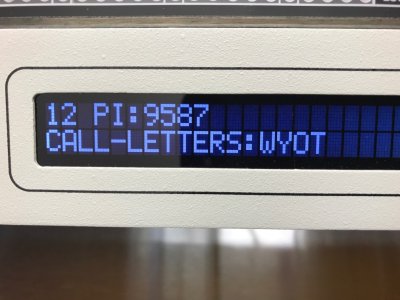
PI: 9587

With the PS, I made sure to remove non-essential words, such as “Now playing” and “by”. For RT, the first one appears 95% of the time. The second and third options are if the Artist and Title are too long for the radio text field. I used clock time, but for some reason it wouldn’t sync like it should’ve and the time drifted. I ended up turning that off, so radios wouldn’t display the wrong time.

I also set the injection level to a decent level, but not too strong. We wanted the RDS to appear and not break up, whenever the station was listenable.

Additionally, I have non-music messages set up for jock on air, syndication and major US holidays. I can login to a website to program these messages from my phone. In the past, we used RDS for station events. There are a lot of Cubs fans in the area and I even shot out a message to the encoder, the exact moment the Chicago Cubs won the World Series in 2016. Oh, and we used to show Artist/Title info for Whitney Allen, but we had issues right when the show started every night. A bunch of Artist/Title info would be sent from the satellite receiver to the encoder all at the same time and this would mess with reporting, so we had to turn it off. :(

The same exact formatting is used on our FM translator, 93.5. PTYN isn’t set, but I might set it when I visit the station in September. I’m not the engineer for these stations. I voicetracked afternoons. The engineer installed the hardware and the OM (my best friend) allowed me to program it to look great on radios.

Here’s a picture from the Inovonics 730 encoder display:

1689081715903.jpeg
 
my gripe with RDS is it has become a text for commercials....

WZLX Boston p*sses me off to no end with that BS
Uh, because it's included as a bonus to advertisers? If you're listening to a spot, why not have sponsor information displayed while the spot runs? Something like that could differentiate one station in a market from another. "Hey, WQRP had textual information that displays when my spot airs, why doesn't WMRB??" These are businesses we're dealing with here, remember?
 
Uh, because it's included as a bonus to advertisers? If you're listening to a spot, why not have sponsor information displayed while the spot runs? Something like that could differentiate one station in a market from another. "Hey, WQRP had textual information that displays when my spot airs, why doesn't WMRB??" These are businesses we're dealing with here, remember?
Some stations in Philadelphia have a full-time RDS radiotext advertiser, not just when their commercial is played on the air.
 
Some stations in KC do that too with their RDS, but they put it as part of the scrolling info and include what's playing.

Couldn't RDS in theory be used to say what song's coming up next/what just played?
 
The Audacy Stations in my Area(PDX) Frequently have "SEASIDE IS FOR FUN!" on the RDS info. Which is Seaside Oregon's Tourist Tag Line.


It truly is is impressive for a cluster who's HD3 Simulcast of KMTT-AM on KWJJ has had "hd3 title, hd3 artist" scrolling for months. Who's HD2 Stations on KNRK and KRKS usually just say "KNRK-2" "KRSK-2"
 
Last edited:
Status
This thread has been closed due to inactivity. You can create a new thread to discuss this topic.


Back
Top Bottom