• Get involved.
    We want your input!
    Apply for Membership and join the conversations about everything related to broadcasting.

    After we receive your registration, a moderator will review it. After your registration is approved, you will be permitted to post.
    If you use a disposable or false email address, your registration will be rejected.

    After your membership is approved, please take a minute to tell us a little bit about yourself.
    https://www.radiodiscussions.com/forums/introduce-yourself.1088/

    Thanks in advance and have fun!
    RadioDiscussions Administrators

Why you should be frightened by AI

davideduardo

Moderator/Administrator
Staff member
I was using Google Search to find missing issues of Merchandising Week, a trade journal that began in the late 1800's. The magazine covered retail sales, becoming focused on electrical and electronics in the mid-20th Century.

I found an AI result that said this:

"Merchandising Week" magazine was a weekly publication focused on FM radio sales, published by World Radio History, and is now defunct.

Here's a more detailed breakdown:

  • Focus: The magazine, according to World Radio History, focused on FM radio sales.
  • Publication Frequency: It was published weekly, except for the last two weeks of December.
  • Publisher: The magazine was published by World Radio History.
  • Content: The magazine covered topics related to FM radio sales, including merchandising techniques and strategies.
  • Current Status: The magazine is no longer published.

So, there you have AI hard at work. Merchandising Week ceased publication decades ago, did not "focus on FM radio sales", and was not published by me.

Other than that, they did accurately state that the magazine is no longer published.

This is what happens when the only information used by AI consists of incomplete and / or inaccurate material on the internet. For example, if enough web publications and websites have information that says that WABC was never a Top 40 station because it is now a talk station, AI searches will give summations that state that WABC was always a talk station!

Frightening!
 
I was using Google Search to find missing issues of Merchandising Week, a trade journal that began in the late 1800's. The magazine covered retail sales, becoming focused on electrical and electronics in the mid-20th Century.

I found an AI result that said this:

"Merchandising Week" magazine was a weekly publication focused on FM radio sales, published by World Radio History, and is now defunct.

Here's a more detailed breakdown:


  • Focus: The magazine, according to World Radio History, focused on FM radio sales.
  • Publication Frequency: It was published weekly, except for the last two weeks of December.
  • Publisher: The magazine was published by World Radio History.
  • Content: The magazine covered topics related to FM radio sales, including merchandising techniques and strategies.
  • Current Status: The magazine is no longer published.

So, there you have AI hard at work. Merchandising Week ceased publication decades ago, did not "focus on FM radio sales", and was not published by me.

Other than that, they did accurately state that the magazine is no longer published.

This is what happens when the only information used by AI consists of incomplete and / or inaccurate material on the internet. For example, if enough web publications and websites have information that says that WABC was never a Top 40 station because it is now a talk station, AI searches will give summations that state that WABC was always a talk station!

Frightening!
I mean, David, human beings aren't any better at it, and the brighter bulbs like you and I know it. Wikipedia has been around long before AI was introduced to the masses, and it's been the biggest source of misinformation available out there for many years. At least the robots will eventually learn and make the corrections needed as they progress. The same sure can't be said for editors on Wikipedia. There are bugs in every rollout, and with the massive amount of worldwide information these bots have to assimilate, it's going to take some time for fact and fiction to be separated out.

But it will happen. Unlike humans, bots aren't going to dig their heels in and stubbornly make their stand, while the rest of us laugh at the lack of their knowledge. There are no fragile egos in the artificial world. It will become superior to anything a human pens somewhere down the road. I don't know if you and I will see it in our lifetimes, but it's on the horizon.
 
I mean, David, human beings aren't any better at it, and the brighter bulbs like you and I know it. Wikipedia has been around long before AI was introduced to the masses, and it's been the biggest source of misinformation available out there for many years. At least the robots will eventually learn and make the corrections needed as they progress. The same sure can't be said for editors on Wikipedia. There are bugs in every rollout, and with the massive amount of worldwide information these bots have to assimilate, it's going to take some time for fact and fiction to be separated out.

But it will happen. Unlike humans, bots aren't going to dig their heels in and stubbornly make their stand, while the rest of us laugh at the lack of their knowledge. There are no fragile egos in the artificial world. It will become superior to anything a human pens somewhere down the road. I don't know if you and I will see it in our lifetimes, but it's on the horizon.
I'm not so sure I agree with your analysis. Yesterday in an e-mail I've since deleted (I didn't know this topic was going to come up here), I read an article by a fellow blind person advocating that blind and visually impaired people should be wary of some of the visual descriptions of web content that is being supplied by some AI programs. Apparently what was happening (I don't consciously use AI myself) was that in some cases, the AI descriptions, while being very detailed, often missed the wbig picture of what was being described; i.e. it couldn't accurately say what the picture was. Maybe AI will get better at this as time goes on but if you're blind and you don't know better, you might take what it says as being accurate when it it is not accurate at all.

With regard to Wikipedia, I don't really think the problem there is human behavior (though that certainly is a problem) as much as what it requires for proof of statements made; specifically, it requires the editor to back up his/her statements with statements from Internet sources, preferrably from Wikipedia-approved sources. Unfortunately (as David noted with the WABC example--which is correct in Wikipedia, by the way), some of these sources are not accurate *and* more accurate information is not available from other preferred sources.
 
I know the OP was at least partly tongue in cheek, and obviously AI has its glitches when it comes to research. Apparently an attorney used AI to do legal research in a key case in DC and his research was dead wrong.

That said, AI will eventually fix its issues when it comes to research. We're at the Model T stage of AI adoption, maybe the Stanley Steamer stage. AI is still being improved and refined.

It's just a matter of the AI companies altering, tweaking the machine-learning code (that's what it's apparently called in the tech world: 'machine learning'). Once they refine the code and alter the programming, AI research will be less apt to misinformation and mistakes.

What people really need to fear from AI is loss of jobs. No need for voice talent, newsreaders, models, photographers, cinematographers, actors, sound and visual designers/engineers, authors, news reporters / journalists, illustrators, musicians, singers, preachers, law clerks, teachers, professors and other educational instructors -- you name it. Once the code is tweaked just right, there will be no need for those professions, or -- at the very least -- the numbers employed in those professions will dwindle to a small trickle.

Some think that even some medical personnel and scientific personnel could be replaced or made redundant by AI. I heard an expert interviewed on the radio three days ago who said that AI could be used in medicine as a diagnosis tool, and in scientific research and analysis.

Automation and computer tech has already decimated many professions. Our own profession, radio, has seen a massive decline in numbers since 2000, and it's not just the economics, it's automation making reduced workforces possible. It's the same in my other former profession, journalism.
 
With regard to Wikipedia, I don't really think the problem there is human behavior (though that certainly is a problem) as much as what it requires for proof of statements made; specifically, it requires the editor to back up his/her statements with statements from Internet sources, preferrably from Wikipedia-approved sources.
Making sure additions to Wikipedia are well sourced is something that wasn't done very well in the early days, but it is being done more carefully now.

Wikipedia does not require sources to be online but it is helpful if you want to verify the information.
 
What people really need to fear from AI is loss of jobs. No need for voice talent, newsreaders, models, photographers, cinematographers, actors, sound and visual designers/engineers, authors, news reporters / journalists, illustrators, musicians, singers, preachers, law clerks, teachers, professors and other educational instructors -- you name it. Once the code is tweaked just right, there will be no need for those professions, or -- at the very least -- the numbers employed in those professions will dwindle to a small trickle.
Interesting data point: when I was in Houston last week, one evening I picked up KIOX from Bay City (96.1), which was running a newscast from something called "U.S. News". A male voice was reading stories. It took a couple of minutes, but I realized there was something slightly odd about the intonation, particularly at the end of some stories. The pacing of the voice reading the scripts was just about perfect. But, once in a while, it sounded just a bit off. I hadn't heard anything quite like that before. I'm convinced this was some type of artificially generated voice that was using AI to apply the proper intonation to sentences, and it mostly worked. If you can feed wire copy into something that will generate that kind of voice, that certainly has some implications for labor requirements.

On the other hand, I had problems with my hotel that the front desk wasn't resolving. So, being a member of the frequent-guest program, I called Hilton. After I described my issues, the bot would ask "do you want to call the front desk?" Well, no, the front desk was the problem. Round and round this went several times until finally the bot connected me to an agent. This may have been deliberate customer-service tomfoolery* on Hilton's part or it may have been crappy coding by script kiddies; in any event, AI and related technologies are replacing human judgment and nuance, not necessarily for the better.

* "tomfoolery" is not the word I want to use, but the word I want to use would probably cause a meltdown.
 
AI is a myth. Any intelligence developed by non-humans is either placed or developed second hand by human intervention. Machines do not "learn" on their own.
 
Making sure additions to Wikipedia are well sourced is something that wasn't done very well in the early days, but it is being done more carefully now.
Not true. I took a random sample of Wikipedia articles on radio stations (I picked several of the "heritage" stations from each of the top 50 markets) and found around 80% contained significant inaccuracies or omissions.
 
Free, consumer-level AI can only fail. It'll get some stuff right, but it's not set up in a way that it can be reliable.

It scrapes the internet for already-existing information, minus the stuff that companies (including many of the ones that produce the highest-quality information) have sued to keep from being scraped, citing copyright.

It then takes the stuff it can legally get (some of it very low-quality, from places like Wikipedia or poorly-written, error-filled articles and blog posts) and scrambles it into an output that avoids strings of words that would trigger plagiarism software.

The problem is that plagiarism-avoidance scrambling (how many ways can you say "water is wet"?) results in stuff getting too scrambled:

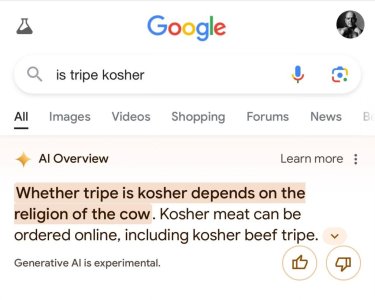
What results can be comical. Here's my favorite of the last few weeks:

480604217_10227466665828073_8807897707893476802_n.jpg


Adding to the low-quality problem is that, as more AI-written articles enter the internet (from lazy writers and cheap publishers), a larger and larger percentage of very likely flawed AI content gets scraped for new searches.

It's part of a phenomenon called "eating its own tail", and it plays out in all sorts of AI applications---the written word just being one of them:


The new administration has already rescinded an executive order from the previous administration, relaxing regulation in ways that, depending on how companies use their newfound freedoms, and how government itself edits previously reliable information to remove content it considers objectionable, could further compromise output in terms of factually-based written word output.


And there is chatter among the techbros that they could do SO much better in terms of output quality if the holders of copyright were (*ahem*) forced by law to cooperate and give access to their copyrighted content---in other words, prohibited from refusing to share.

I think it's only a matter of time before one of the 535 people in the House and Senate on Capitol Hill writes a bill. We'll see where it goes from there.
 
AI is a myth. Any intelligence developed by non-humans is either placed or developed second hand by human intervention. Machines do not "learn" on their own.

This is probably the best I can do for you, Tuna:


Yes, early in the process, a human had to program and train systems to recognize patterns, make choices and create responses. But we're way beyond that now.
 
I have once again chosen the wrong day to stop blurting out the Lord's name in vain.

That is simply horrific.
I just learned about this article that references a study on AI chatbots giving out bad answers to medical questions from a few years ago, when trying to look for that article:

I'm definitely opting out of AI medical note transcribing with my doctor.
 
Not true. I took a random sample of Wikipedia articles on radio stations (I picked several of the "heritage" stations from each of the top 50 markets) and found around 80% contained significant inaccuracies or omissions.
You are, of course, making the assumption that when Wikipedia sourcing policies change, those changes include all past Wikipedia entries. Unfortunately, my past experience in the hotel industry and present experience with issues of website accessibility tell me that when changes do occur, they occur with things going forward in the future first and not with things that have already occurred.

Which, of course, would make you right as most of the radio station articles in Wikipedia haven't been updated in quite a while.
 
Not true. I took a random sample of Wikipedia articles on radio stations (I picked several of the "heritage" stations from each of the top 50 markets) and found around 80% contained significant inaccuracies or omissions.
I'm just going by what is stated on Help Desks. People complain a lot when their unsourced edit get removed.


Back
Top Bottom