• Get involved.
    We want your input!
    Apply for Membership and join the conversations about everything related to broadcasting.

    After we receive your registration, a moderator will review it. After your registration is approved, you will be permitted to post.
    If you use a disposable or false email address, your registration will be rejected.

    After your membership is approved, please take a minute to tell us a little bit about yourself.
    https://www.radiodiscussions.com/forums/introduce-yourself.1088/

    Thanks in advance and have fun!
    RadioDiscussions Administrators

Denver Willobee Exits Indie 102.3


Apparently his new venture takes him to the UK next week.
 
My take on Indie 102.3's programming, a sound for which Willobee was largely responsible, is here: https://radiodiscussions.com/thread...ite-and-it-looks-horrible.778010/post-6844307

The TL;DR, for me at least:
It's a station I want to like but can't manage to do so.

Main reason is that most of their personalities get in the way.

What I would really like to see is for KUNC's "The Colorado Sound" (KJAC) to take over the Indie 102.3 network, but that's pure fantasyland.

In any event, it wouldn't surprise me if there are some changes at Indie...and I know what changes I'd like to see...but clearly I'm not in sync with the execution of their programming philosophy. It will be interesting to see if that changes.

One thing Indie and The Colorado Sound have to face is that KBCO is so well established and, for once, iHeart hasn't screwed it up too much. And, honestly, their on-air people are better communicators than most of the personalities at Indie (except for Jason Thomas, who's very good).
 
1.51.92.31.81.71.7KVOQ-FMindie 102.3AAAPublic Broadcasting of Colorado88,300

1.01.31.00.81.70.9KJAC-FM105.5 The Colorado SoundAAACommunity Radio for Northern Colorado58,600

At a quick glance, Indie seems to be the better performer of the two over the last little while. I wonder how Indie will go under new leadership.
 

At a quick glance, Indie seems to be the better performer of the two over the last little while. I wonder how Indie will go under new leadership.
Those numbers are missing some context:

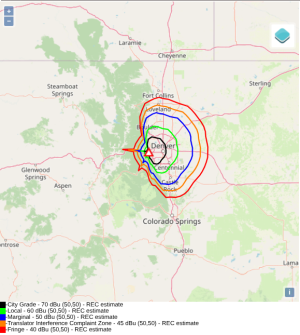
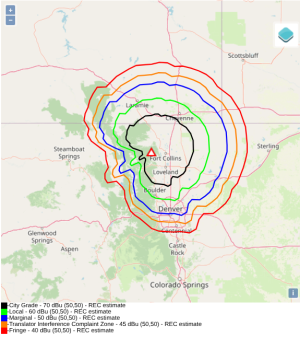
The KJAC transmitter is west of Fort Collins; its city-grade signal doesn't reach the northern Denver suburbs. Its local-grade signal doesn't reach much of Denver proper. Lesser-quality radios would not be able to pick it up in the city. Its primary coverage areas are Fort Collins and Greeley.

The KVOQ transmitter is on Lookout Mountain just west of Denver, where other FMs and most TV stations have their transmitters. Its city-grade signal covers most, but not all of Denver...that contour misses several east-side neighborhoods and Aurora. Its local-grade signal covers most of the core of the Denver metro.

The following fccdata.org (REC) maps are roughly at the same scale or close to it. KJAC has a wider coverage area but it's focused on the northern part of the Front Range. Cheyenne, Wyoming probably gets better reception of the station than much of Denver.

KVOQ.Coverage.pngKJAC.Coverage.png
KVOQ also has stations in Colorado Springs and some mountain towns as well as a translator in Pueblo and one in Boulder. KJAC has a translator in Boulder plus two mountain communities. Boulder would be a factor in surveys but not the other cities or communities.

For added context, the major state universities are in Boulder and Fort Collins, with Greeley also having a substantial university.

KJAC has had technical problems in recent months. For several weeks earlier this fall, it was broadcasting in mono.

Though there are reception challenges in Denver, KJAC still pitches to Denver listeners.

KJAC manages to get the numbers that it gets even in the face of such challenges. If it were on equal footing with KVOQ, the story might be different.
 
KJAC based on playlist review is arguably a purer form of AAA and has more of a coffee house music vibe. If an artist that has crossed over into the mainstream is played, chances are quite good you will hear a deep album track as opposed to a recognizable single.

Indie 102.3 seems to be less mellow and is also more likely to play a recognizable single, especially if the artist in question was a big 90's modern rock artist. That said, 102.3 still plays a plenty of true indie material. For instance, a review of recent hours of music showed "Island in the Sun" by Weezer and "Hurt" by Nine Inch Nails, two songs that are well known among longtime alternative rock listeners.
 
In another thread, someone asked why NPR isn't exclusive to one station in a market. The answer is because NPR is a membership organization similar to the Associated Press. Stations pay NPR to air their shows. So in Denver, there are two stations that carry NPR News. There are also two public stations that run the AAA format. What makes KUNC different from KCPR? Their presentation. What makes Indie different from the Sound? Their presentation.

A number of public broadcasters around the country have launched AAA stations because they feel the format fits their mission, and the audience fits with the public radio membership profile. So public broadcasters in Buffalo, Nashville, and Denver have AAA stations. Broaden the view, and you will see KEXP in Seattle, WXPN in Philadelphia, WFUV in New York City, and WUMB in Boston. The thing about the AAA format is it can go in many directions. It doesn't have to follow a narrow playlist as you see with commercial music formats. The approach is more music-centric, and the presentation is determined by the PD, who assembles a team to execute that presentation.

In comparing KVOQ to KJAC, the measure of success isn't in 6+ Nielsen ratings. What matters is the ability of each station to attract memberships. So it's possible that Indie is getting great ratings, but losing money. Or perhaps isn't capitalizing on those ratings by converting listeners to members. That might be why its PD is leaving the area for new adventures, where perhaps the measure of success is more aligned to what he wants to do.
 
KJAC based on playlist review is arguably a purer form of AAA and has more of a coffee house music vibe. If an artist that has crossed over into the mainstream is played, chances are quite good you will hear a deep album track as opposed to a recognizable single.

Indie 102.3 seems to be less mellow and is also more likely to play a recognizable single, especially if the artist in question was a big 90's modern rock artist. That said, 102.3 still plays a plenty of true indie material. For instance, a review of recent hours of music showed "Island in the Sun" by Weezer and "Hurt" by Nine Inch Nails, two songs that are well known among longtime alternative rock listeners.

KJAC will go deeper, to be sure, and can be especially fond of music that you might have heard on a college radio station in the 1980s and 1990s. It also programs Americana from time to time, something that's totally absent from Indie. Conversely, Indie will program a bit of hip-hop, which KJAC tends not to do. I think doing either could lead to tune-out. I run the risk of projecting my own tastes here, but I will say that I'm more likely to tune away from hip-hop than I am from Americana. Maybe it plays better in Pueblo.

KJAC also has more speciality programs - "Torch and Twang" (Americana), "Music 101" (thematic retrospectives), "Colorado Playlist" (local artists), compared to Indie.

I went over the coverage situation upthread, but will remind that Indie has a broader network of stations than KJAC...likewise for CPR in general.

In another thread, someone asked why NPR isn't exclusive to one station in a market. The answer is because NPR is a membership organization similar to the Associated Press. Stations pay NPR to air their shows. So in Denver, there are two stations that carry NPR News. There are also two public stations that run the AAA format. What makes KUNC different from KCPR? Their presentation. What makes Indie different from the Sound? Their presentation.
Definitely agree about the presentation. Again, my opinion: KJAC just has better communicators. I haven't been one to put too much emphasis on personalities (hence my frequent jabs at "The Cult of the Deejay"), but, for a AAA format, I think personalities are quite important. They have to be good communicators who sound like they're interested in the music without trying too hard to be so cool and impressing you with their knowledge. That's where Indie often stumbles. To be fair, KJAC has actually been in its present format longer than Indie ... ten years versus about six (before that Indie was "Open Air", a more eclectic format). It feels as though KJAC is a more settled product while Indie is still trying to find its niche.

One shouldn't forget that there's an established commercial AAA station in the market (KBCO). Figuring out how to compete against it can't be easy.


As for KUNC versus CPR News (the calls are actually KCFR, by the way, though that's not how people know it) - the main difference between them is weekdays between 9 am and 3 pm, plus evenings and weekends. Their weekday schedules are identical at other times, including the BBC World Service, Morning Edition (KUNC carries an additional hour of ME 9-10 am that CPR News uses for its own "Colorado Matters"), Marketplace, and All Things Considered. In other words, the "hits" of public news/talk radio are covered equally by both. There is some coverage overlap...I can receive both well, even without relying upon KUNC's Lookout Mountain translator...but they co-exist. I donate to both.

There's also Rocky Mountain PBS's KUVO, a jazz station that carries NPR news on the hour. Obviously, due to its format, it's quite distinct from the other stations.
In comparing KVOQ to KJAC, the measure of success isn't in 6+ Nielsen ratings. What matters is the ability of each station to attract memberships. So it's possible that Indie is getting great ratings, but losing money. Or perhaps isn't capitalizing on those ratings by converting listeners to members.
If I had to guess, I'd pick the latter. It would also be fair to say KUNC/KJAC has less overhead than CPR. It's a smaller organization, its network is smaller, and its news programming is more short-form in nature. CPR may still need to cut costs.


That might be why its PD is leaving the area for new adventures, where perhaps the measure of success is more aligned to what he wants to do.
He really didn't say very much in his departure announcement other than point to what he considered to be his successes at Indie. Which is fine; he launched the current format and it's got something of a foothold. Maybe it was time for someone else to come along and advance the station's objectives further.

 
Just a note from a 20-year veteran of public radio: even though it's "Morning Edition" on both CPR News and KUNC in morning drive, it's hardly an identical program on both services.

ME, and to a lesser extent ATC in the afternoon, are designed to be a hybrid of national segments from NPR and local content from the member station carrying the show. Depending on the local station's level of staffing and content production, it's not uncommon for more than 20 minutes of each hour to be distinctly local.

The only pieces of ME that are consistently carried nationally by pretty much every member station are at least the first block of the hourly newscast from :01 to :04 and the A-block of national ME content from :07 to :19. Most stations also carry the B and C blocks later in the hour, but larger stations have a lot of free rein to rearrange content and to put in local stories in place of some or all of the national content.

All of which is to say that listening to an hour of "Morning Edition" on CPR and on KUNC is likely to be a different experience on each station, with some common content but also a fair amount of differentiation.
 
All of which is to say that listening to an hour of "Morning Edition" on CPR and on KUNC is likely to be a different experience on each station, with some common content but also a fair amount of differentiation.

Which is another way of saying:

What makes KUNC different from CPR? Their presentation.

The point is people subscribe to the station, not NPR News. Same with the two AAA stations. The audience can tell the difference.
 
Just a note from a 20-year veteran of public radio: even though it's "Morning Edition" on both CPR News and KUNC in morning drive, it's hardly an identical program on both services.
{...}

All of which is to say that listening to an hour of "Morning Edition" on CPR and on KUNC is likely to be a different experience on each station, with some common content but also a fair amount of differentiation.
Which is something I'm aware of, but didn't want to dive too deep into the details to avoid veering off-topic, since this thread is about Indie 102.3 and not necessarily about CPR News. Obviously, one difference will be in how each station handles local news segments. This varies greatly between KUNC and CPR, with the latter having somewhat more resources to bear. The content is different as well: KUNC is focused on the northern and central Front Range plus the plains, areas where most of its coverage is, while CPR also includes Colorado Springs, Pueblo, and Western Slope coverage, also matching its areas of reception. Strangely, CPR sometimes seems to neglect Denver in its news coverage (in my opinion), possibly expecting its Denverite website to pick up the slack. I will note that CPR actually replaces the network open for each hour of ATC with an introduction by a local host. That's strikingly different.

There are also areas of Colorado served by either CPR or by KUNC but not by both. The main overlap is in the central part of the Front Range; there are others in a few mountain communities. There's too much complexity to go into detail here, but you can look up the network lineup for each at their websites.

Indie and KJAC overlap only in the northern and central Front Range, as far as I can tell.
 
It also programs Americana from time to time, something that's totally absent from Indie. Conversely, Indie will program a bit of hip-hop, which KJAC tends not to do. I think doing either could lead to tune-out.

I think hip-hop does have a place on Alternative and AAA radio. While I'm not really a fan, I have become more tolerant of the genre, especially the more Alt/Indie artists.

That might be why its PD is leaving the area for new adventures, where perhaps the measure of success is more aligned to what he wants to do.
He really didn't say very much in his departure announcement other than point to what he considered to be his successes at Indie. Which is fine; he launched the current format and it's got something of a foothold.

While he was elusive his next project, he did say it is taking him to London, UK.
 
Apparently unannounced, KJAC recently rearranged its program schedule. WXPN's "World Café" has moved from 10 pm-midnight to 7-9 pm. Morning host "Ben" (KJAC only uses first names on the air) has moved to the 9 pm-2 am time slot, dubbing that time "Ben Up All Night". Ron Bostwick, who had been doing evenings, moves back to mornings. Program director Margot Chobanian remains in middays with "Stacy" continuing as afternoon host. In September, the station's owner, Community Radio for Northern Colorado, laid off more than a quarter of its staff. Based in Greeley, CRNC also owns public news/talk station KUNC.

Speaking of "World Café", possibly the prototypical AAA-oriented public radio program, CPR's Indie 102.3 doesn't carry it.


Back
Top Bottom