
• Get involved.
    We want your input!
    Apply for Membership and join the conversations about everything related to broadcasting.

    After we receive your registration, a moderator will review it. After your registration is approved, you will be permitted to post.
    If you use a disposable or false email address, your registration will be rejected.

    After your membership is approved, please take a minute to tell us a little bit about yourself.
    https://www.radiodiscussions.com/forums/introduce-yourself.1088/

    Thanks in advance and have fun!
    RadioDiscussions Administrators

Vermont WJJR & WZRT move off Killington Peak

Both move to Grandpa Knob north and west of Rutland (see article below). How is their signal to the east in the Connecticut Valley? One wonders they did not build a combiner with their sister station WJEN on Pico Peak or will that eventually join the other two on Grandpa Knob also?
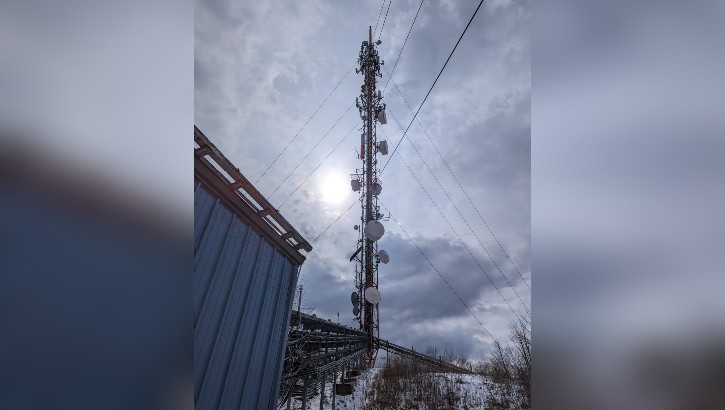
 
Each station, 98.1 WJJR and 97.1 WZRT, had been on Killington Peak. They had been powered at only a little over 1,000 watts because Killington is so tall, 2,950 feet in height above average terrain (HAAT).

Now they've increased their power to 3,300 watts because Grandpa Knob isn't as tall. The HAAT is now 1,335 feet, not quite as tall as the Empire State Building.

Grandpa Knob is also the tower location for Vermont Public Broadcasting's 88.7 WRVT and Channel 28 WVER.
 
Wonder why so little output power for signals? WEZF and WHOM broadcast from high mountains with significant output power, 46kw for WEZF and 48kw for WHOM. Even WPKQ, very short spaced to WKNE, and directional runs with 22.5kw. Could they output much more energy if they wanted to when they first came on the air using much a bigger antenna?
 
Station like 92.9 WEZF, 94.9 WHOM, 105.1 WTOS are full "Class C" FM's, the equivalent of 100kw @ 600 meters (or so) above average terrain.. These three examples broadcast from the top of some tall peaks.. Mt. Washington, Mt Mansfield, and Sugarloaf. WPKQ 103.7 moved their antenna atop Mt Washington in the late 1980's, and the signal is reduced in the direction of Keene.. WZRT & WJJR are Class C2's, the equivalent power of 50kw @ 150 meters.. . Both had excellent signals from the top of Killington with a lot of range, at 1150 watts each. Their signals are almost nonexistent east of the Green Mountains. WJJR has the lesser of the two signals, having to protect C3, 97.9 from Au Sable NY.
 
Last edited:
WPKQ 103.7 moved their antenna atop Mt Washington in the late 1980's, and the signal is reduced in the direction of Keene..

WZRT & WJJR are Class C2's, the equivalent power of 50kw @ 150 meters.. . Both had excellent signals from the top of Killington with a lot of range, at 1150 watts each. Their signals are almost nonexistent east of the Green Mountains. WJJR has the lesser of the two signals, having to protect C3, 97.9 from Au Sable NY.
What a cluster move that was. While the signal is "reduced" towards Keene, it still puts way to much power and causes much more interference to WKNE than should've ever been allowed.

While WZRT and WJJR have much lesser signals to the East than before, they actually have improved signals into the metro Rutland area, which is where it counts for them anyways. While there are other factors with the move that I won't discuss here, that certainly was a gain for them.
 
"While WZRT and WJJR have much lesser signals to the East than before, they actually have improved signals into the metro Rutland area, which is where it counts for them anyways. While there are other factors with the move that I won't discuss here, that certainly was a gain for them"

I respectfully disagree.. Those signals that originated from the top of Killington impacted Rutland County fine prior to the Grandpa's Knob move, with only a few exceptions in between Rutland and Killington on Rt 4. 97.1 & 98.1's reach across Southern & Central Vermont, eastern NY, and western NH was HUGE.. Having a better signal into the "Metro Rutland area" is hardly worth bragging about . Like your antenna picture website, Mr. Necrat!
 
Station like 92.9 WEZF, 94.9 WHOM, 105.1 WTOS are full "Class C" FM's, the equivalent of 100kw @ 600 meters (or so) above average terrain.. These three examples broadcast from the top of some tall peaks.. Mt. Washington, Mt Mansfield, and Sugarloaf.

Most of the Northeastern United States is Class B territory. From Norfolk VA to Madison WI to Coastal Maine, it's all Class B. But there is a strip of territory most of us don't know about. It's at the top of NY State and Northern New England near the Canadian border and it falls in Class C territory.

This creates an interesting situation in Portland and Bangor. The cities are in Class B but if FM stations locate their towers just north of those cities, they are in Class C. This is why in Portland WHOM, WBLM, WFNK, WMEA and WJJB are all high-powered Class C stations. But other stations in Portland that have their towers in or near the city limits are Class B. Same in Bangor. WQCB, WTOS, WVOM and WHCF are Class C. The other stations in Bangor are Class B.

Northern Vermont is in Class C. So WEZF, WVPS and WBTZ are high-powered. Burlington's top country station, 98.9 WOKO, is Class C. It runs 100,000 watts. But it never bothered to go on a tall tower. Its HAAT is only 310 feet. So despite that maximum power, its signal is just a little better than a full power-full height Class B.
 
Never could understand how WPKQ née WMOU could have ever moved to Mt. Washington with co-channel with WKNE not overly far away even with the directional antenna. WMOU does pre-date WKNE, and one wonders if all along that allocation was for Mt. Washington but never made the move until the late 1980s by then with WKNE around? Surprised that WMOU did not instead try to move to the Portland market along the lines of what WRUM did in 2006.

As for WZRT and WJJB, was there any discussion about moving over to nearby Pico Peak joining WJEN instead of moving to the Grandpa Knob tower?
 
It costs a lot of money to go up and down Killington when something goes bad at the transmitter site.
It costs a lot of money to go up and down ANY remote transmitter site, when something goes bad.. In the case of Killington, in most seasons there's the K1 Gondola and a small hike to the fire tower.
 
Status
This thread has been closed due to inactivity. You can create a new thread to discuss this topic.


Back
Top Bottom