• Get involved.
    We want your input!
    Apply for Membership and join the conversations about everything related to broadcasting.

    After we receive your registration, a moderator will review it. After your registration is approved, you will be permitted to post.
    If you use a disposable or false email address, your registration will be rejected.

    After your membership is approved, please take a minute to tell us a little bit about yourself.
    https://www.radiodiscussions.com/forums/introduce-yourself.1088/

    Thanks in advance and have fun!
    RadioDiscussions Administrators

WJR at 500 kW Directional (once proposed)

Below is a graphic comparing the currently licensed operation of WJR to their proposal for 500 kW transmitter power using a directional antenna to limit their radiation toward Toronto to 50 kW (which the FCC did not grant).

The parameters of the 500 kW array below are not necessarily those that were defined by WJR, but they do limit radiation toward Toronto to 50 kW, maximum.
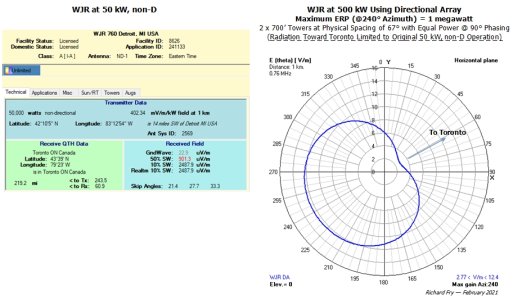
WJR - 500 kW Directional (Once Proposed).jpg
 
Last edited:
Interesting. Is this from back around World War II, similar to the WLW 500K plan?
Certainly that would still make WJR a viable signal in parts of Canada as it is now. Can't imagine the signal would be all that degraded in the areas of Canada that are local or semi-local to Detroit, such as Windsor and Sarnia. But wow would that 500K peel paint in Detroit and Toledo, among other places, even more than it does now.
 
Interesting. Is this from back around World War II, similar to the WLW 500K plan?
That proposal of WJR was made in the 1950s, joining along with "500 kW" proposals made by some other Class 1-A AM stations back then. They all were based on the fact that the FCC once granted 500 kW (experimentally) to WLW. None of those new applications ever was granted by the FCC, though (even experimentally).
 
This is all water under the bridge, but I was wondering what the improvement in WJR's GW would have been in Kalamazoo, MI if they had been authorized for their 500 kW DA back in the 1950s. Kalamazoo (ZIP 49001) is well into the region of 4 mS/m and 2 mS/m soil on the FCC M3 conductivity map, ~120 miles on a compass bearing of N275.1°E from the WJR transmitter site.
  • For 50 kW non-D operation, the field from WJR in ZIP 49001 is about 0.36 mV/m.
  • For the 500 kW DA pattern I posted above here, their field would have been about 1.3 mV/m.
A field of 1.3 mV/m isn't a big winner even in a modest-sized urban area, but still it might have been quite "listenable" on a good home/car radio at most locations in/around Kalamazoo.

For perspective, WJR now has a GW field of about 1.3 mV/m near Bay City, MI, and that Tri-City area had plenty of listeners to WJR back when I grew up in Saginaw. I suppose WJR still might have plenty of listeners there, if their programing now matched what it was back then — with local talent including J.P. McCarthy, Karl Haas, Mike Whorf, Ted Strasser, Bud Guest, Jimmy Launce, Jay Roberts, Charlie Park, etc.
 
Last edited:
For perspective, WJR now has a GW field of about 1.3 mV/m near Bay City, MI, and that Tri-City area had plenty of listeners to WJR back when I grew up in Saginaw. I suppose WJR still might have plenty of listeners there, if their programing now matched what it was back then — with local talent including J.P. McCarthy, Karl Haas, Mike Whorf, Ted Strasser, Bud Guest, Jimmy Launce, Jay Roberts, Charlie Park, etc.
Here is today's reality: in home and at work listening takes place in 95% of the cases in Nielsen surveys within the 5 mV/m signal area. And, when I studied that as part of developing purchase criteria for stations at the group I was with, it was over 10 years ago. Today, I believe that the cut-off point is around 10 mV/m. The ITU, with more experience with European high-power AMs, says 15 mV/m is needed for clean reception.
 
Here is today's reality: in home and at work listening takes place in 95% of the cases in Nielsen surveys within the 5 mV/m signal area. ... Today, I believe that the cut-off point is around 10 mV/m. The ITU, with more experience with European high-power AMs, says 15 mV/m is needed for clean reception.
No arguing this for "clean reception" in today's noisy r-f environments.

But even so (and IMO), listeners will tolerate some background noise when tuned to an AM broadcast station if they really are interested in the program content they are listening to.

Back in the 1950s-60s, WJR appeared in the listener ratings of distant counties in three states and the province of Ontario where their daytime groundwave had noticeable r-f noise on it.
 
No arguing this for "clean reception" in today's noisy r-f environments.

But even so (and IMO), listeners will tolerate some background noise when tuned to an AM broadcast station if they really are interested in the program content they are listening to.

Back in the 1950s-60s, WJR appeared in the listener ratings of distant counties in three states and the province of Ontario where their daytime groundwave had noticeable r-f noise on it.
But today people who still listen to radio (Average listening levels are about 60% or more below year 2005 levels) listen mostly to FM and hardly ever to stations outside the "good signal" areas of individual stations. And, except for sports that may not be available on FM, very few people under 50 spend any time with any AM station.
 
except for sports that may not be available on FM, very few people under 50 spend any time with any AM station.
I wonder how much of that is related to modern-day program practices vs. the ability of those AM stations to deliver tolerably quiet audio output from AM receivers.

Also there is a lot more competition for listeners these days from satellites, smartphones, WiFi receivers, etc.
 
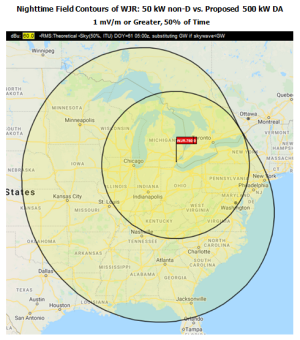
As a follow-up, below is a comparison of the nighttime fields of WJR using their existing transmit facilities vs. if the FCC allowed them to use 500 kW with a directional antenna, as WJR proposed in the 1950s.

The 1 mV/m contours in this comparison are a fairly strong field. Even when using 50 kW non-D, WJR usefully can be received with fields much lower than 1 mV/m — where their co-channel interference is low enough.

WJR Nighttime Fields, 50 kW non-D vs. 500 kW Directional.png
 
In the near north Chicago suburbs I used to receive WJR during the day on a good radio before the 750 in northwest Indiana came on.
 
In the near north Chicago suburbs I used to receive WJR during the day on a good radio before the 750 in northwest Indiana came on.
I can still pick up WJR 24/7 on my car radio without fail. Very listenable. Chevy Equinox stock radio. It helps that the 750 from northwest Indiana isn't as strong around here as it is where you are.

I wonder if part of the idea for 500kw for WJR was to provide statewide coverage....or at least a good signal throughout the entire lower peninsula. The southwest portion of the state has really bad ground conductivity, which keeps WJR from having a competitive groundwave signal in at least some of that area.
 
I can still pick up WJR 24/7 on my car radio without fail. Very listenable. Chevy Equinox stock radio. It helps that the 750 from northwest Indiana isn't as strong around here as it is where you are.

I wonder if part of the idea for 500kw for WJR was to provide statewide coverage....or at least a good signal throughout the entire lower peninsula. The southwest portion of the state has really bad ground conductivity, which keeps WJR from having a competitive groundwave signal in at least some of that area.
WNDZ has their daytime signal pointed right at me. However, before they came on the air, WJR was a regular during the day.
 
Actually, many parts of the Lower Peninsula have much lower conductivity than the M-3 Map. If you look at some of the more recent applications online, you'll see radials measured in many areas are in the 0.1-3 mS/m range. The inland lakes are even substantially less than M-3, due to lower ionized salt levels than the Great Lakes. I'm going to see what the measured values are over certain lakes where radials have been done. WTCM 580, WCCW 1310, and WMKT 1270 are some applications I want to check out. When WCPT 820 increased to 5.8 kW Day, they measured WMJH 810 Rockford, MI toward Lake Michigan, and some of the radials had portions that were 0.1 mS/m. It's too bad that they don't have the DA Proofs of Performance online, as those show actual measured values out to 20 miles of so in many directions. Some of the Chicago Area stations have done radials on upgrades also. I think WNDZ 750 did a radial to show no 25 mV/m overlap with WBBM 780, and WMFN 640 did one to show no 25 mV/m overlap with WSCR 670. A lot of stations aren't doing the old type proofs anymore. If I'm not mistaken, the Method of Moments just demonstrates that the parameters of the DA are correct, not the useful signal prediction function and automatic opportunity to let out nulls in many cases, or even go nondirectional, that the Proofs provided. Stations still run limited radials when they do upgrades. It's easier than ever to run radials with the relatively new Potomac FIM 4100, ironically.

The late J P McCarthy used to field questions about WJR's Day signal on his morning show, and a frequent question is why the signal fell off rapidly near Clare. He explained that it was the sand. And the boaters pointed out that over Lake Huron, the signal reached the far shoreline and islands in Canada in the Daytime.
 
Last edited:
On another note, I have been going through some History Cards, and in 1961, WWJ-FM 97.1 applied for 500 kW ERP from the current TL and COR AGL as WXYT-FM, like WJFM 93.7 was for a while. I guess since they couldn't run more than 5 kW on 950, they thought they could keep up with WJR applying for 500 kW!
 
... I wonder if part of the idea for 500kw for WJR was to provide statewide coverage....or at least a good signal throughout the entire lower peninsula. The southwest portion of the state has really bad ground conductivity, which keeps WJR from having a competitive groundwave signal in at least some of that area.
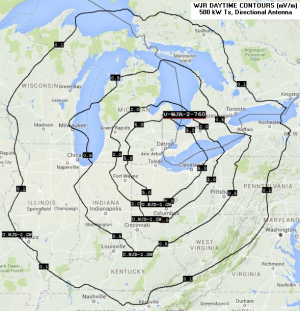
Below is a coverage map showing the 5, 2, 0.5 and 0.1 mV/m daytime groundwave contours of WJR using a 500 kW transmitter and the directional antenna pattern posted earlier in this thread.

It includes the "modernized" effects of varying Earth conductivity in the irregular shapes of those contours,

1615285260361.png
 
I can still pick up WJR 24/7 on my car radio without fail. Very listenable. Chevy Equinox stock radio. ...

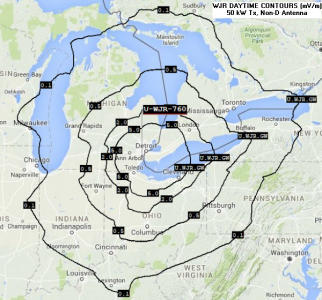
Below is a coverage map showing the 5, 2, 0.5 and 0.1 mV/m daytime groundwave contours of WJR using a 50 kW transmitter and their non-D antenna.

It also includes the "modernized" effects of varying Earth conductivity in the irregular shapes of those contours.

WJR 50 kW Daytime GW, non-D.png
 
WJR's 25 mV/m signal with 50 kW extends to the East side of Ann Arbor, matching or exceeding M-3, but starts to take a hit by the West side of Ann Arbor. Some say the Jackson County line, but it is really closer than that. That is where the apparent "null" toward Chicago starts.

This link has the 25, 5, 2, and 0.5 mV/m contours shown in the presentation.

 
Last edited:
But even so (and IMO), listeners will tolerate some background noise when tuned to an AM broadcast station if they really are interested in the program content they are listening to.

Back in the 1950s-60s, WJR appeared in the listener ratings of distant counties in three states and the province of Ontario where their daytime groundwave had noticeable r-f noise on it.
AM has become the nursing homes of radio. The difference is; new customers stopped coming through the door thirty years ago.
With streaming, ability to store playlists of your favorite music, and the ability to hear podcasts of your favorite subject matter, music, news, and keep in touch with your friends and family from a device that will fit into your purse or pocket, all noise free, AM has become a part of history. Why some cling to this whole; 'if you program it, they will come'-way of rationalizing the death of AM radio, has no legs.
 
@sc.....

One thing I'll say about WJR is that their day signal....or what's left of it...is pretty much the same as I remember as a teenager. WLW is the other 50kw "distant city" signal that's also audible here 24/7, It's slightly weaker at my location than WJR, but still listeable 24/7 on a good car radio in an open area. I may be misremembering, but I think WLW is just a tad weaker than it was during my high school days.

The dropoff in ground conductivity in southwest Michigan as you enter from the Chicago area amazes me. Three summers ago we went in with our kids for a week in a vacation house in Southaven. Pretty much 50 or so miles directly across the lake fron Chicago, The Chicago blowtorches there were weaker than... let's say Milwaukee... but still good. Even though Milwaukee is farther away from the 50kw sticks than Southaven is.

But what really struck me was how pathetic the "local" signals were. Especially compared to their counterparts on this side of the lake. 5kw WHFB on 1060 from less than 20 miles away in Benton Harbor didn't always trip the scan button in my car radio. The 1400 from Benton Habor/St. Joe was obviously even weaker.....With WRJN from Racine, Wisconsin (across the lake) clearly audible underneath
 
Status
This thread has been closed due to inactivity. You can create a new thread to discuss this topic.


Back
Top Bottom